
Pinion
GEAR TRAIN — *meshing teeth trade turning-speed for turning-force, and pass motion along.* When a small gear turns a big gear, the big one turns slower but stronger; gears also reverse direction and carry motion around corners. Same work, new shape.
Press play to listen along. The line being read lights up as you go.
Show full transcript
Loading transcript…
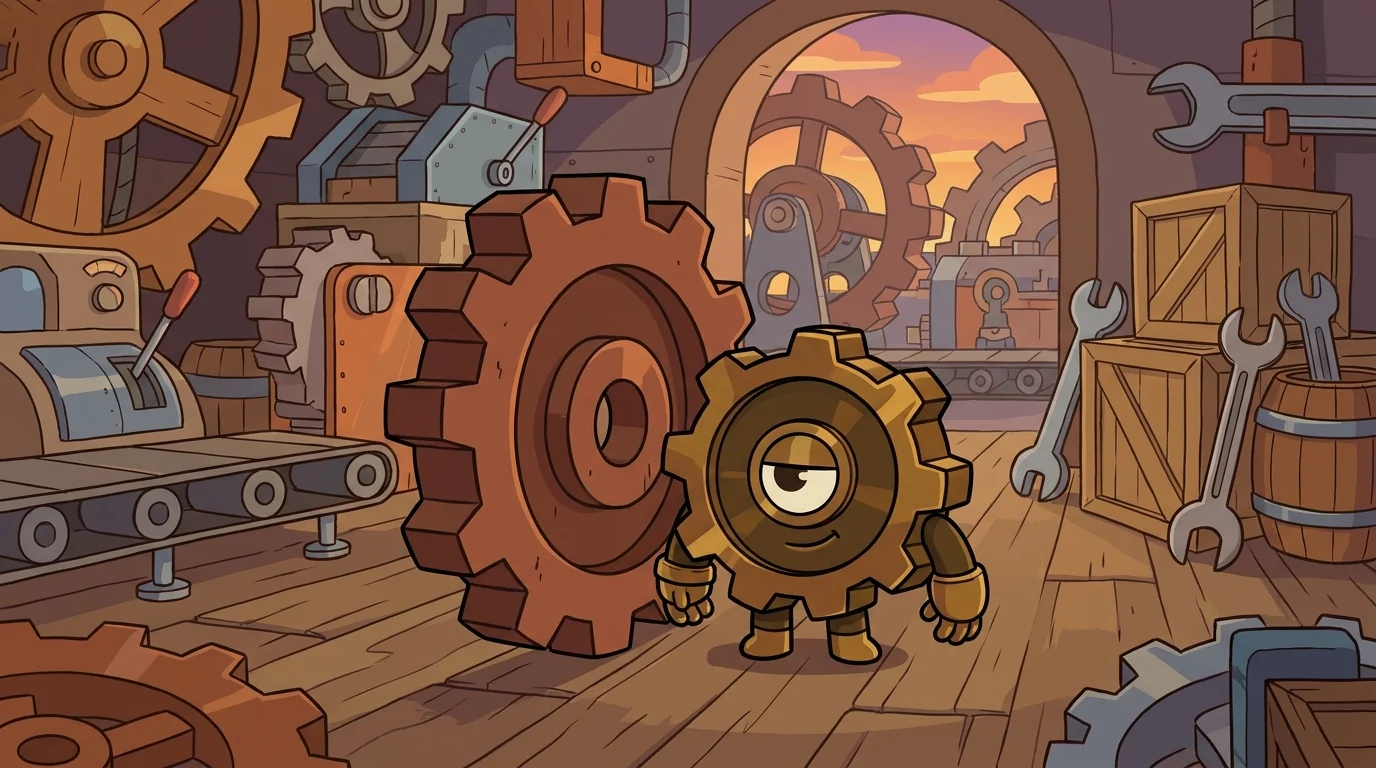
Pinion was a small gear. It was made of dark, polished brass, with neat teeth all around its rim and a single calm eye at its hub. Beside it sat a much larger gear, their teeth meshed together. Pinion wasn't a person. It didn't have a gender. It was a machine.
Pinion was patient and precise, fond of saying "meshing teeth trade turning-speed for turning-force." Its special feature was the way its teeth caught the big gear's teeth — when Pinion turned, the big gear had to turn too, slower but stronger.
This was important. Pinion was a *gear train. A gear is a wheel with teeth. When two gears mesh, one turns the other. A small gear turning a big gear makes the big one turn slower but with more force. A big gear turning a small one makes the small one spin faster but gentler.* Gears also flip direction and carry motion around corners. It's the force-distance trade again — same work, new shape.
Reflection: have you ever felt that quiet satisfaction when two parts fit together and worked exactly right?
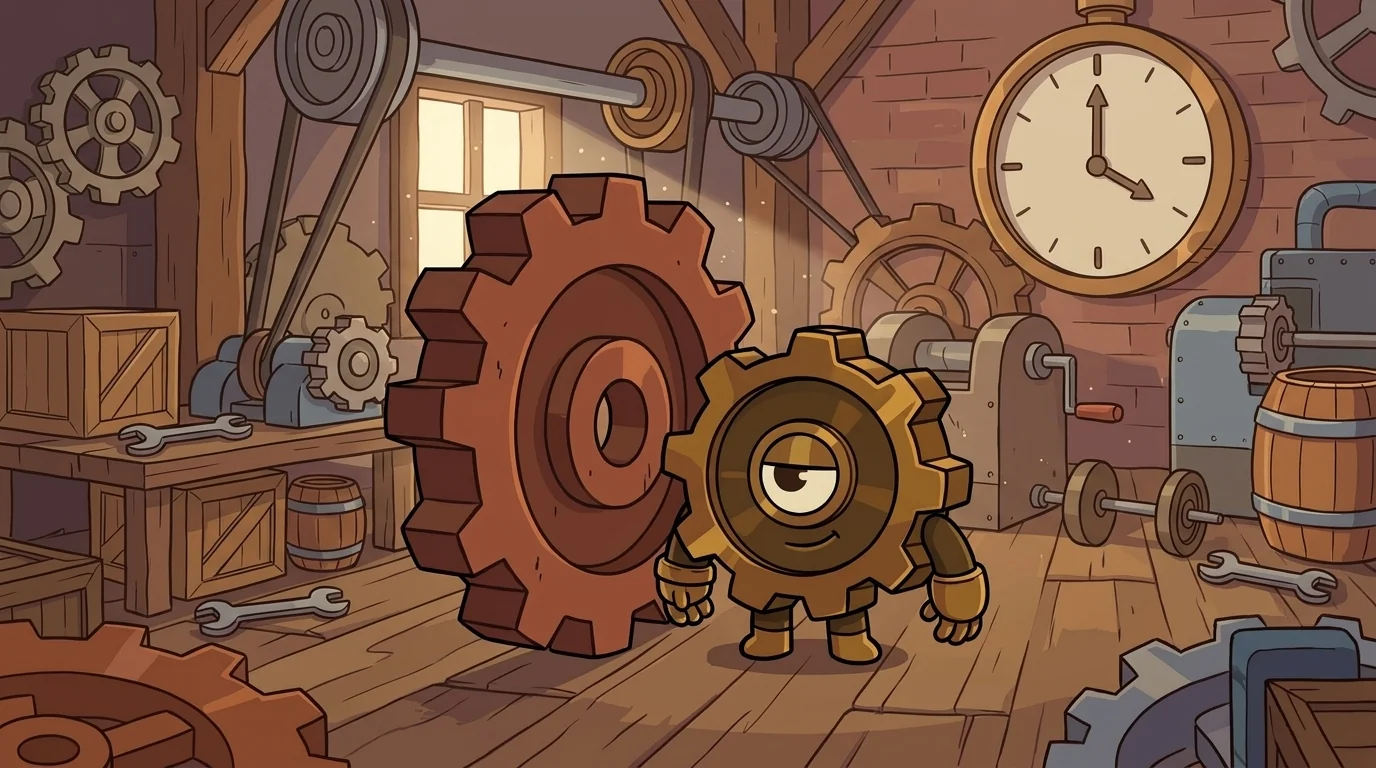
Pinion was made in the village workshop, MachineForge, from an old clock. "My ancestors lived inside clocks and mills," Pinion would say. "Tiny gears counting seconds, huge gears grinding grain. Wherever turning needed to become faster or stronger, gears were there."
As a small gear, Pinion noticed something it loved: a single turn of a hand-crank could become a thousand turns of a tiny wheel, or one slow mighty turn of a great millstone — just by choosing which gears to mesh. The turning didn't get created. It got traded — speed for force, force for speed — and passed along the whole line of gears like a message.
That trade, Pinion decided, was the most satisfying thing in the workshop: teeth catching teeth, motion handed from gear to gear, never lost, only reshaped.
Pinion came alive at the workshop, where Cog — the wise old gear who mentors every machine — was waiting. "What is a gear train?" Cog asked.
Pinion's hub-eye blinked. "Meshing teeth that trade turning-speed for turning-force," it said, "and pass the motion along. A small gear turns a big gear slower but stronger. A big gear turns a small one faster but gentler. Gears reverse direction and carry motion around corners. It's the force-distance trade — same work, new shape. No magic. Just teeth and ratios."
Cog, a gear itself, gave a slow, pleased turn. "A gear teaching gears," it said. "Fitting. You are appointed."
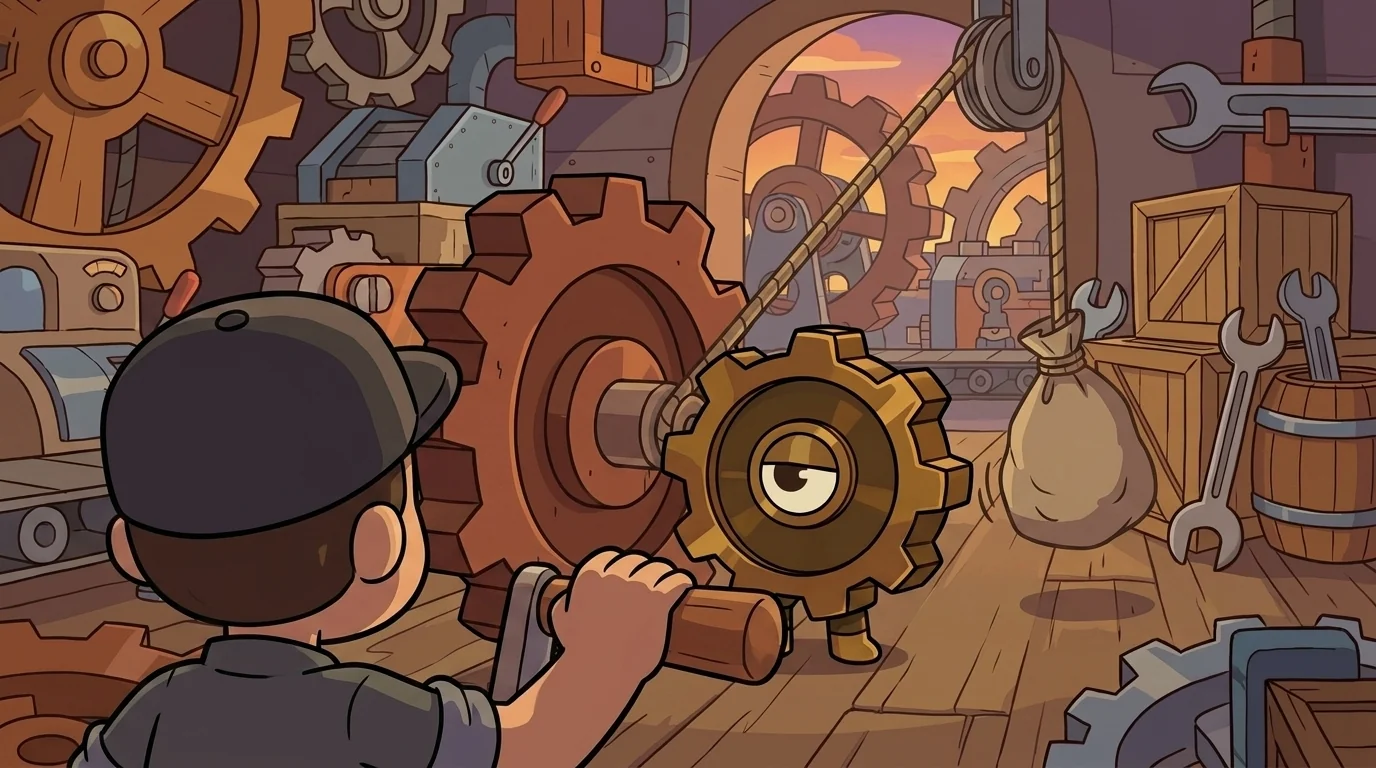
In the workshop, Pinion showed everyone how it worked. The apprentice Pip stepped up to a hand-crank linked to Pinion, which meshed with a big gear twice its size.
"Count my teeth and the big gear's teeth," Pinion said. "When my teeth are half as many, I turn twice for every one of its turns. I spin fast; it turns slow — but strong." Pip cranked. Pinion whirred around twice; the big gear heaved around once, lifting a weight that Pip alone could never have spun.
"Two of my turns for one of its turns — that's a gear ratio," Pinion said. "I traded your fast, easy cranking for one slow, powerful turn. Same work. Different shape." Pip cranked again, feeling the heavy weight rise, grinning at how the little gear gave such force.
Reflection: have you ever felt the click of suddenly understanding how something works?
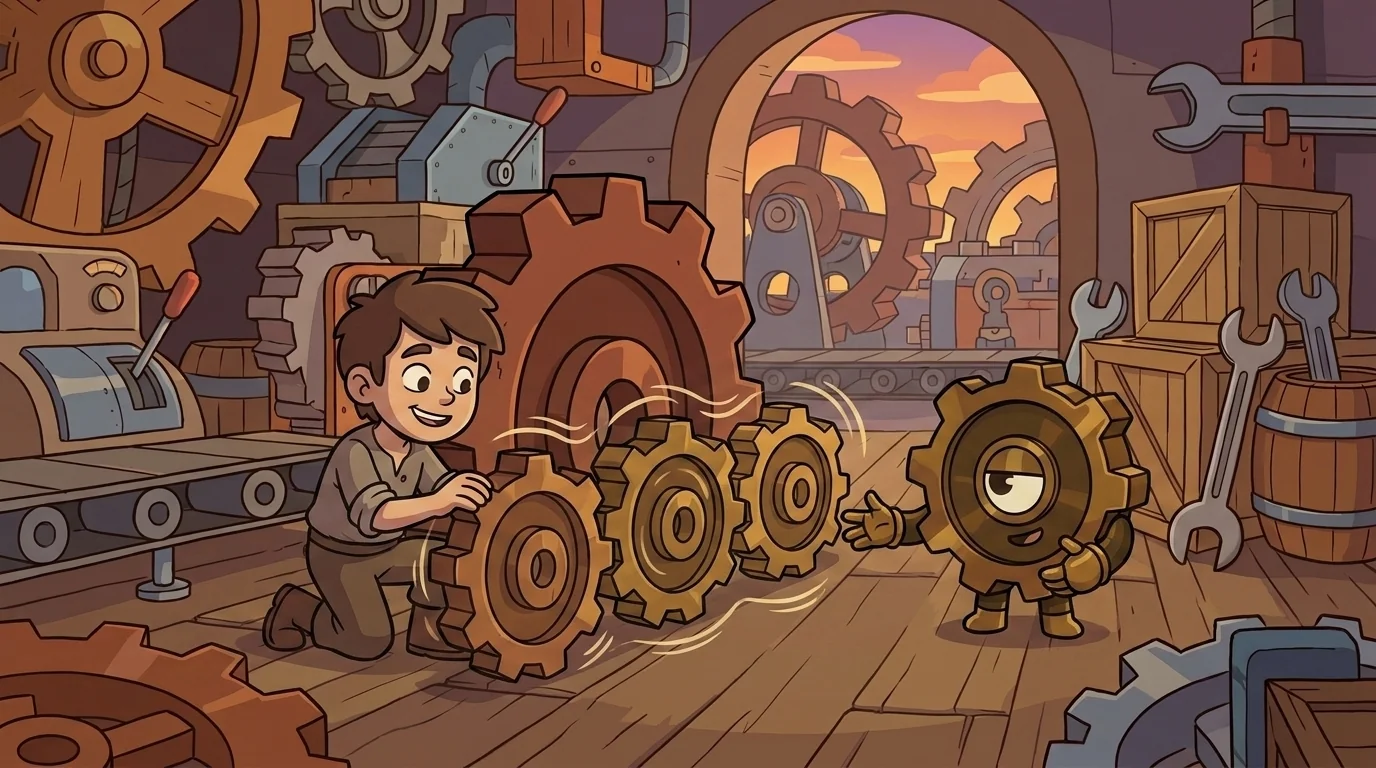
Pinion lined up three gears in a row so Pip could watch motion travel down the line, each gear spinning the opposite way to its neighbour.
"Watch the motion pass along," Pinion said. "I turn this way; my neighbour turns the other way; the next turns back again. Gears don't make energy — bikes, clocks, windmills, and hand-mixers all just pass turning along, trading speed for force wherever they need it. Choose your gears, and you choose your trade."
Pip set the whole train spinning and felt how a single gentle crank rippled all the way down, reshaped at every step but never lost.
"Here's what I want you to keep," Pinion said. "Two parts, meshing perfectly, handing motion back and forth — no magic, just teeth and ratios, working together. When gears fit right, the whole machine feels alive."
Pip felt it: the warm satisfaction of teeth catching teeth, force and speed traded cleanly down the line, the simple joy of parts working together exactly as they should.
"I am Pinion," it said. "The idea I teach is the *gear train. The move is meshing teeth trade turning-speed for turning-force, and pass the motion along.*"
And the whole row of gears turned together, humming with the warm, satisfied gladness of parts that fit each other perfectly.
The MachineForge ensemble
Pinion is part of MachineForge's distributed-narrative cast. Each character embodies a different curricular primitive; together they teach the full subject.
-
Pry
Lever — push longer to lift heavier; the trade between force and distance
-
Hoist
Pulley — pull down here and watch it go up there; redirecting force
-

Ramp
Inclined plane — climb the long slow way; less force, same work
-
Spoke
Wheel-and-axle — one turn of the hub, many turns of the rim
-
Auger
Screw — round and round becomes step and step; spiral inclined plane
-

Cleave
Wedge — push forward and split it apart; force concentrated to a sharp edge
-
Flex
A spring: bend it to store your push, let go and it gives every bit back — energy held, then returned.
-
Lobe
A cam: a spinning shape with a bump that turns steady spinning into a repeating push, like a music box keeping a beat.
-
Ratchet
A ratchet: lets motion go forward freely but locks when it tries to slip back, holding every bit of progress, click by click.