
Pry
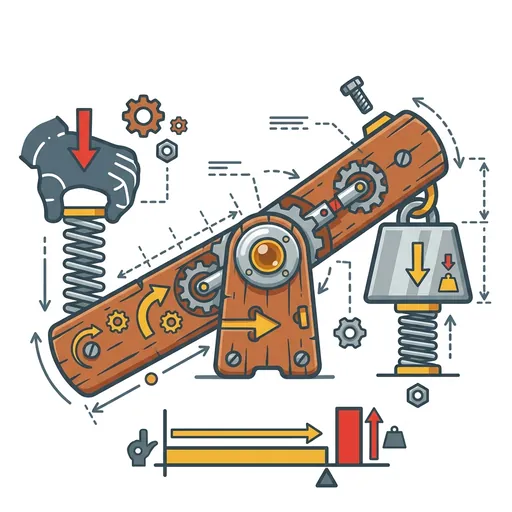
LEVER — *push longer to lift heavier. the trade between force and distance.*
Listen along — Pry
Loading audio…
Press play to listen along. The line being read lights up as you go.
Show full transcript
Loading transcript…
Chapter 1 — Pry and the Long-Arm Trade
The stone by the granary door was bigger than the apprentice who wanted it moved.
Pry lay across a small wooden block, an amber plank with one long arm and one short one and a single round eye set exactly at the middle, where it balanced. The eye was Pry’s pivot. Pry rocked gently on the block, long arm dipping, short arm rising, long arm dipping again — a slow seesaw, waiting.
“Roll the stone onto my short side,” Pry said, its voice smooth as sanded wood.
The apprentice heaved the great stone onto the short arm and stepped back, doubtful. Pry only settled, patient. “Now lean on the long side. Not hard. Long.”
The apprentice pressed down on the far end of the long arm and walked it slowly toward the floor — a long, easy push — and across the pivot, the short arm swung up, and the stone that outweighed the apprentice lifted clean off the ground.
“Push longer,” Pry said, pleased, “to lift heavier.”
Pry had learned that sentence the hard way, back when it was only a fresh plank leaning against a fencepost, certain that lifting meant straining.
An old crowbar, bent and rusty and wise, had watched it try to buck a barrel straight up and fail. “You’re pushing short and hard,” the crowbar said. “Push long and gentle instead. Reach out past your pivot.”
Pry did not understand until it tried. It slid its pivot close to the barrel, so its own long arm stretched far away. Then it pushed that long arm down a great distance — and the barrel, on the short side, rose only a hand’s width, but it rose, easily, without a strain anywhere.
Something turned over quietly inside Pry. The push had not grown bigger. It had grown longer, and length across a pivot became strength on the other side. It hadn’t gotten anything for free — it had traded a long gentle journey for a short powerful one. Same effort, different shape. That trade, Pry decided, was the most honest kind of strength there was.
Pry carried the idea to the MachineForge, the workshop where machines that knew how they worked could earn a bench. Cog, the old grey gear who kept the place, met it at the door.
“Show me,” Cog said. He set a round river-stone, far too heavy to lift bare-handed, at the end of Pry’s short arm.
Pry slid its block until its long arm reached far out across the floor. It let its own weight roll slowly down the long arm — and the river-stone eased up into the air on the short side, gentle as a held breath, and hung there.
Cog watched the stone float. His fulcrum-old eyes crinkled. “No heaving,” he said. “No magic word. You just moved the pivot and let the geometry do the lifting.” He tipped his head toward the empty bench. “That’s the whole idea. There’s room here for you.”
On lesson day the apprentices crowded Pry’s bench, and a small one named Pip crowded closest, staring at a stone he clearly thought was hopeless.
“Set the stone on my short arm,” Pry told him. Pip rolled it on; it looked immovable. “Now press my long arm down. Slow. All the way.”
Pip pressed. He walked the long arm far, far down — much farther than the stone would ever travel — and Pry pivoted around its eye, and the short arm carried the great stone up into the light. Pip’s mouth fell open. He looked at his own two hands.
“You didn’t get stronger,” Pry said kindly. “You pushed a long, patient way, and I handed you a short, powerful lift in return. That’s the trade — force for distance, distance for force, and the work you did stays exactly the same. It only changed its shape across my pivot.” Pry rocked once more, gently. “Not magic, Pip. Geometry.”
Pip stepped back and stared at the stone hanging in the air — the stone he had been sure was too heavy for anyone his size.
A warm, startled happiness spread through him, the kind that makes you stand a little taller without deciding to. And Pry, balancing quietly on its block, felt it too: that soft, spreading joy of watching someone discover they were stronger than they had believed, if only they leaned the long, patient way instead of heaving all at once.
That feeling, Pry knew as the workshop settled into evening, was the real reason it loved to teach. Not the stone. The face of the child who lifted it.
The MachineForge ensemble
Pry is part of MachineForge's distributed-narrative cast. Each character embodies a different curricular primitive; together they teach the full subject.
-
Hoist
Pulley — pull down here and watch it go up there; redirecting force
-
Ramp
Inclined plane — climb the long slow way; less force, same work
-
Spoke
Wheel-and-axle — one turn of the hub, many turns of the rim
-
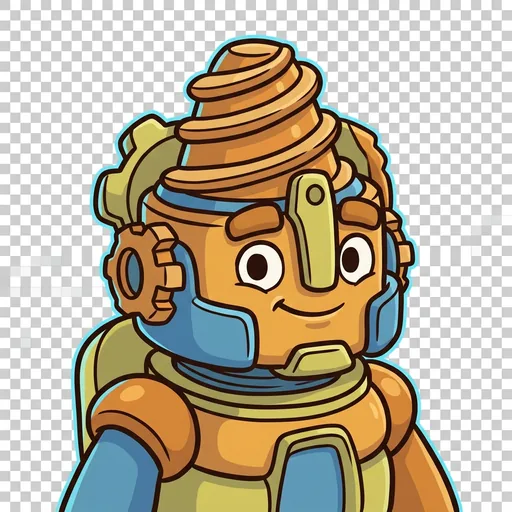
Auger
Screw — round and round becomes step and step; spiral inclined plane
-

Cleave
Wedge — push forward and split it apart; force concentrated to a sharp edge
-
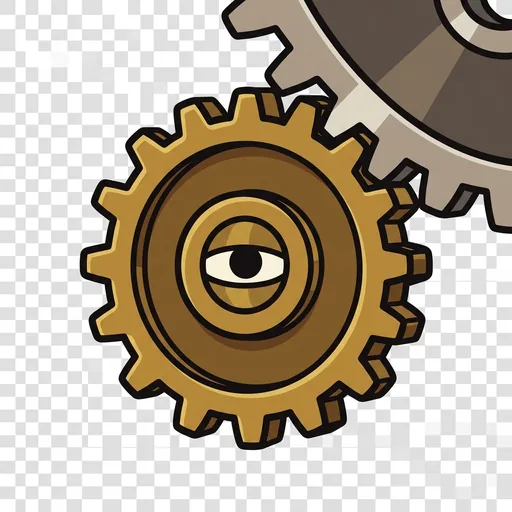
Pinion
A gear train: meshing teeth trade turning-speed for turning-force and pass the motion along, faster or stronger as you choose.
-
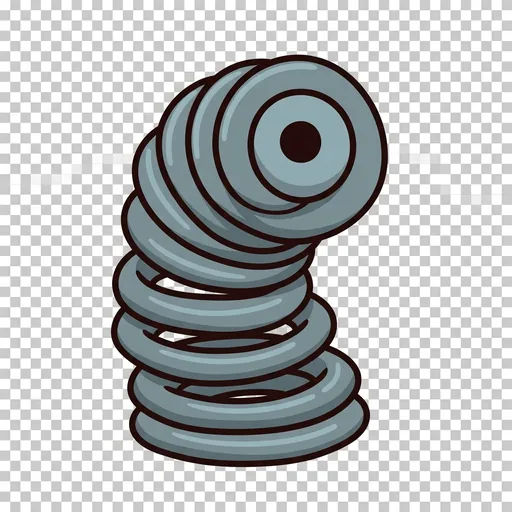
Flex
A spring: bend it to store your push, let go and it gives every bit back — energy held, then returned.
-
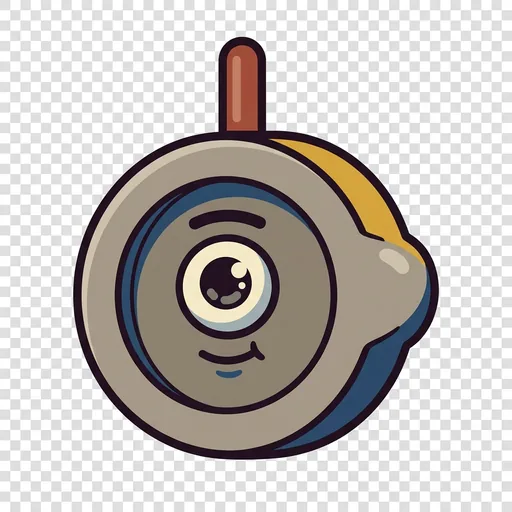
Lobe
A cam: a spinning shape with a bump that turns steady spinning into a repeating push, like a music box keeping a beat.
-
Ratchet
A ratchet: lets motion go forward freely but locks when it tries to slip back, holding every bit of progress, click by click.