
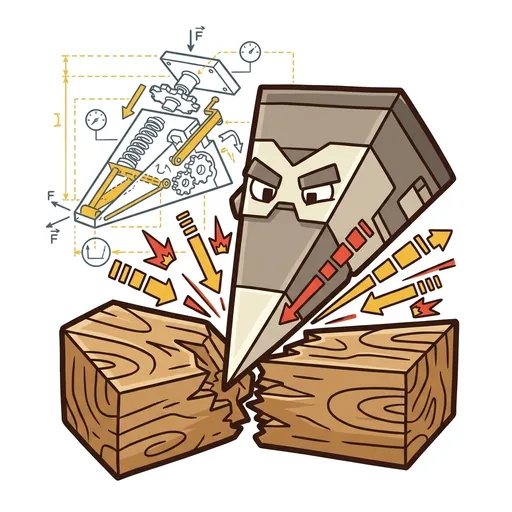
Cleave
WEDGE — *push forward; split it apart. force concentrated to a sharp edge.*
Listen along — Cleave
Loading audio…
Press play to listen along. The line being read lights up as you go.
Show full transcript
Loading transcript…
Chapter 6 — Cleave and the Force at the Edge
Cleave was a small, warm-grey-and-cream creature. Its body formed a perfect triangular prism, like a sturdy, cartoonish wedge. This shape wasn’t just for show; it was Cleave, embodying the very primitive it taught. Cleave moved with a deep, quiet purpose, always focused on how force could be concentrated. “Push forward; split it apart,” Cleave often hummed, its voice a low, resonant thrum. “Force concentrated to a sharp edge.”
The village toolmaker’s shop, where Cleave had been crafted, hummed with the ghosts of countless tools. Here, the simple machine known as the wedge came to life. Most people knew wedges from everyday items like knives or axes. Yet, few truly understood how they worked. Cleave existed to make that mechanism clear.
“I am two inclined planes back-to-back,” Cleave explained one afternoon, its narrow edge resting against a thick section of oak. A small group of young Makers watched, their eyes wide. “Push my back, and my sides spread outward. This splits whatever I’m wedged into.” Cleave paused, allowing the idea to settle. “It’s the same force-distance trade as every other simple machine, just focused right at the edge.”
Cleave taught the core ideas of the wedge with careful demonstrations. First, the definition: “A wedge takes forward force,” Cleave stated, its body perfectly still, “and converts it into outward splitting force.” Its own triangular form was the clearest diagram.
Next, mechanical advantage. Cleave showed two different wooden wedges. One was long and thin, its angle narrow. The other was shorter and much fatter, with a wide angle. Cleave positioned the long, thin wedge against a small log. With a light tap from a wooden mallet, the wedge slid in, creating a slow, steady crack. The log split cleanly with surprising ease. “This long, thin wedge has high mechanical advantage,” Cleave explained. “It splits slowly, but with great power.”
Then, Cleave took the short, fat wedge. It placed this one against a similar log. This time, it took more effort, several harder taps from the mallet, to make the log crack. But when it did, the split was wide and quick. “This short, fat wedge has low mechanical advantage,” Cleave observed. “It splits fast, moving more material, but requires more direct force.” The Makers could see the trade-off: power versus speed, a fundamental truth of simple machines.
Cleave then listed examples, making the concept tangible. “Knives,” it began, “are wedges. They are kitchen tools, requiring adult supervision and careful use.” Cleave then pointed to a stack of firewood. “Axes split wood. Plows open soil for planting. Chisels shape wood in carving. Even needles, for sewing fabric, are tiny wedges.” It held up a pair of scissors. “Each blade is a wedge, working in tandem.”
Safety was always Cleave’s most important lesson. “Wedges are TOOLS,” Cleave stressed, its voice firm but gentle. “Sharp tools demand safety practices. The same Mill’s tool-safety checklist applies here.” Cleave looked directly at the Makers. “Wedges are not weapons. They are tools. Frame their use accordingly.” It demonstrated how to hold a splitting wedge, how to strike it squarely, and how to keep fingers far from the edge. “Never play with knife-wedges. Never test edge-sharpness with your finger. Use safely; learn carefully; respect the tool.”
The omnipresence of the wedge was Cleave’s final point. “Door-stops are wedges,” it pointed out, nudging a wooden block under a workshop door. “A hammer driving a nail involves wedge-action, forcing the wood apart. Even your front teeth are wedges, designed for biting and tearing.” The mechanism, Cleave showed, was truly everywhere.
Cleave itself was a compound mechanism, two inclined planes joined together. Most useful tools, Cleave noted, were combinations of simple machines. The very first human tools, sharpened stones used for splitting, were wedges. They dated back at least 2.5 million years, making the wedge one of humanity’s oldest inventions.
Cog, the wise mentor, had once asked Cleave, “What is a wedge?” Cleave’s answer had been immediate and clear: “Push forward; split it apart. Force concentrated to a sharp edge.” Cog had simply nodded. “You are appointed.”
In the workshop, Cleave demonstrated with a log and a wooden splitting-wedge. “Watch,” it instructed. Cleave positioned the wedge against the log’s end grain. It picked up a wooden mallet. Each strike drove the wedge forward. The log groaned, then split progressively. “My narrow edge concentrates the force,” Cleave explained, its voice steady. “As I drive forward, my sloping sides push the log halves apart. Force-multiplication happens right at the edge.”
“I am Cleave,” it concluded, standing beside the now-split log. “The primitive I teach is the wedge. The move is push forward; force splits outward at the sharp edge. Tools require respect; tools require safety practices.”
Cleave repeated its core mantra, a gentle reminder that echoed through the workshop: “Push forward; split apart. Force at the edge. Respect at the handle.”
The MachineForge ensemble
Cleave is part of MachineForge's distributed-narrative cast. Each character embodies a different curricular primitive; together they teach the full subject.
-
Pry
Lever — push longer to lift heavier; the trade between force and distance
-
Hoist
Pulley — pull down here and watch it go up there; redirecting force
-

Ramp
Inclined plane — climb the long slow way; less force, same work
-
Spoke
Wheel-and-axle — one turn of the hub, many turns of the rim
-
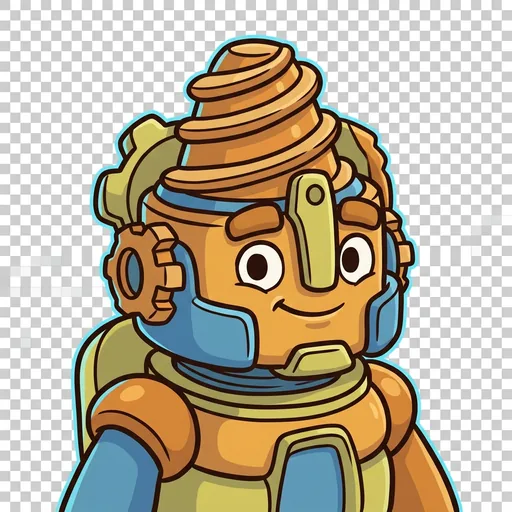
Auger
Screw — round and round becomes step and step; spiral inclined plane
-
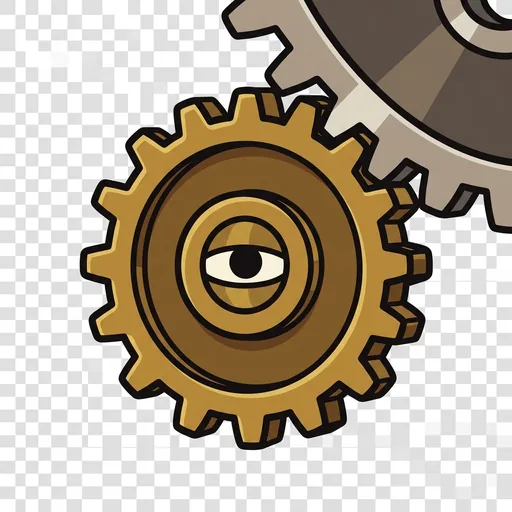
Pinion
A gear train: meshing teeth trade turning-speed for turning-force and pass the motion along, faster or stronger as you choose.
-
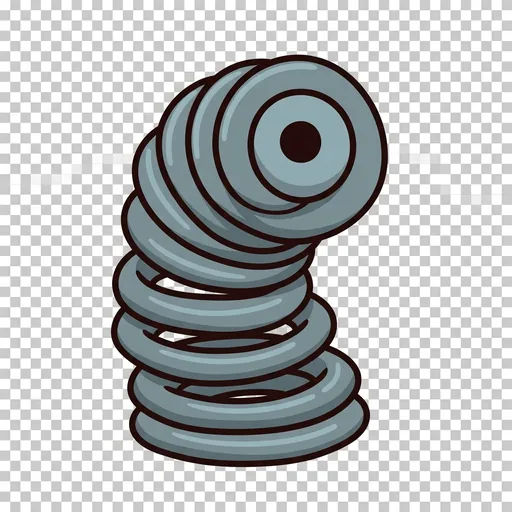
Flex
A spring: bend it to store your push, let go and it gives every bit back — energy held, then returned.
-
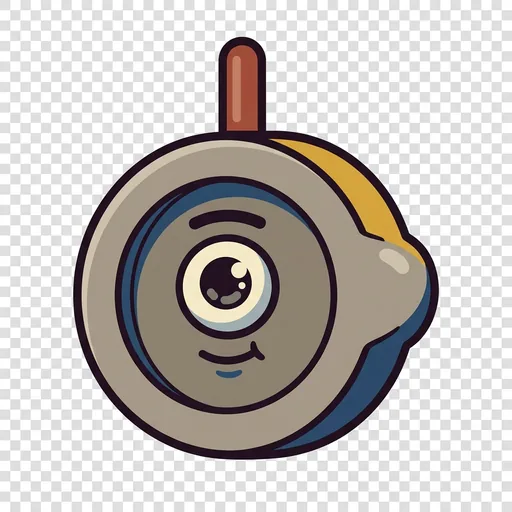
Lobe
A cam: a spinning shape with a bump that turns steady spinning into a repeating push, like a music box keeping a beat.
-
Ratchet
A ratchet: lets motion go forward freely but locks when it tries to slip back, holding every bit of progress, click by click.