
Bough, Drift and Bridge
THE FAMILY TREE — languages are related like a family: Bough traces them back to shared ancestors on a tree of tongues, Drift shows how sounds shift slowly and systematically over generations, and Bridge points out the cognates — words that still echo their shared roots across related languages
A story read by Bough, Drift and Bridge
Loading audio…
Press play to listen along. The line being read lights up as you go.
Show full transcript
Loading transcript…
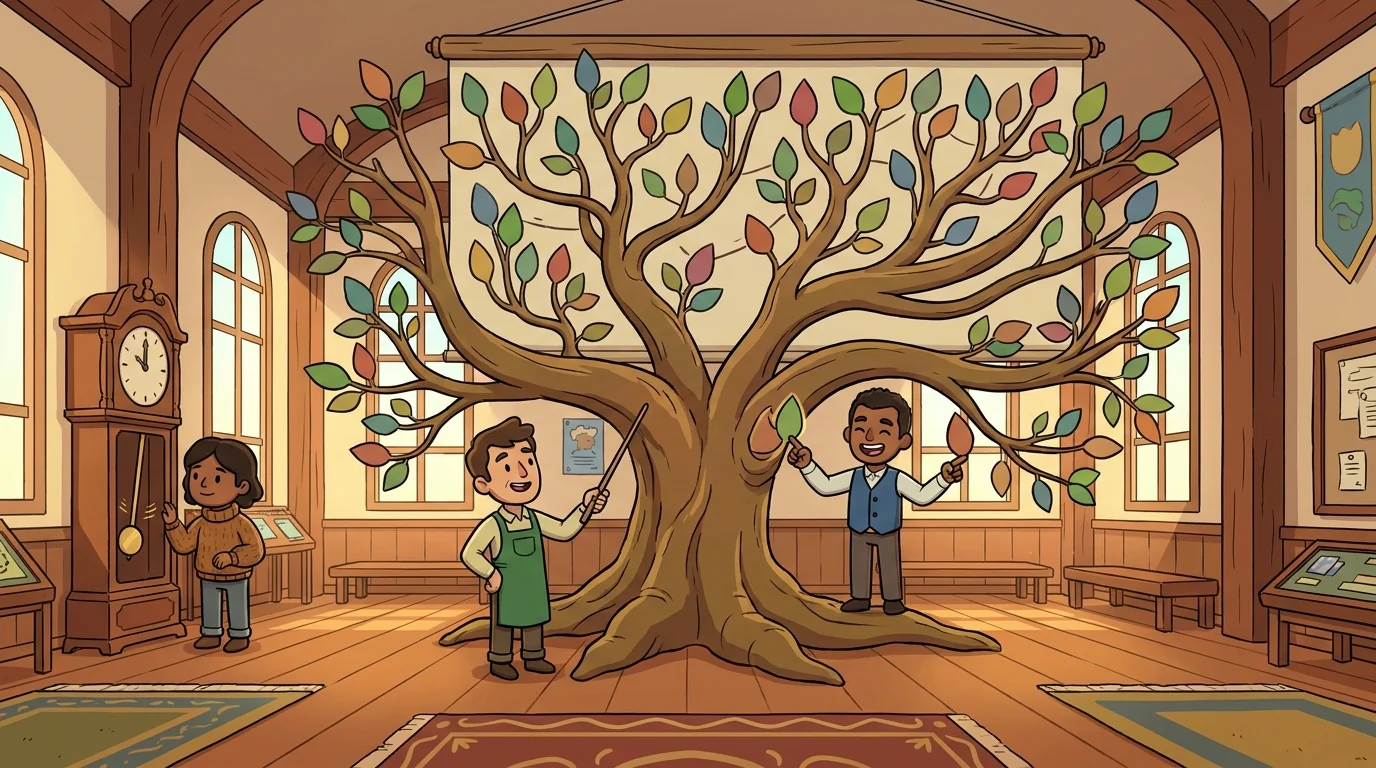
In a hall hung with an enormous branching chart — a great tree with hundreds of languages growing off its limbs — three friends spent their days showing visitors something that always surprised them: that languages, like people, have families.
Bough tended the great tree itself, tracing the branches back to their roots.
Drift kept a slow-ticking clock that measured change across generations.
And Bridge stood between two nearby branches, pointing out the family resemblances.
"People think their language just... exists," said Bough, gazing up at the tree. "As if it fell from the sky, all finished. But every one of them grew off a branch, from a branch, from a root. Come see."
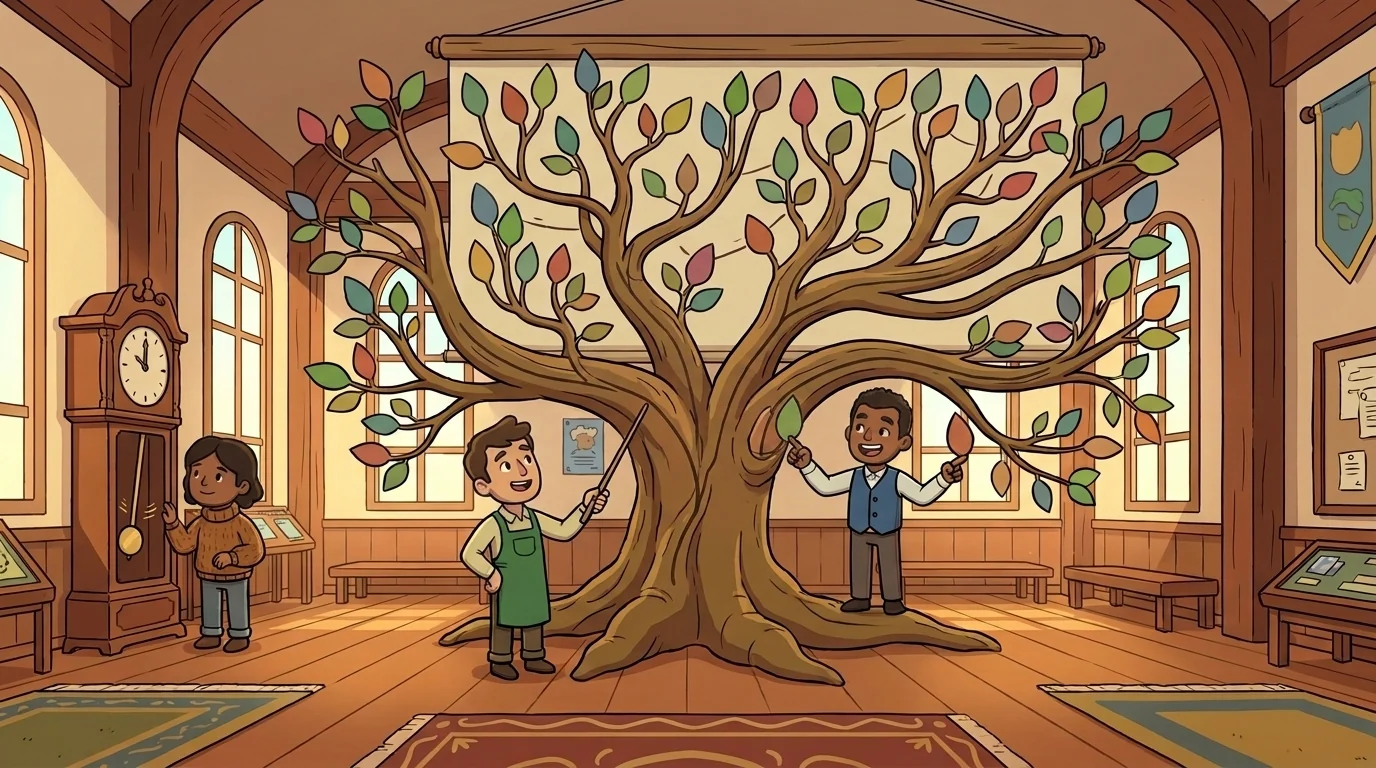
Bough went first, tracing a hand up the great branching tree — because the first surprise is that languages have ancestors.
"Look here," said Bough, following two branches back. "English and German look pretty different today, right? But follow them back down the tree — back and back — and their branches join. They grew from the same limb. And follow that down, and it joins with the branch that grew Spanish and French and Hindi and Persian, all the way to one ancient root-language nobody alive ever heard, spoken thousands of years ago." Bough traced the great convergence. "They're not strangers. They're cousins — some close, some distant — all grown from shared ancestors on one enormous family tree. When you learn that your language has a family, the whole world of tongues stops being a scatter of unrelated noises and becomes what it really is: a vast, related, growing tree."
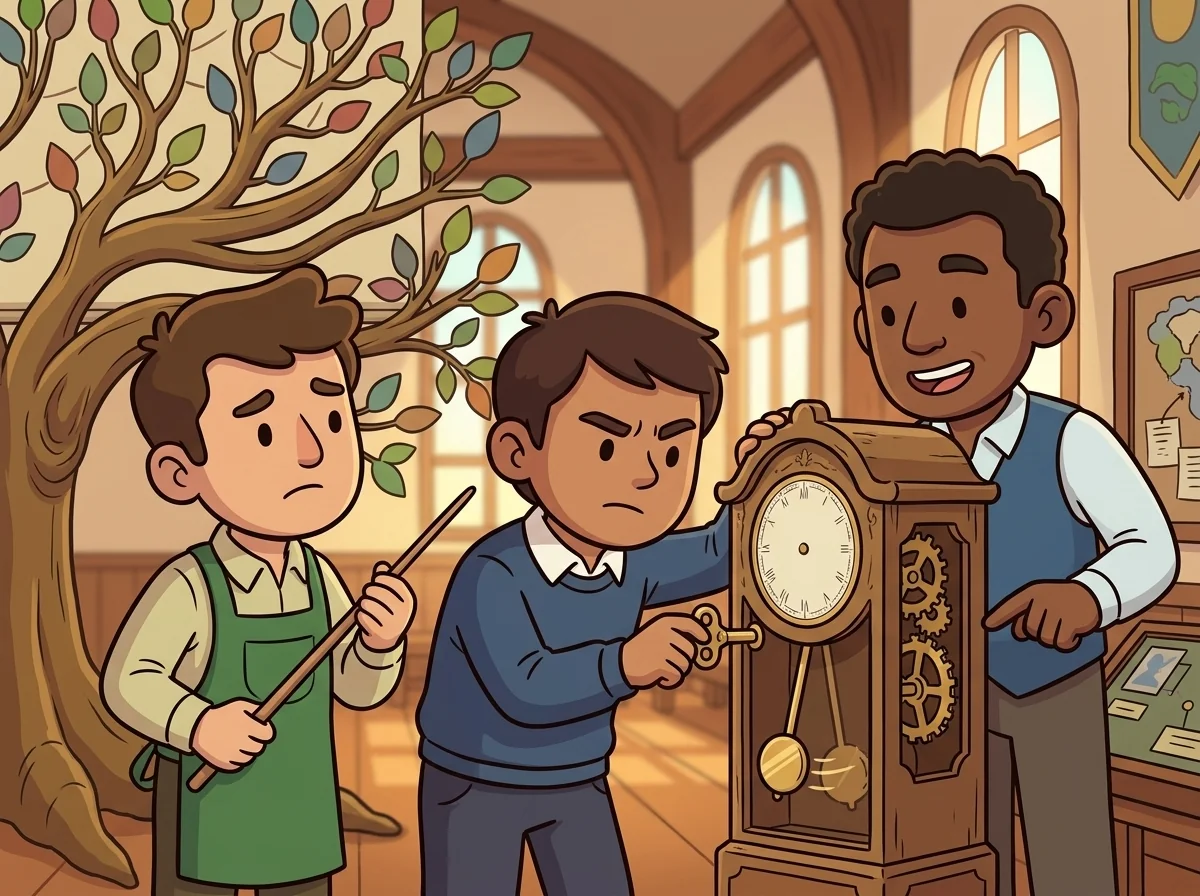
Then Drift wound the slow clock, because the next question is: if they came from the same root, why do the cousins sound so different now?
"Because of me," said Drift, ticking. "Sounds change — slowly, over many generations, a little at a time. And here's the beautiful part: they don't change randomly. They drift in patterns." Drift showed how, across the centuries, a whole language full of p sounds might slowly, systematically soften into f sounds — every single one, the same shift, over hundreds of years. "That's why the old root word for 'father' became pater in one branch and father in another — the p drifted to f down one limb, in a regular, traceable pattern, while it stayed put down the other." Drift kept the slow rhythm. "Nobody decided to change it. It just drifted, generation by generation, mouth by mouth, like a slow tide reshaping a coastline. Give a shared word enough centuries down two different branches, and it grows into two different-sounding cousins — but the pattern of the drift is the trail of breadcrumbs that leads them back to each other."
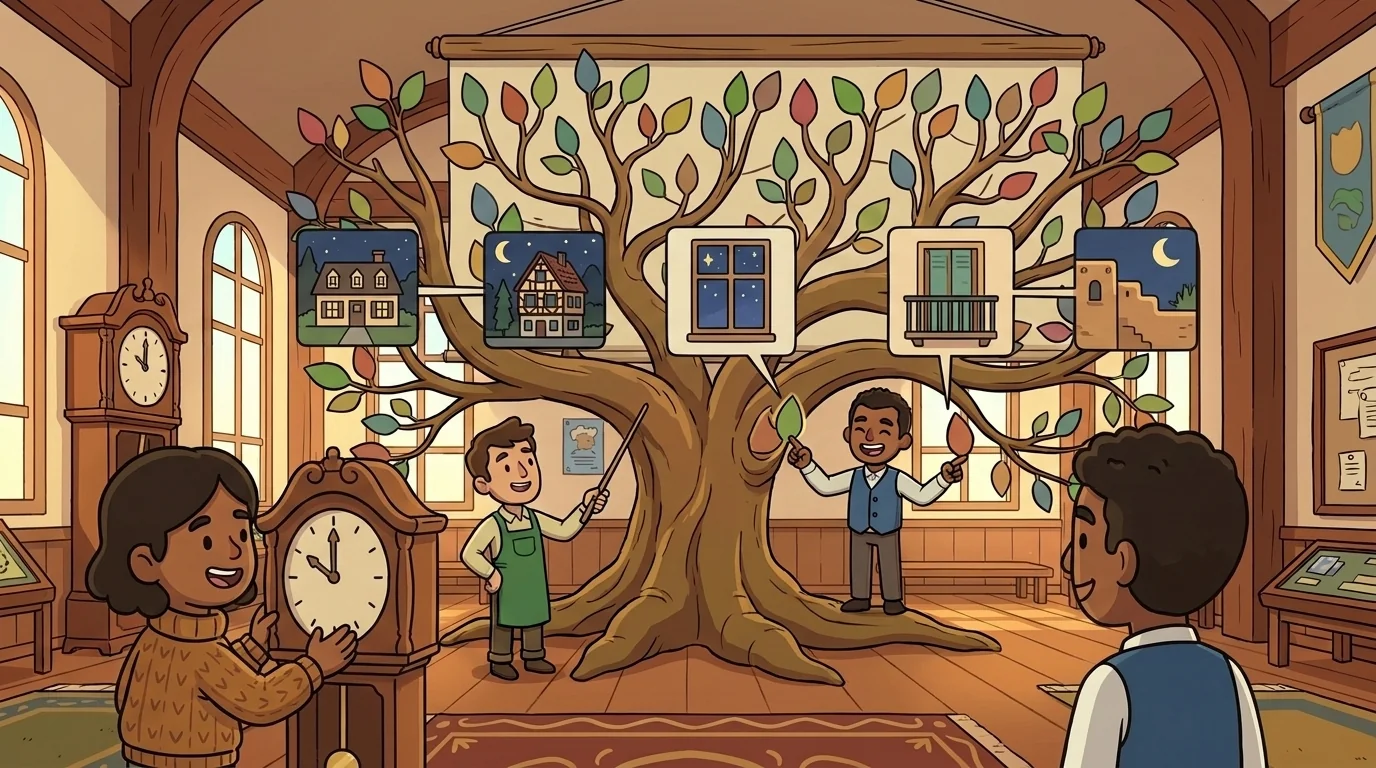
And that trail was exactly what Bridge lived to point out — the cognates, the family resemblances that survive the drift.
"So the sounds drifted," said Bridge, standing between two branches, "but the echo is still there, if you know how to hear it. Look — night in English. Nacht in German. Nuit in French. Notte in Italian. Noche in Spanish." Bridge lined them up. "Different, sure — but can you hear it? The same ancient word, drifted down five branches, still echoing the same shape. Those are cognates — words that still show their shared root across related languages, like the same nose showing up on cousins in a family photo." Bridge smiled. "And loanwords are the tree's other trick — words that hop between branches when people trade and travel, so a word born on one limb ends up growing on another. Once you can spot a cognate, learning a related language gets a hundred times easier — because half the words are already family you half-recognize."
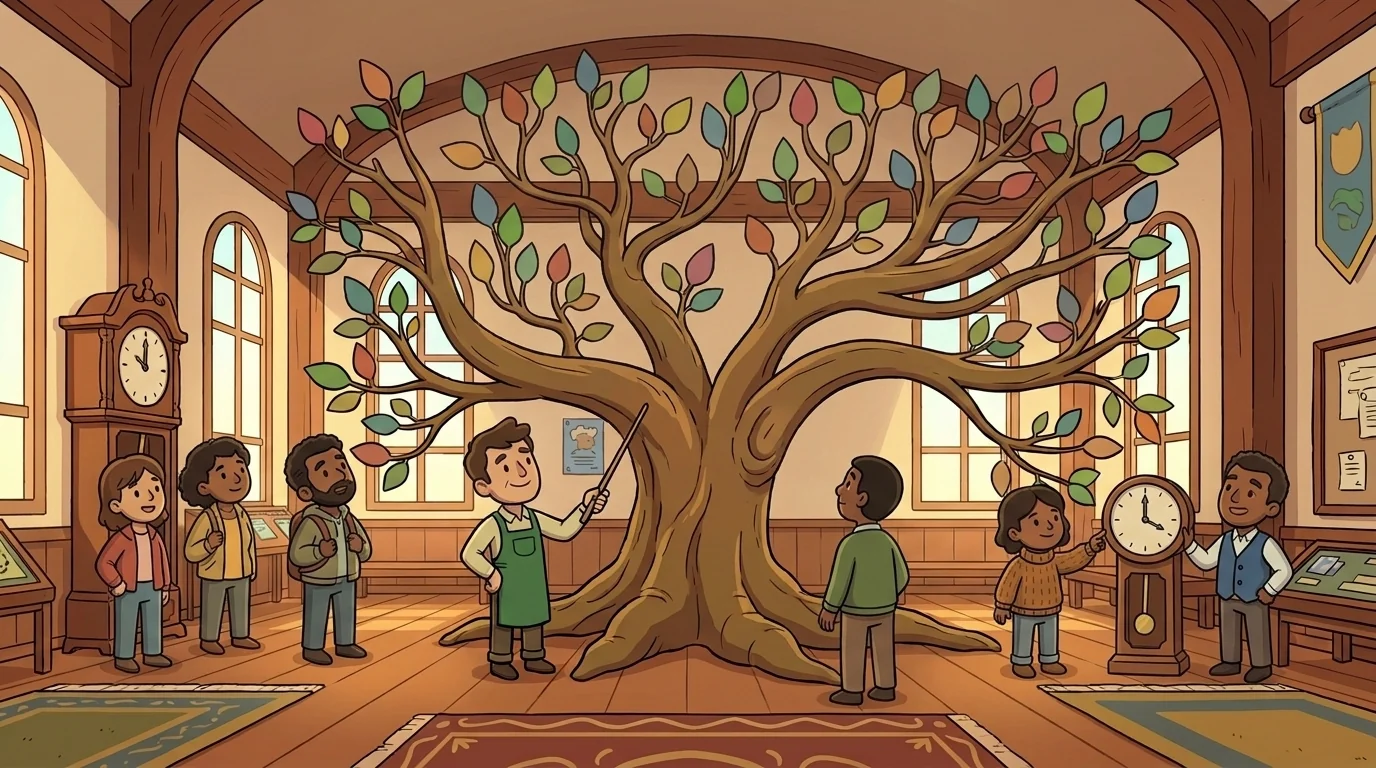
By the end of the tour, the visitors looked at the great branching tree differently — not a chart of foreign strangers, but a family portrait, full of cousins near and far, resemblances and drift and shared ancient roots.
"Good ancestry," said Drift.
"Good drift," said Bridge.
"Good cognates," said Bough.
There is a quiet wonder in discovering that the languages of the world are related — that behind their thousands of different sounds runs a great branching family tree, with shared ancestors, patterned drift, and cognates echoing across the limbs like family faces. It turns the babble of the world into something you can read: not a scatter of unrelated noise, but a living, growing, related thing. And once you can spot a cognate — hear the same ancient word echoing across two tongues — you never quite hear language the same again. You hear the family in it.
The LinguaQuest ensemble
Bough, Drift and Bridge is part of LinguaQuest's distributed-narrative cast. Each character embodies a different curricular primitive; together they teach the full subject.
-

Bough
Language families (genetic descent — Indo-European / Sino-Tibetan / Afro-Asiatic / Niger-Congo / Austronesian)
-

Drift
Sound change (phonological evolution — Grimm's Law, vowel shifts, palatalization)
-

Glyph
Writing systems (alphabetic / abjad / abugida / syllabic / logographic — and how each captures speech)
-
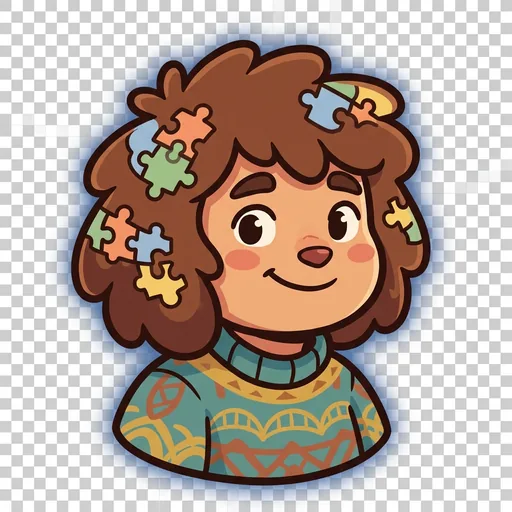
Bridge
Cognates and loanwords (shared roots across languages; trade-route borrowings)
-

Cant
Sociolinguistics — dialect, register, code-switching, formal/informal speech
-
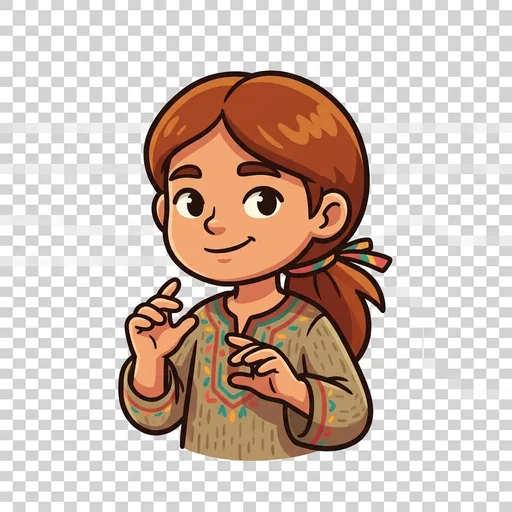
Sign
Signed languages — full natural languages spoken with hands, face, and space; each Deaf community's own, never 'just gestures'
-
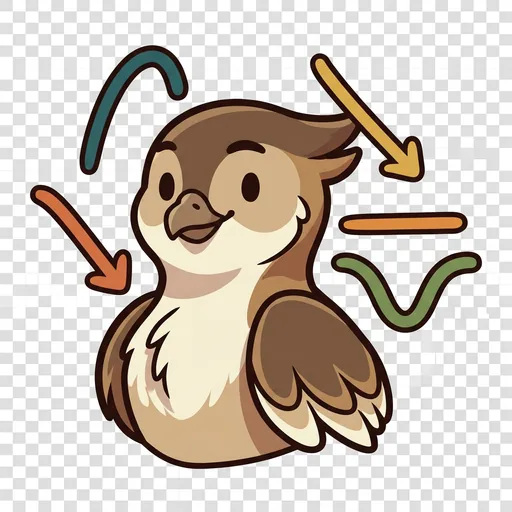
Swoop
Tone — pitch that changes a word's meaning (tonal languages); precise and sophisticated, never 'sing-song' or 'exotic'
-
Weft
Word order / syntax — languages arrange words differently (SVO/SOV/verb-first); no order is 'backwards,' each is complete
-

Lex
Untranslatable words — words no other language has in one breath; not a gap in your language but a gift another can offer
-

Nook
Endangered languages + revitalization — keeping fading languages safe; decline is from histories of harm, never the speakers' fault; communities lead the revival


