
Times
MULTIPLYING FRACTIONS — multiplying by a fraction means taking a fraction OF something. Half of a third is a sixth. Lay one strip across another; the overlap where they cross is the answer. Multiplying by a fraction makes things smaller.
Press play to listen along. The line being read lights up as you go.
Show full transcript
Loading transcript…
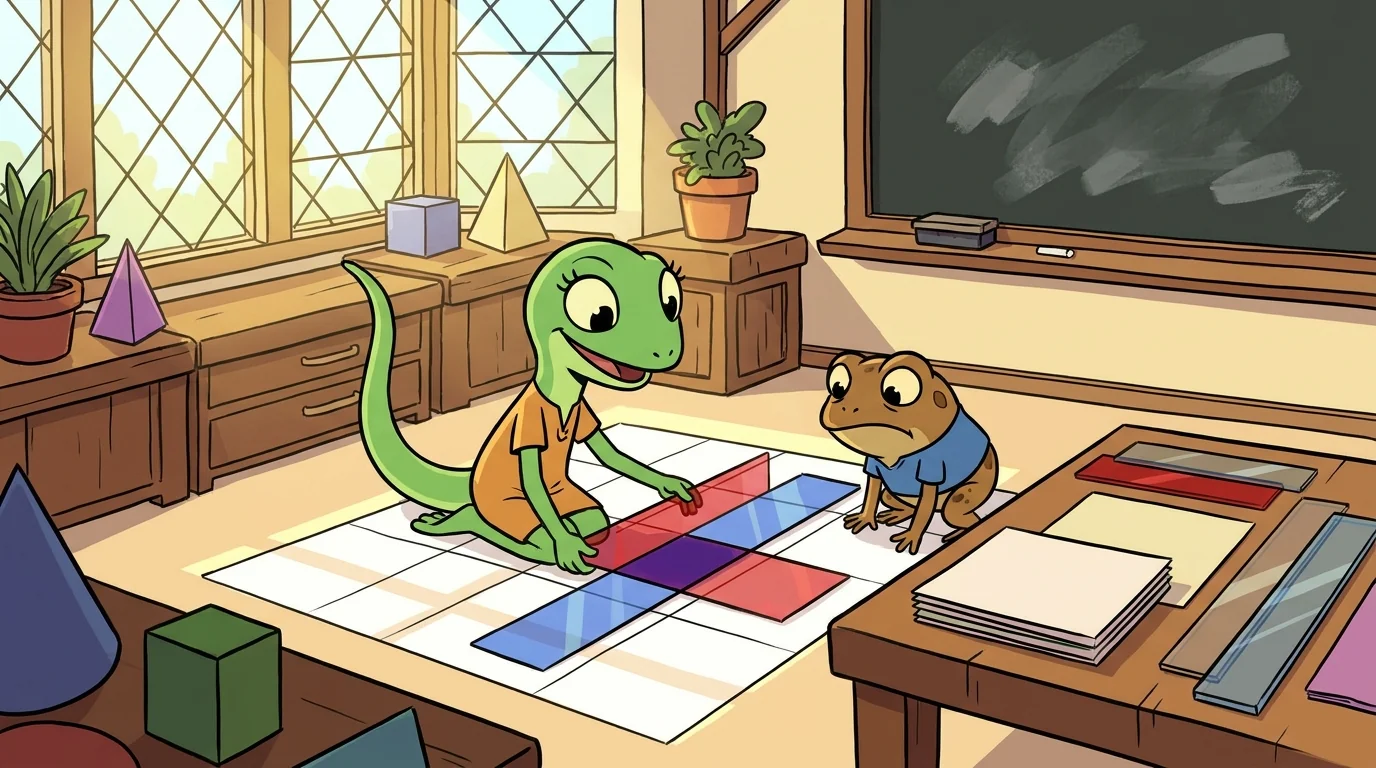
Times made shadows cross, and she had built her whole life around the small miracle of where they met.
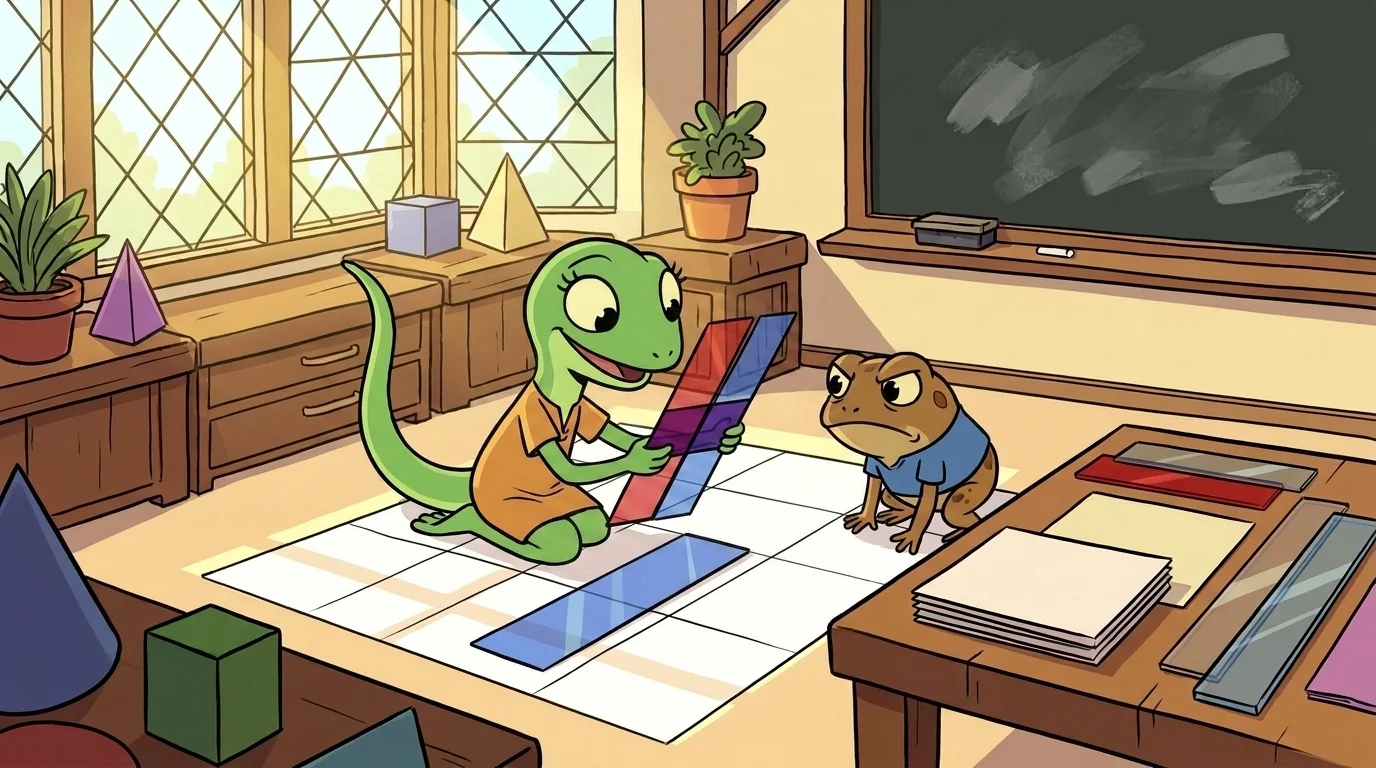
In a sun-warmed corner of the FairShare Village academy she kept two long strips of coloured glass — one red, one blue — and a patch of bare white floor to lay them on. She was a quick, bright-eyed lizard, narrow and exact, and she spent her afternoons sliding one strip across another and studying the place where they crossed, as though the answer to some old question might be hiding there.
A young toad named Bo had wandered in to watch, and Times, who never minded an audience, set the blue strip down so that it covered exactly one-third of the floor patch. Then she laid the red strip across it the other way, sideways, until the red covered one-half of the patch in its own direction.
Where the two strips overlapped, the light deepened into a dense, secret purple — a small rectangle, far smaller than either strip that had made it.
"That purple piece," Times said, touching its edge, "is one-half of one-third. And would you like to know what it actually comes to?" She traced the little rectangle with one claw. "One-sixth. Half of a third is a sixth — no more, no less."
Bo's brow furrowed. "But it got smaller. You laid one thing across another — you multiplied — and the answer is tinier than either piece you started with. Things are supposed to get bigger when you multiply."
Times grinned, delighted, the way she always was when somebody arrived at exactly the right objection. "That," she said, "is the surprise that ambushed me when I was your age. Sit down and let me tell you how I worked it out, because I promise you it was not obvious."
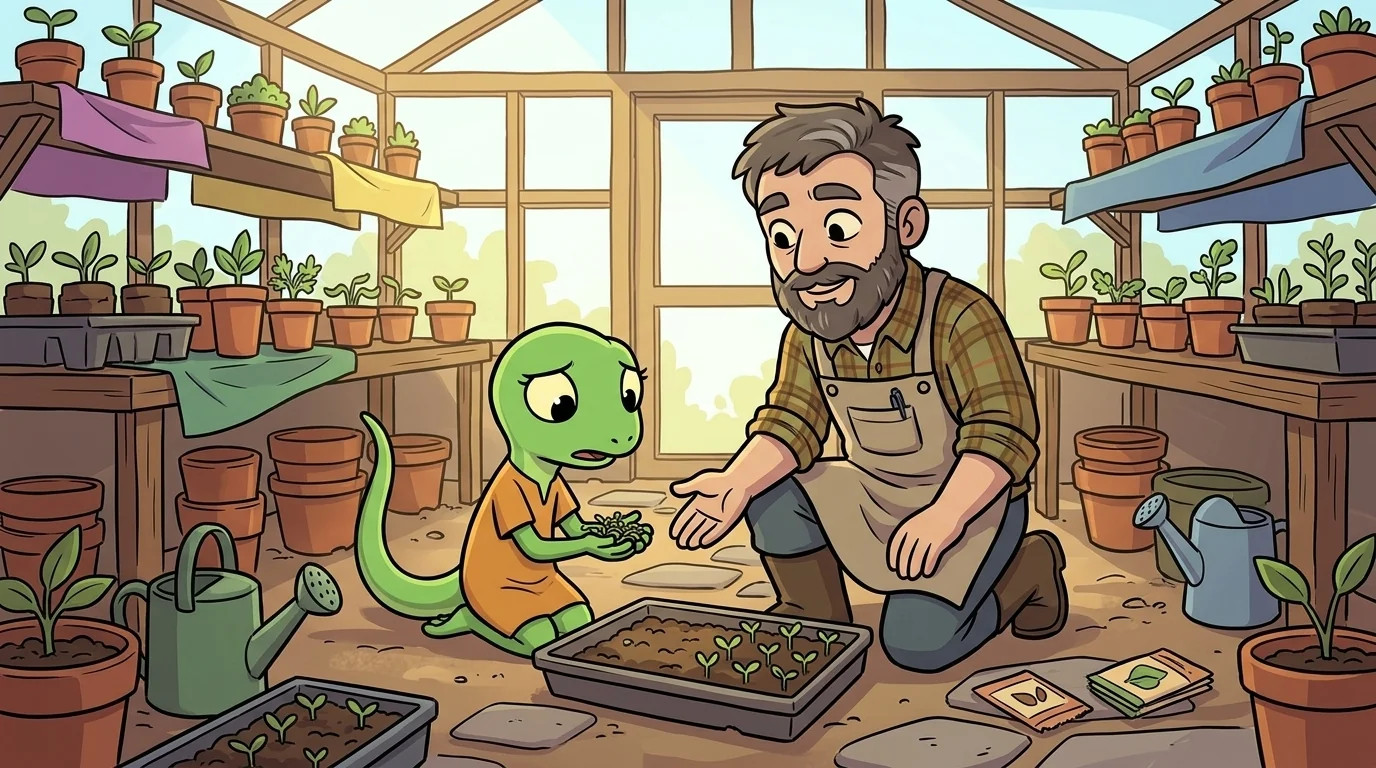
When Times was small, the surprise found her first, and it gnawed at her for a solid week before it let go.
She had been helping her uncle in his greenhouse, a glass-walled place where seedlings grew under sheets of coloured cloth that turned the light to syrup. He pointed her toward a wooden tray that was already only about a third full of sprouts. "Take half of that tray," he told her, "and carry it across to the bench."
Little Times scooped up half of the third-full tray, carried the small green handful across, and then stopped dead, holding it, genuinely confused. "This is hardly anything," she said. "It's nowhere near half a tray. But you said half. Half is meant to be a lot."
Her uncle knelt down to her level. "Half of what, though — that's the question you skipped. Half of a whole tray would be a generous heap. But you didn't take half of a whole. You took half of a third. You took a part of a part. And a part of a small thing can only ever be a smaller thing still."
Times stared down at the little clutch of sprouts in her hands. Half of a whole would have filled both arms. Half of a third barely filled one palm. The word multiply had meant more to her for as long as she could remember — it was practically the definition. Yet here it sat in her hands, quietly, undeniably, meaning less.
"Part of a part," she whispered, and the phrase made her feel dizzy and thrilled at the same time, the way a true idea sometimes does. That afternoon she went home and laid two paper strips across each other on the kitchen floor, just to watch the overlap shrink, and she found she never quite got tired of doing it.
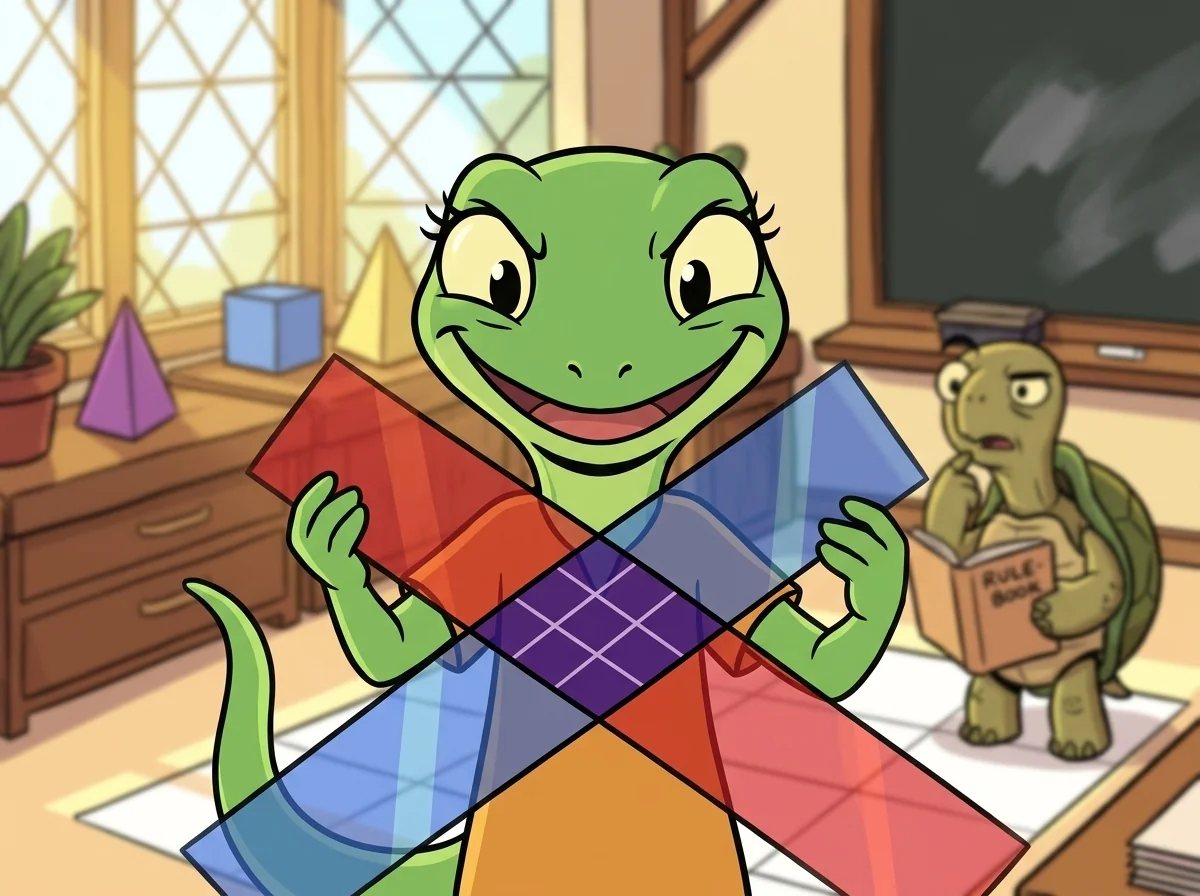
Years later, Times arrived at the academy with her two glass strips wrapped carefully in a square of cloth and very little else to her name.
Slice, the old tortoise who ran the place, looked her over and set her a problem without preamble. "What is two-thirds of three-quarters?" he asked. "No memorised tricks. Show me the thing itself."
Times did not reach for a pencil. She knelt, unrolled her cloth, and laid the first strip across the white floor patch until it covered three-quarters of it. Then she turned the second strip sideways and laid it across the first, the other way, until it covered two-thirds of the patch in its own direction.
Where the two strips crossed, a block of doubled colour appeared, and the crossing lines had quietly diced the whole patch into a neat grid. "The strips have cut the patch into twelfths now," she said, counting under her breath — "four columns one way, three rows the other, twelve little squares in all. And the overlap, the part both strips agree on, covers six of those twelfths." She looked up. "Six-twelfths. Which is only another name for one-half."
Slice raised a single, ancient eyebrow. He had taught multiplication by the rule — top times top, bottom times bottom — for the better part of sixty years, and the rule was perfectly good. But he had never once watched a student lay the answer out in light before, and see it arrive on its own.
"The rule still holds, of course," Times added quickly, as if worried he might think she scorned it. "Two times three is six, four times three is twelve, six-twelfths. I'm not throwing it away. I simply prefer to see the thing happen. The overlap doesn't lie, and it doesn't ask me to take anything on faith."
"You may stay," Slice said.
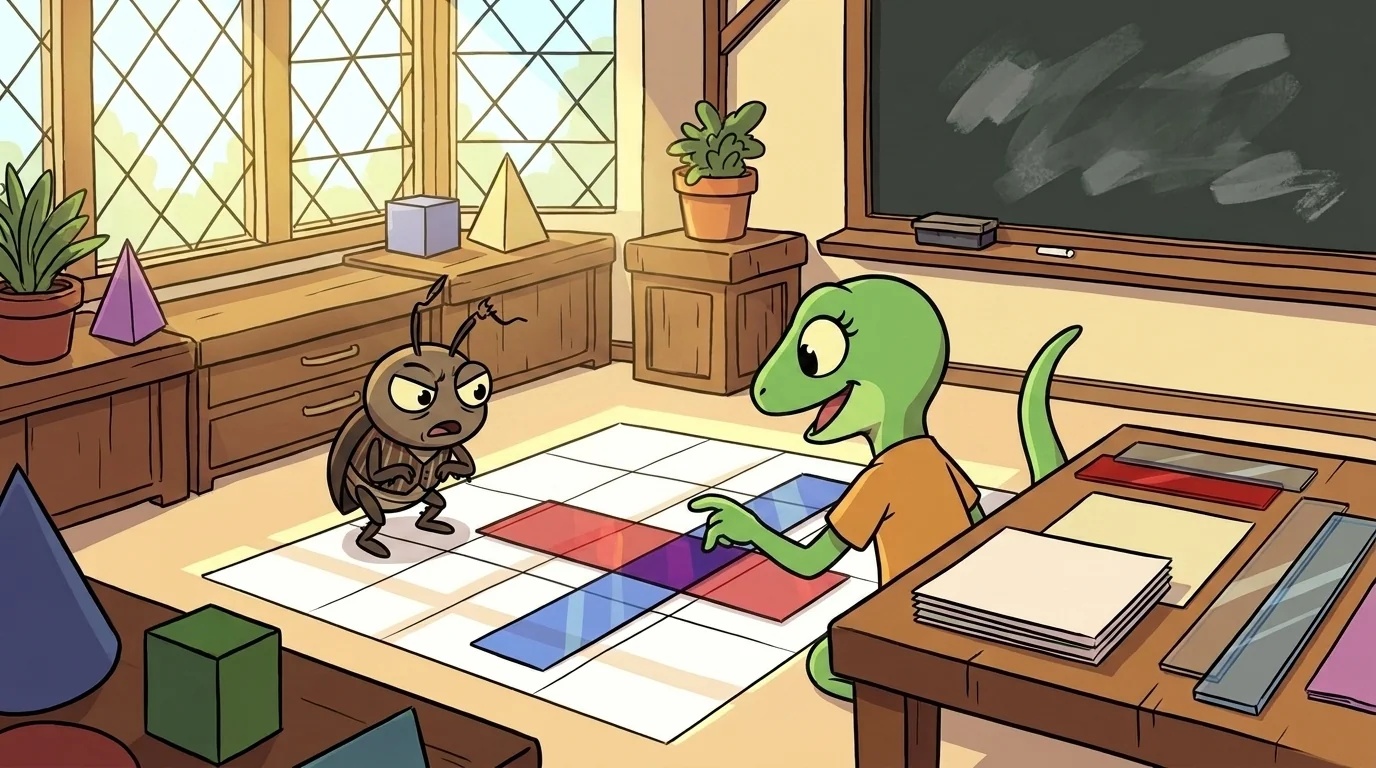
In her sunny corner, some weeks on, Times met a grumpy beetle named Cricket, who marched in and slapped a worksheet down on the floor as though it had personally insulted him.
"Multiplying fractions is broken," Cricket announced, "and I can prove it. I did one-half times one-fourth and the answer came out as one-eighth. One-eighth is smaller than both of them. Multiplication is supposed to make things bigger — everyone knows that — so the whole method must be wrong."
"The method is fine," Times said gently. "It's the word that's been tricking you, and honestly it's an easy trap to fall into. Watch." She laid down a strip covering one-fourth of the patch, then crossed it with a strip covering one-half the other way, and the overlap settled into a tiny, modest rectangle. "One-half of one-fourth. You aren't stacking two things on top of each other to build something taller. You're reaching into a piece and taking a part of it — and a part is always smaller than the whole you reached into."
Cricket squinted at the little overlap for a long moment. "So 'times,' here, really means 'of.'"
"That is the entire secret," Times said. "When you multiply by a fraction, times means of. Half times a fourth is just half of a fourth — and half of something already small is bound to be smaller still."
Then she did a thing that made Cricket's antennae twitch. She picked up the two strips and swapped them — laid the fourth where the half had been, and the half where the fourth had been, crossing them again. The overlapping rectangle was exactly, precisely the same size as before.
"Half of a fourth, or a fourth of a half," Times said. "Two different sentences, two different orders — and the very same answer. One-eighth, whichever way round you say it. The order you cross the strips in never changes the overlap they make."
Cricket stared, his complaint quietly evaporating. "Two whole different sentences," he said slowly, "and one little purple square."
"One little purple square," Times agreed, thoroughly pleased with him.
When the sun finally slid off her corner of the floor and the coloured strips went dark and ordinary, Times wrapped them back in their cloth for the night.
She thought, as she often did at this hour, about her uncle's greenhouse — the tiny handful of sprouts, half of a third, the word multiply turning soft and small and strange in her young hands. She had been so certain, back then, that multiplying could only ever mean more. It had taken a single pair of crossed shadows to teach her that taking a part of a part means less, and — this was the part that still moved her — that the shrinking wasn't a mistake or a flaw in the rules. It was the whole quiet point of the thing.
Bo the toad, still loyally there at closing time, asked one last question. "Times? When I'm on my own, and there's nobody to lay strips for me — how will I remember that multiplying can make it smaller?"
Times smiled and lifted her two strips into the last of the light, crossing them slowly so that the overlap dwindled to a thin bright sliver between her hands.
"You won't have to remember a rule," she said. "Just remember the little word of. Half of a third. A part of a part. A part is always smaller than the thing you took it from — and if you ever forget, the overlap will be right there, telling you the truth in plain light."
Bo nodded, watching the small crossed shadow narrow to almost nothing, and set off home through the dusk thinking about all the parts of parts there must be in the world — each one smaller than the last, each one resting exactly where it ought to be.
The FractionForge ensemble
Times is part of FractionForge's distributed-narrative cast. Each character embodies a different curricular primitive; together they teach the full subject.
-

Halver
Partitioning — splitting a whole into equal parts (denominator construction)
-

Pie
Wholes and parts — mixed numbers, improper fractions, whole-as-pie anchor
-

Equi
Equivalent fractions — different forms, same value (×n/×n scaling)
-

Stretch
Common denominators — scaling to a common base for comparison + addition
-

Dot
The decimal point and fraction-decimal-percent equivalence
-
Liner
Number-line placement — every fraction has an exact spot between the whole numbers
-

Gather
Adding and subtracting fractions — you can only combine pieces that are the same size
-
Tenth
Decimal place value — each column right of the point is ten times smaller
-
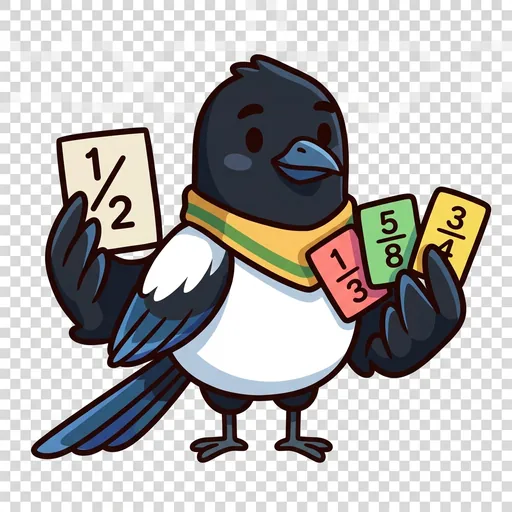
Rank
Comparing and ordering fractions using benchmarks and reasoning