
Tenth
DECIMAL PLACE VALUE — the columns after the decimal point each shrink by ten. Tenths, then hundredths, then thousandths. The 7 in 0.7 means seven-tenths; the 7 in 0.07 means seven-hundredths. The column tells you the size.
Press play to listen along. The line being read lights up as you go.
Show full transcript
Loading transcript…
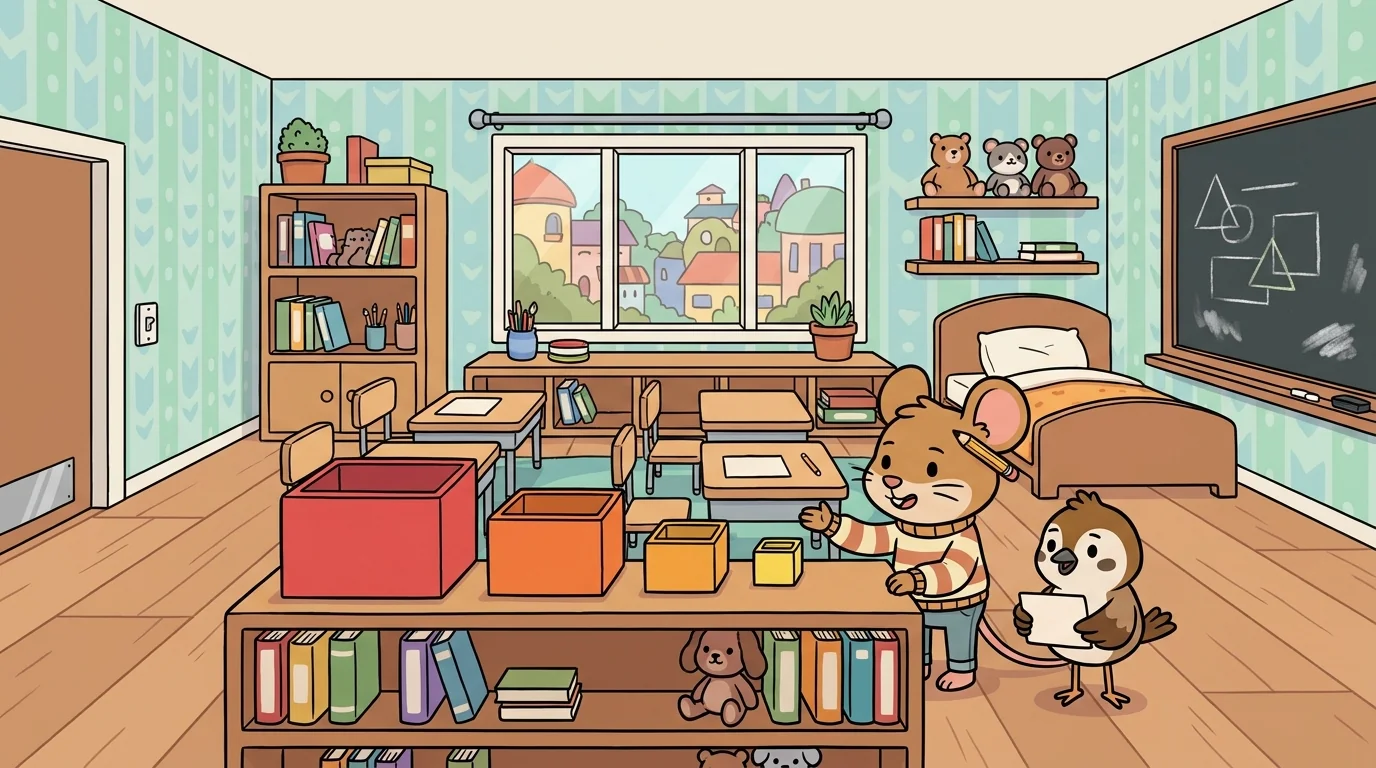
Tenth lined things up in columns. To her, a number with its digits jumbled was as unsettling as an unmade bed.
In her room at the FairShare Village academy she kept a set of nesting boxes on a shelf — a large one, then a slightly smaller one that fitted neatly inside it, then a smaller one inside that, on and on down the row, each box exactly ten times smaller than the box before it. She was a tidy little dormouse with a pencil perpetually tucked behind one ear, and she believed, with quiet conviction, that everything had a proper place.
A young sparrow named Fen came to her one morning with a number written on a card: *0.7*. "What does the seven mean?" Fen asked.
Tenth took the seven and set it gently into the very first box after the point — the biggest of the small boxes. "It means seven-tenths," she said. "Seven pieces, and each piece is one-tenth of a whole. So the seven isn't merely a seven. It's a seven that happens to be living in the tenths box — and where it lives is precisely what tells you how big it is."
Fen blinked, turning this over. "The spot matters more than the actual number?"
"Oh, the spot matters more than almost anything else about it," Tenth said. "The very same digit can mean wildly different amounts depending on which box it's standing in. Let me show you exactly why, because once you see it you can't unsee it."
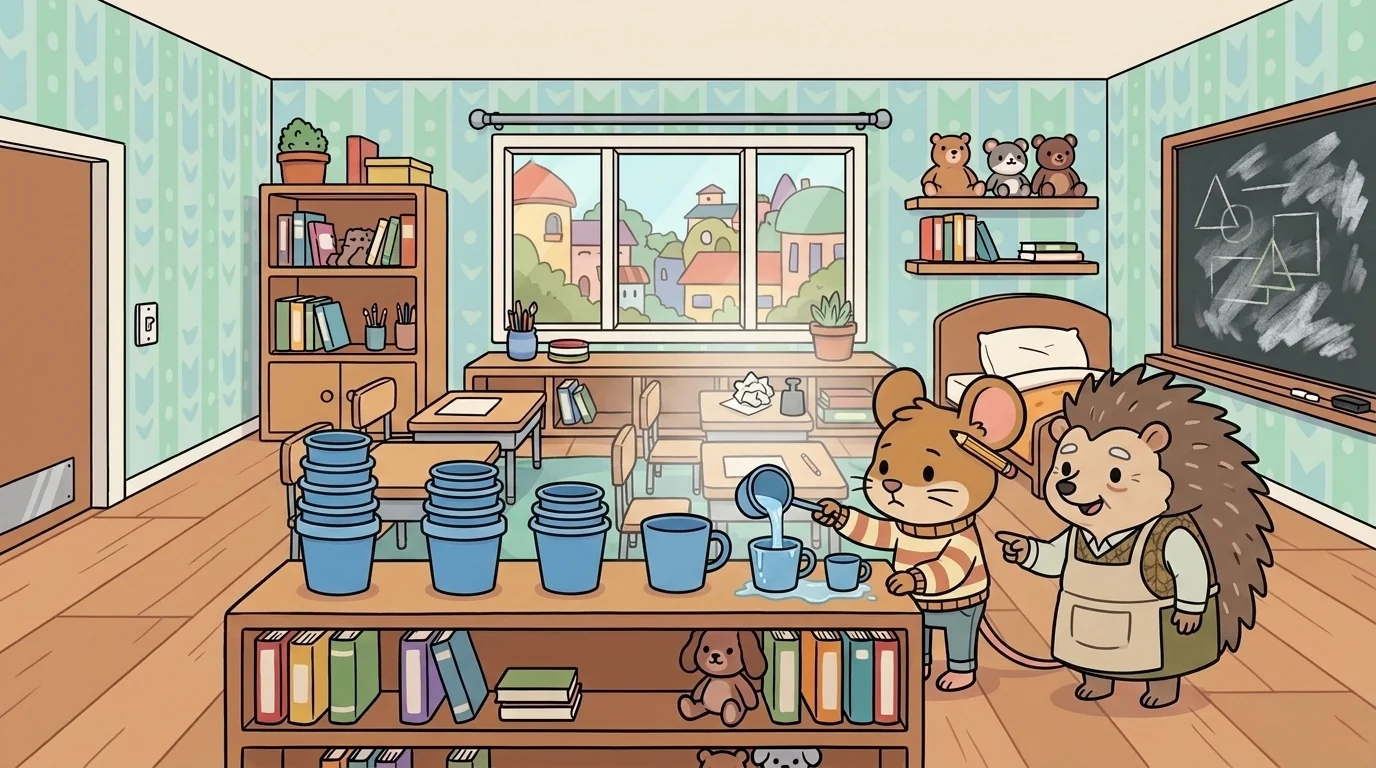
When Tenth was small, she didn't understand columns at all — and her ignorance once cost her a prize.
There was a village guessing jar one autumn: write down your guess for the weight of an enormous pumpkin, and the closest guess won the pumpkin itself. Little Tenth, wanting to seem clever and precise, wrote down a careful answer — but she crammed all her digits together in a rush, paying no mind to where each one sat. The guess that came out the other end meant something wildly different from what she had intended. What should have been a near-miss was suddenly off by an enormous margin, an embarrassing one.
The grocer who ran the jar was not unkind about it. He pulled out a set of little measuring cups, each one ten times smaller than the cup beside it, and poured a brimming big cup of water into a smaller one until it overflowed across the counter. "See that? It takes ten of the little ones to fill a single big one. That's exactly how the columns work. Ones, then tenths, then hundredths — each step you take to the right, ten times smaller than the step before."
Then he pointed at her crammed-together guess. "Your digits were fine, every one of them. They were just sitting in the wrong cups."
Tenth stared at the row of cups, the spilled water still beading on the wood. A 7 sitting in the tenths cup meant seven-tenths. The same 7 sitting in the hundredths cup meant seven-hundredths — ten times smaller. Same digit. Different home. Entirely different size. She went home that night and built her own set of nesting boxes by candlelight, and she never crammed a number together carelessly again.
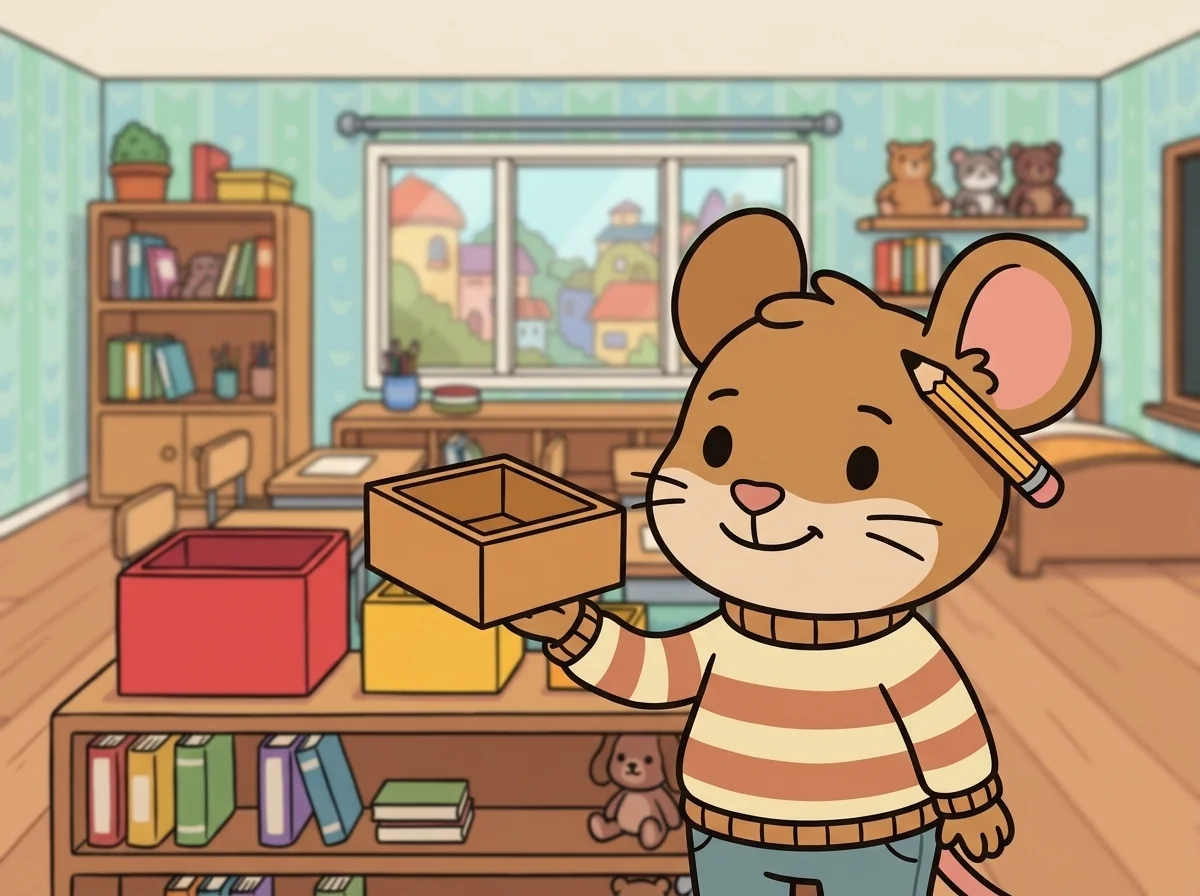
Tenth came to the academy years later with her nesting boxes tucked under one arm.
Slice, the old tortoise, wrote two numbers on the board to test her: *0.7 and 0.07*. "Same digit in both," he said. "Tell me the difference between them."
Tenth did not rush. She set up her boxes in a careful row on the desk: the ones place, then a little painted dot, then the tenths box, then the hundredths box. Into the tenths box of the first number she placed a 7-tile. "Seven-tenths. Seven of the larger small pieces."
Then she placed a 0 into the tenths box of the second number, and slid its 7 one box further along, into the hundredths box. "Seven-hundredths. And notice what the zero is doing — it's holding the tenths spot open, declaring no tenths here, and in doing so it pushes the seven down into the next box, which makes the seven ten times smaller."
"The zero isn't nothing at all," she added, warming to it. "It's a placeholder. It keeps the seven standing in the correct box. Take the zero away, and the seven slides straight back up into the tenths box and becomes ten times bigger — and the whole number changes meaning."
Slice nodded slowly. He had taught decimals as just numbers with a dot in them for a great many years. He had never before watched a student treat a humble zero as a careful little fence, posted on purpose to keep everyone in their proper place. "You may stay," he said.
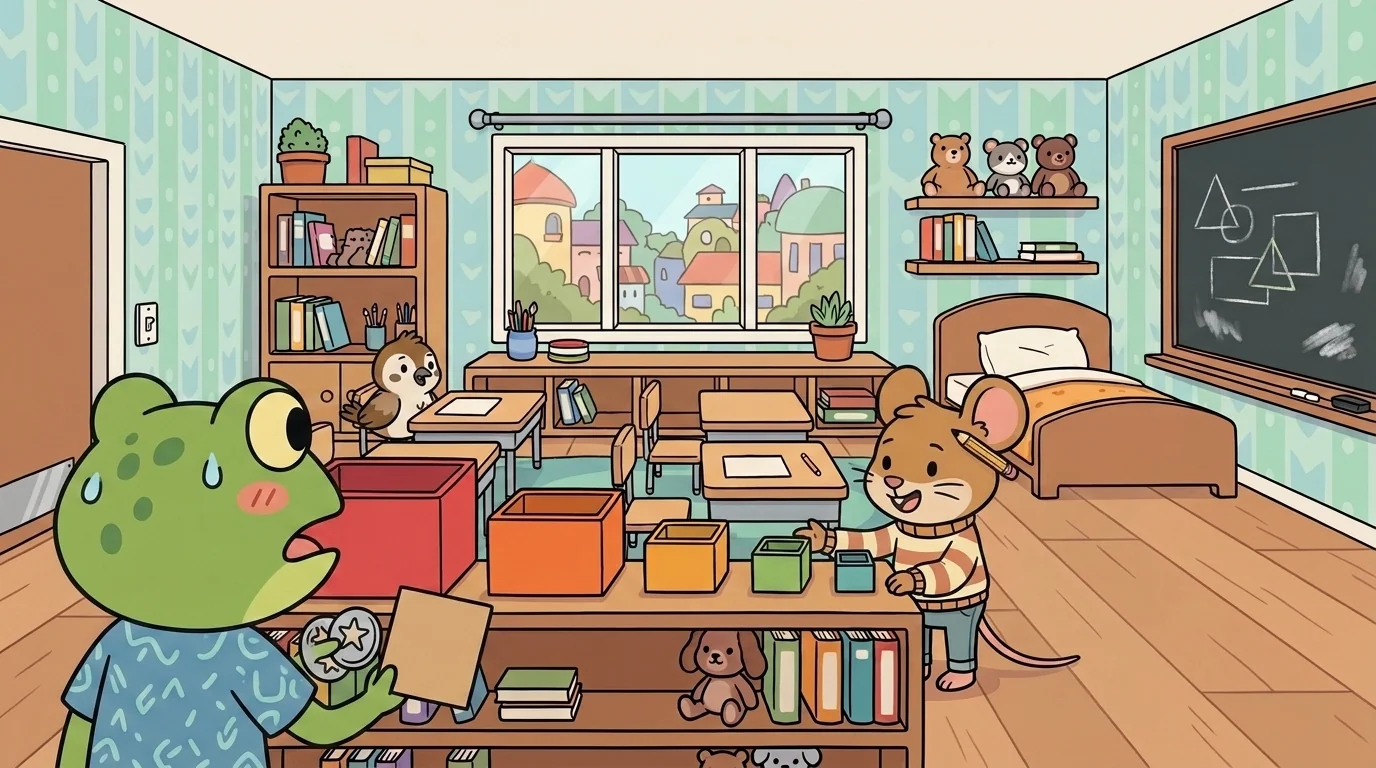
In her tidy room, some time later, Tenth met a flustered frog named Bramble, who arrived clutching two coins and a grievance.
"Decimals are sneaky," Bramble declared. "I wrote thirty cents as 0.30, and my friend wrote it as 0.3, and we had a whole argument about which one of us was right. We can't both be right — that's not how being right works."
"Let's box it up and find out," Tenth said calmly, and laid out her columns. Into Bramble's number she placed a 3 in the tenths box and a 0 in the hundredths box. "Three-tenths, and zero-hundredths." Then into the friend's number she placed a 3 in the tenths box and simply left the hundredths box standing empty. "Three-tenths, and... nothing after it."
She tilted her head, considering the two side by side. "Both of you put a 3 in the tenths box. That's the part carrying the value — three-tenths of a dollar is thirty cents, either way you write it. The extra zero in the hundredths box only says and zero hundredths, which is perfectly true but adds precisely nothing. So you're both right, and neither of you was wrong."
Bramble's eyes went round. "So the zero at the very end is just being polite. But the zero in the middle — the one in 0.07 — that one's actually doing a job."
"Now you've truly got it," Tenth said, delighted. "A zero that holds a spot between other digits is doing real, necessary work — it keeps everyone standing in the right box. A zero hanging off the very end is just tidying up after itself. And the boxes will always tell you, instantly, which sort of zero you're looking at."
Bramble laughed despite himself. "I am never going to trust a zero quite the same way again."
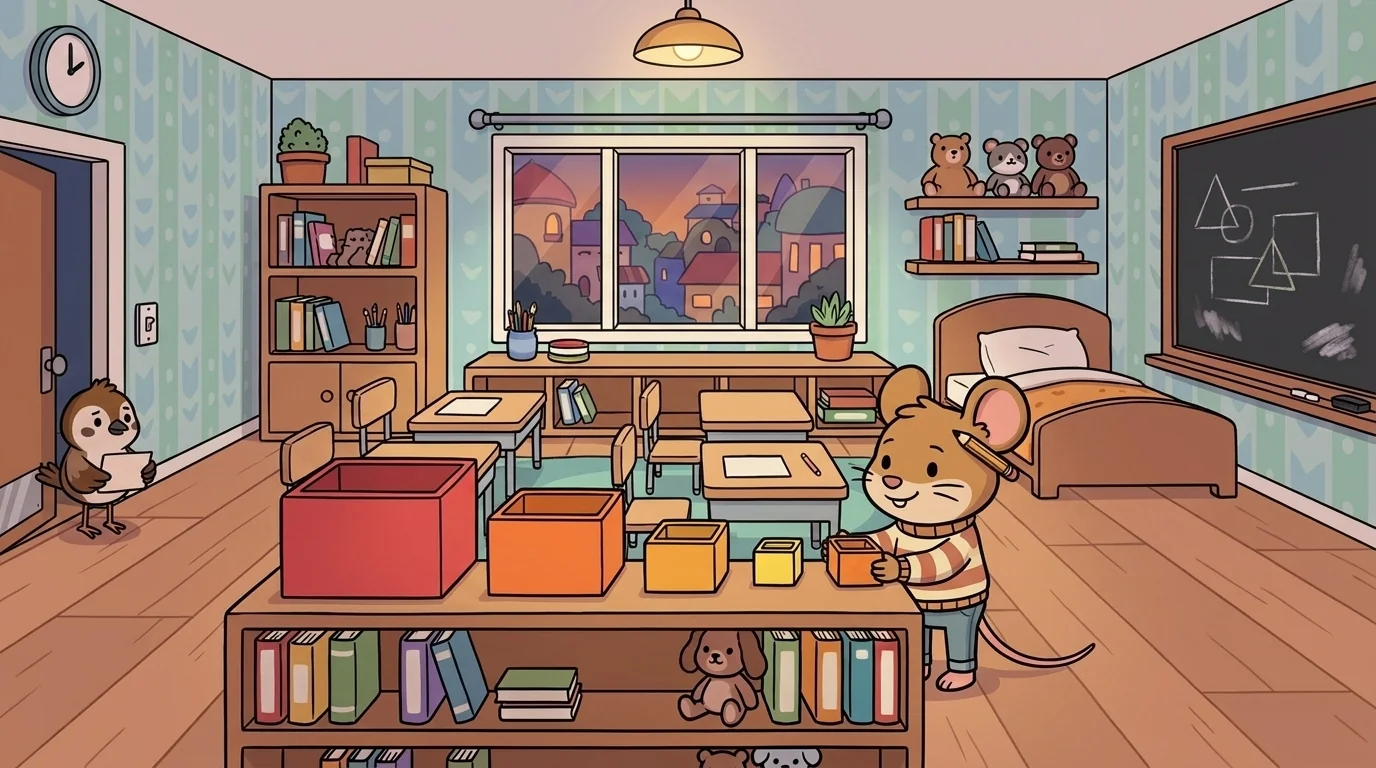
When evening came and the academy settled into quiet, Tenth straightened her nesting boxes along the shelf, largest to smallest, each one ten times tinier than the last.
She thought, as she often did, about the guessing jar all those autumns ago — her clever answer ruined not because the digits had been wrong, but because they'd been sitting in the wrong cups. The grocer's patience. The water spilling over the counter. Your digits were fine. They were just sitting in the wrong homes.
Fen the sparrow, still perched in the doorway, asked the last question of the day. "Tenth? How do I always know which box a digit is supposed to go in?"
Tenth pointed at her shelf of nesting boxes, the whole row of them descending neatly into smallness. "Start at the point, and walk to the right," she said. "First box you come to, tenths. The next, hundredths. The next, thousandths. Each single step, ten times smaller than the one before. The digit itself hasn't changed at all — but the box it sits in tells you precisely how much it's worth. Find the box, and you'll always know the size."
Fen looked at the long row of boxes, large to small, and nodded. Then he flew home through the dusk, picturing every number he passed tucked neatly into its own little nesting box — each one resting in exactly the right place, and not a digit out of its home.
The FractionForge ensemble
Tenth is part of FractionForge's distributed-narrative cast. Each character embodies a different curricular primitive; together they teach the full subject.
-

Halver
Partitioning — splitting a whole into equal parts (denominator construction)
-

Pie
Wholes and parts — mixed numbers, improper fractions, whole-as-pie anchor
-

Equi
Equivalent fractions — different forms, same value (×n/×n scaling)
-

Stretch
Common denominators — scaling to a common base for comparison + addition
-

Dot
The decimal point and fraction-decimal-percent equivalence
-

Liner
Number-line placement — every fraction has an exact spot between the whole numbers
-

Gather
Adding and subtracting fractions — you can only combine pieces that are the same size
-

Times
Multiplying fractions — a fraction OF a fraction, shown as the overlap of two strips
-
Rank
Comparing and ordering fractions using benchmarks and reasoning