
Liner
NUMBER-LINE PLACEMENT — every fraction has an exact spot on the number line between the whole numbers. 3/4 lives three of four equal steps from 0 to 1. A fraction is a place you can always find.
Press play to listen along. The line being read lights up as you go.
Show full transcript
Loading transcript…
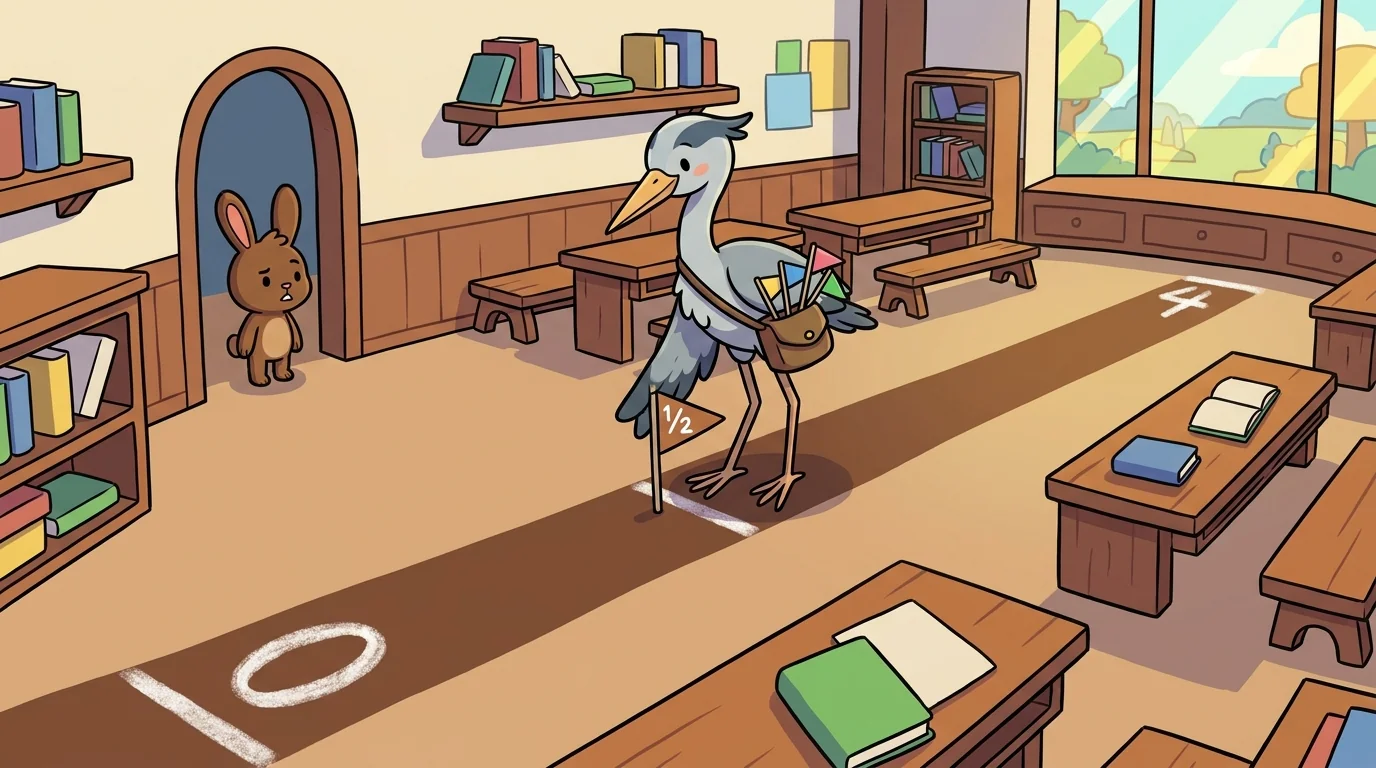
Liner walked a straight line. She always had, and she made no apology for it.
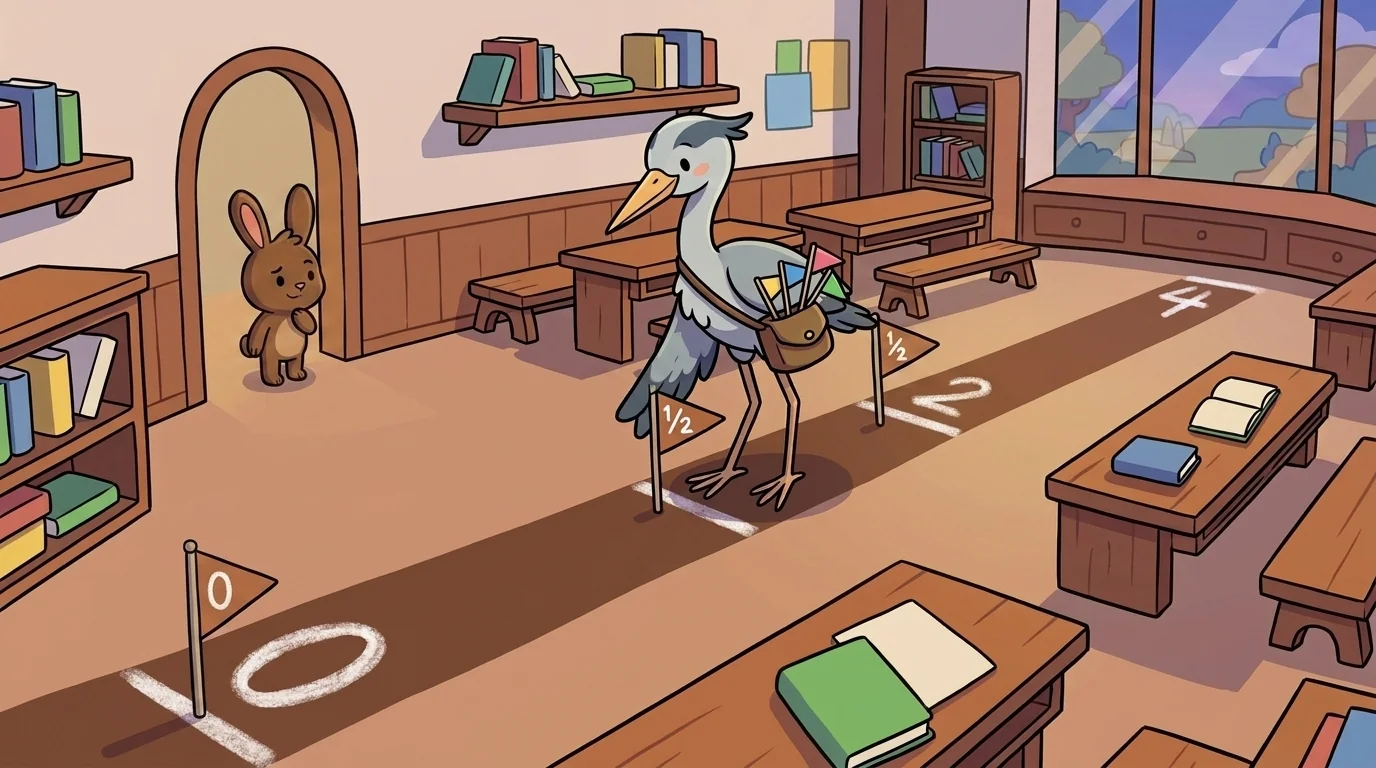
Down the middle of the FairShare Village academy floor ran a long painted stripe that travelled from one wall clear to the other. It began at a broad chalk *0 and ended, a great distance away, at a broad chalk 4*. To everyone else in the academy it was simply a line on the floor, the sort of thing you stepped over without thinking. To Liner it was the most interesting road in the entire world, and she treated it like one.
She was a careful heron — tall and grey, with long, deliberate legs that had been built, it seemed, for stepping down exactly where she meant to step and nowhere else. A satchel of small cloth flags hung at her side, and each flag carried a tiny number stitched onto it.
She paced the line without hurry. When she reached the spot that lay precisely halfway between the 0 and the 1, she stopped, reached into her satchel, and planted a flag in the floorboard seam. The flag read *1/2*.
"There you are," she said softly, in the tone you might use to greet a friend you had been expecting.
A young rabbit named Theo watched her from the doorway, unimpressed and a little baffled. "It's just a spot on the floor," he said.
Liner smiled, unoffended. "Every spot on this line is a number," she said. "Even the spots that fall between the big ones. Especially those — they're the ones most people forget are even there."
When Liner was small, she got lost. Constantly, and badly.
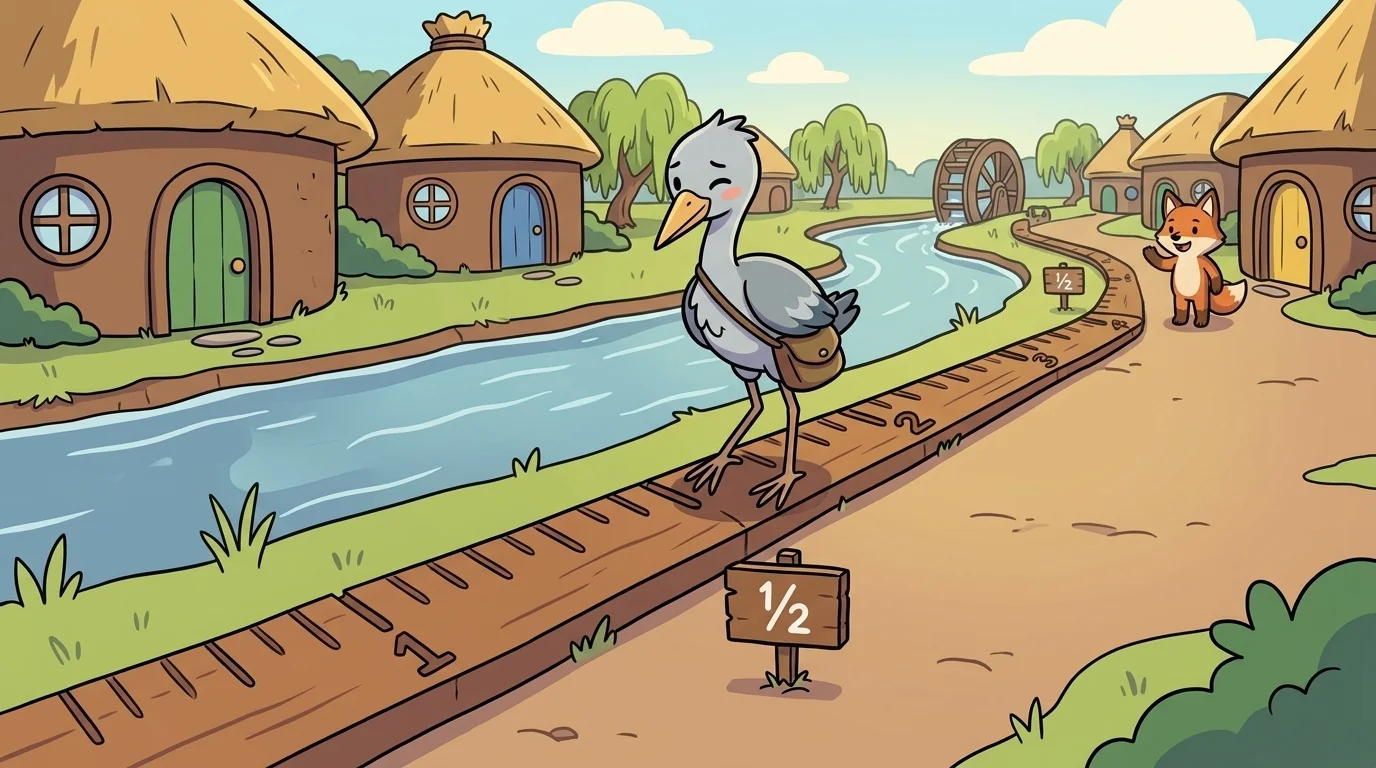
She had grown up in a village built along a long, winding river, where every house looked maddeningly like the last — round and brown, each with the same little door, set at the same modest angle to the water. She would set out, full of confidence, for her grandmother's house, and somehow arrive instead at the baker's, or the well, or some lane she was certain she had never laid eyes on before, blinking back tears of frustration.
"I can't find anything," she confessed to her grandmother one evening, after a kind fox had walked her home for the third time that single week.
Her grandmother did not scold her, which Liner remembered ever after. Instead she took the child down to the riverbank, where a long wooden measuring rail ran the length of the path, notched off in even, regular steps. *0 stood at the bridge. 1 stood at the old willow. 2* stood at the mill.
"You don't need to remember every house in the village," her grandmother said. "You need to remember the line. Our house is here." And she laid one finger on a spot that fell exactly halfway between the willow and the mill. "Not at 1. Not at 2. Right in the middle of them — halfway between."
Liner stared at the spot beneath her grandmother's finger. It wasn't a whole number at all. It was a place that lived between the numbers — and yet it was exact, and fixed, and it would be in that same position tomorrow and the day after and forever. It would never drift.
"Halfway between 1 and 2," she whispered. And for the first time in her whole short life, she knew, without any doubt, exactly where home was. She never got truly lost again.
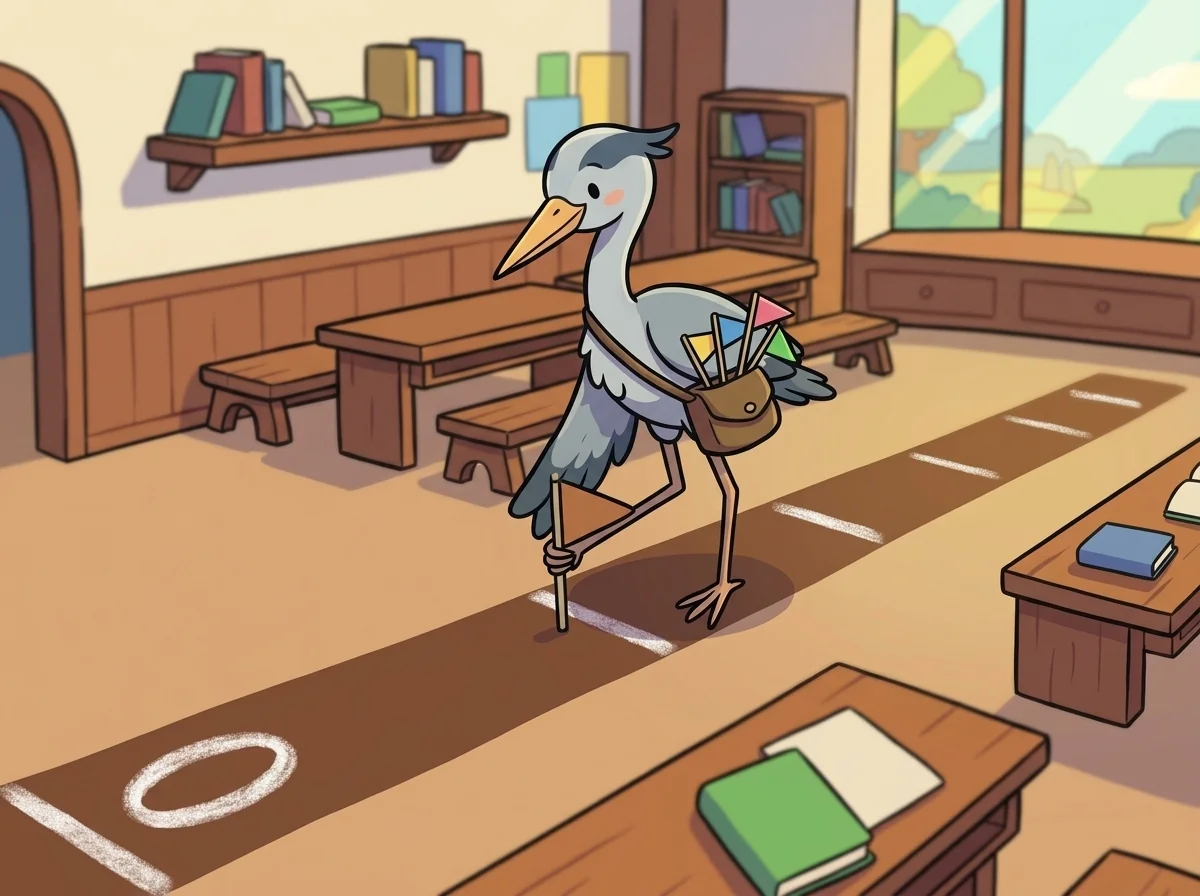
Liner arrived at the academy years later carrying her satchel of flags and almost nothing else.
The head of the academy, a slow and venerable tortoise named Slice, met her standing at the painted line on the floor. "I'm told you place numbers," he said.
"I place all of them," Liner answered. "Including the ones that like to hide in between the whole numbers, where people don't think to look."
Slice gestured at the line. "Show me three-quarters, then."
Liner did not hurry — she never did. She walked first to the *0, then carefully to the 1, measuring the distance between them with her even, deliberate steps. Then she returned and divided that single step from 0 to 1 into four equal parts, scratching a faint mark at each division with the tip of one claw. One. Two. Three. On the third scratch, she planted a flag. 3/4*.
"Three-quarters isn't three slices of a pizza," she said. "It's a place. It's three of the four equal steps from 0 to 1, and it lives right here, and it has always lived right here whether anyone came to find it or not."
Slice studied the flag for a long, considering moment. He had taught fractions for sixty years, mostly with pies and cakes and the cutting of round things — and in all that time he had never once watched a student simply walk to a fraction, as though it were an address.
"You may stay," he said.
In her corner of the academy, Liner kept her long line and her satchel of flags. One overcast afternoon Theo the rabbit came back to her, holding two cards and wearing the particular scowl of a child whose teacher has said something that refuses to make sense.
"These are supposed to be different," he said, and held them up. One card read *1/2. The other read 2/4*. "Half, and two-quarters. They've got different numbers on them. So they have to be different things. But my teacher swears they're the same, and that makes no sense at all."
"Let's not argue about it," Liner said mildly. "Let's walk it instead — that settles most arguments."
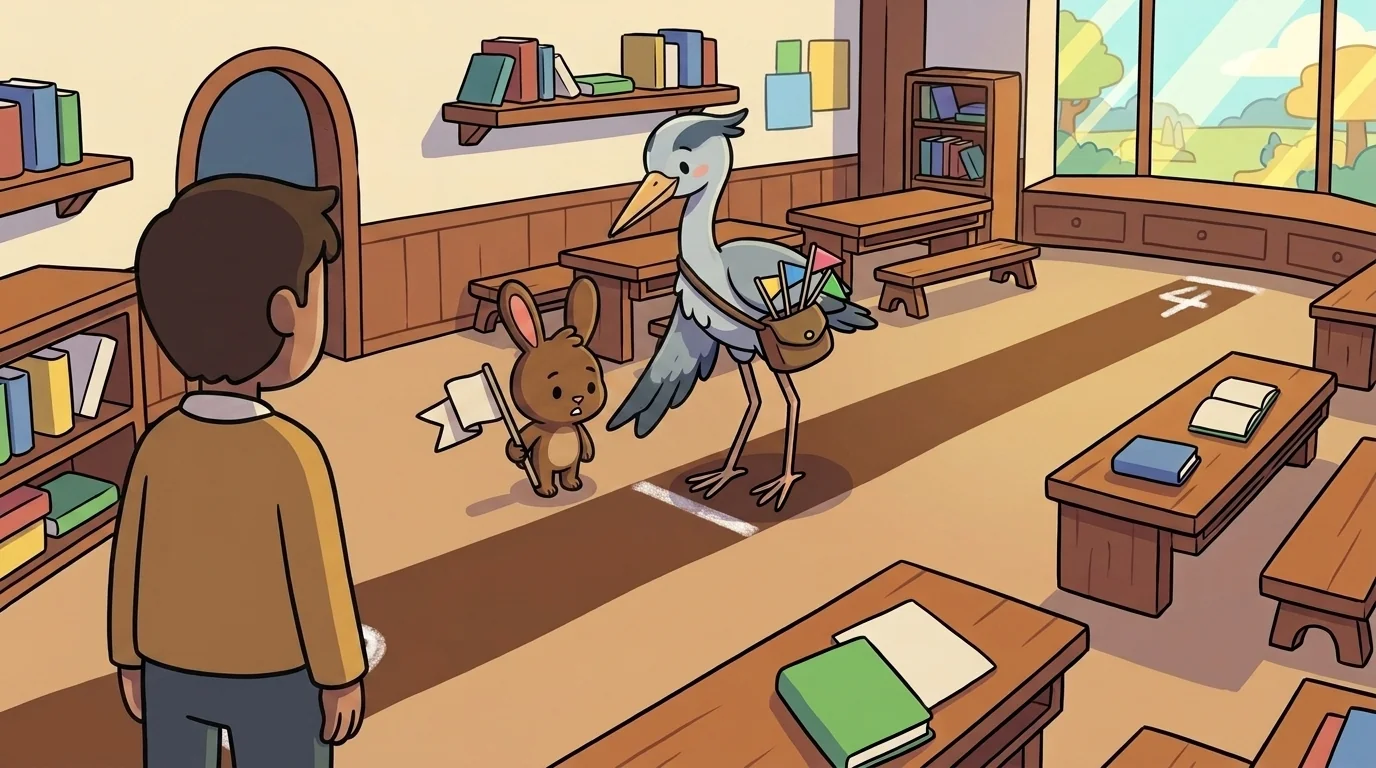
She handed Theo the *1/2* flag. "Go and stand where one-half lives."
Theo measured from 0 to 1, found the middle of that step, and planted himself there, holding his flag aloft.
Then Liner took up the *2/4* flag and measured for herself. She divided the step from 0 to 1 into four equal parts, and she counted off two of them. One. Two. And she stopped — standing shoulder to shoulder with Theo, on the very same patch of floor.
Theo looked down at his own feet, and then across at Liner's. They occupied the same spot exactly.
"They land here, together," Liner said gently. "The same place, reached two different ways. Different names, identical spot — and that is what equivalent means. Half of the way along, or two-quarters of the way along: it's the very same distance from where you began."
Theo's ears went up. "So they're not lying to me after all. They're just... two flags for one place."
"Two flags for one place," Liner agreed.
Later, when Theo had gone home and the academy had emptied into quiet, Liner walked her line one final time, the way she did at the close of every single day.
She passed the flag for 1/2. She passed the flag for 3/4. She passed a dozen quiet places she had named and marked over the years, each one resting exactly where she had left it. Not one of them had shifted. Not one of them ever would.
She stopped at last at the spot that lay halfway between 1 and 2 — the spot that, on a different line, in a different riverside village, a very long time ago, had been home.
A small voice came from the doorway. Theo again, on his way out, but with one last question still in him. "Liner? What if I forget where a fraction is supposed to go?"
Liner looked at him with great kindness. "You won't have to remember every one of them," she said. "You only have to remember the line. Count the equal steps out from 0, and the fraction will be sitting right where it always is — waiting for you, exactly where you left it."
Theo nodded slowly and headed off down the road, counting his steps in the gathering dark. He did not get lost, not even a little — and underneath that, quiet and steady, was the safe, settled feeling of a boy who finally knew he could always find his way home.
The FractionForge ensemble
Liner is part of FractionForge's distributed-narrative cast. Each character embodies a different curricular primitive; together they teach the full subject.
-

Halver
Partitioning — splitting a whole into equal parts (denominator construction)
-

Pie
Wholes and parts — mixed numbers, improper fractions, whole-as-pie anchor
-

Equi
Equivalent fractions — different forms, same value (×n/×n scaling)
-

Stretch
Common denominators — scaling to a common base for comparison + addition
-

Dot
The decimal point and fraction-decimal-percent equivalence
-

Gather
Adding and subtracting fractions — you can only combine pieces that are the same size
-

Times
Multiplying fractions — a fraction OF a fraction, shown as the overlap of two strips
-

Tenth
Decimal place value — each column right of the point is ten times smaller
-
Rank
Comparing and ordering fractions using benchmarks and reasoning