
Branch
MORPHOLOGICAL ADAPTATION + EVOLUTIONARY CHANGE — *branching-not-laddering* (evolution is a bush, not a ladder). The paleontology primitive of *tracing how organisms changed over time through branching lineages.*
Press play to listen along. The line being read lights up as you go.
Show full transcript
Loading transcript…
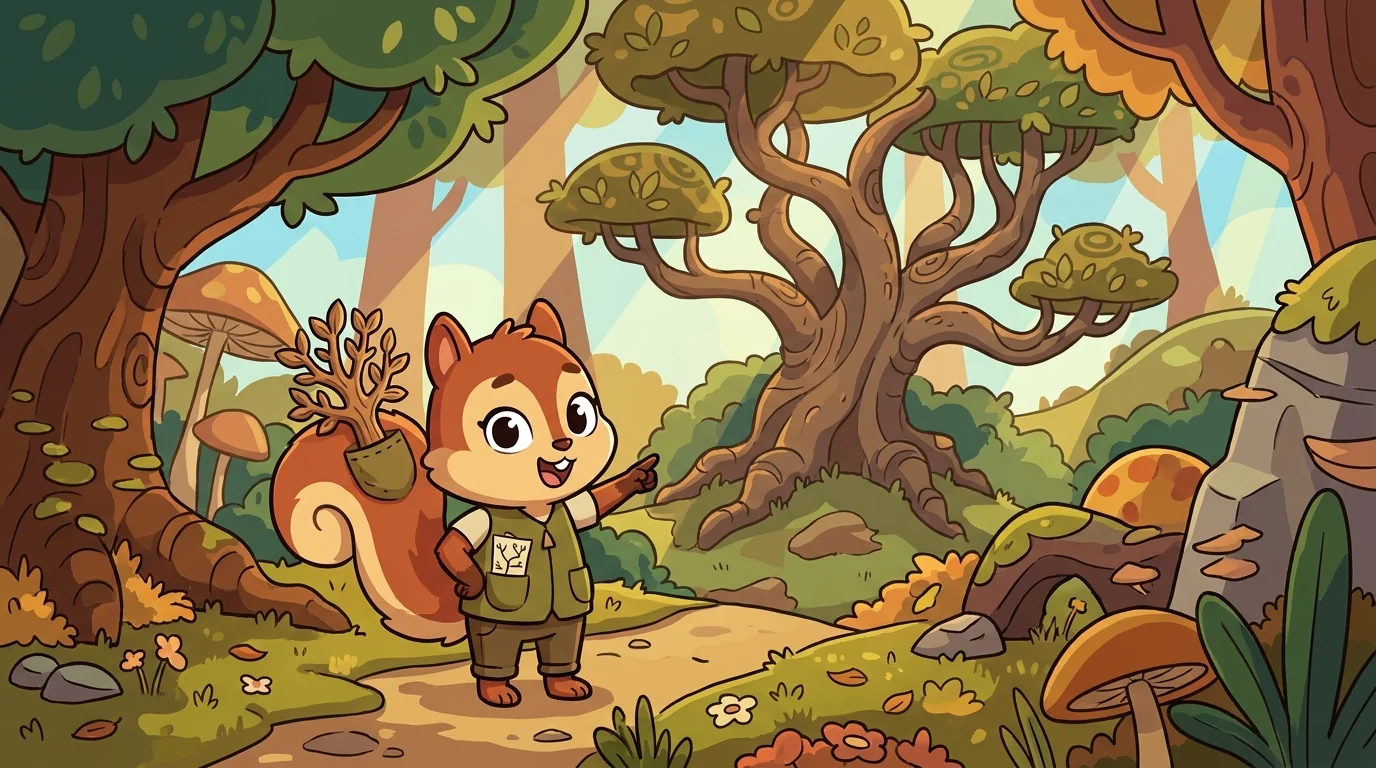
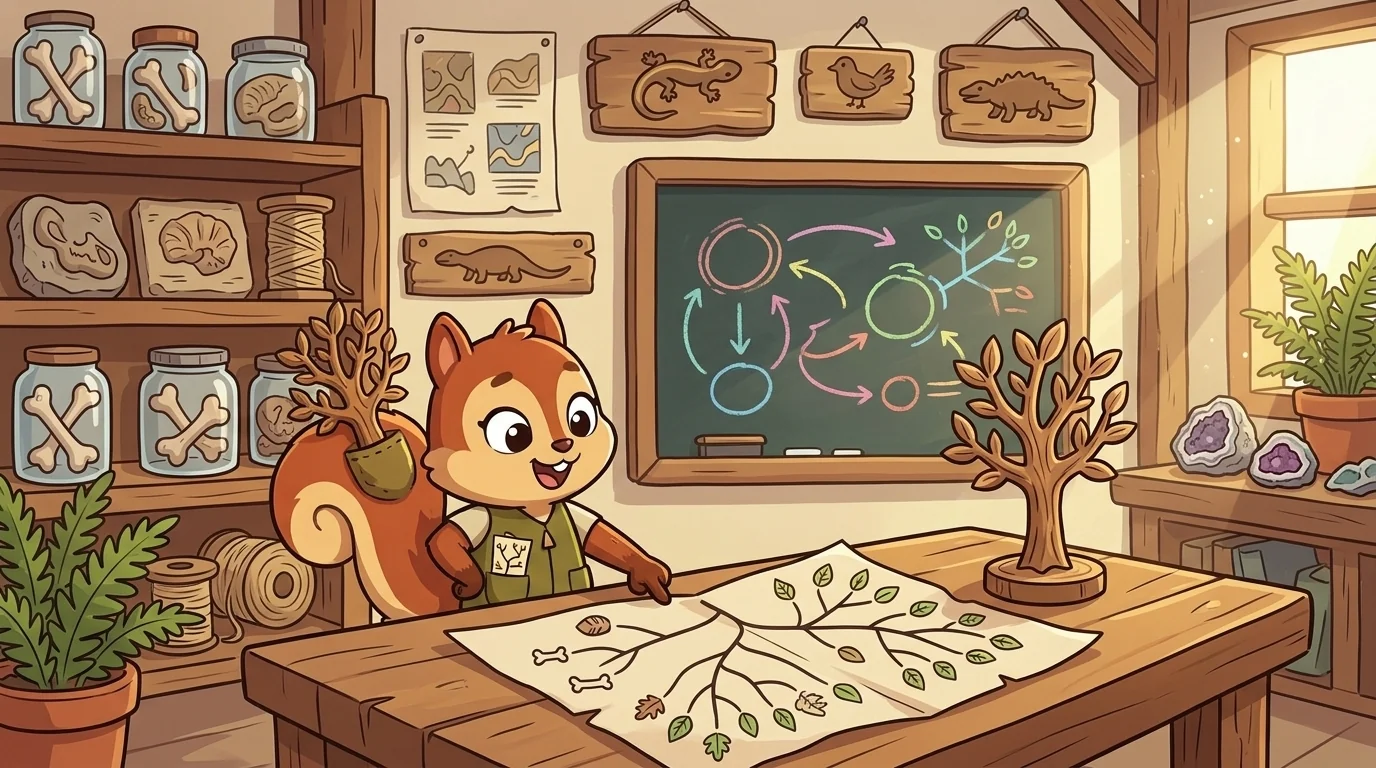
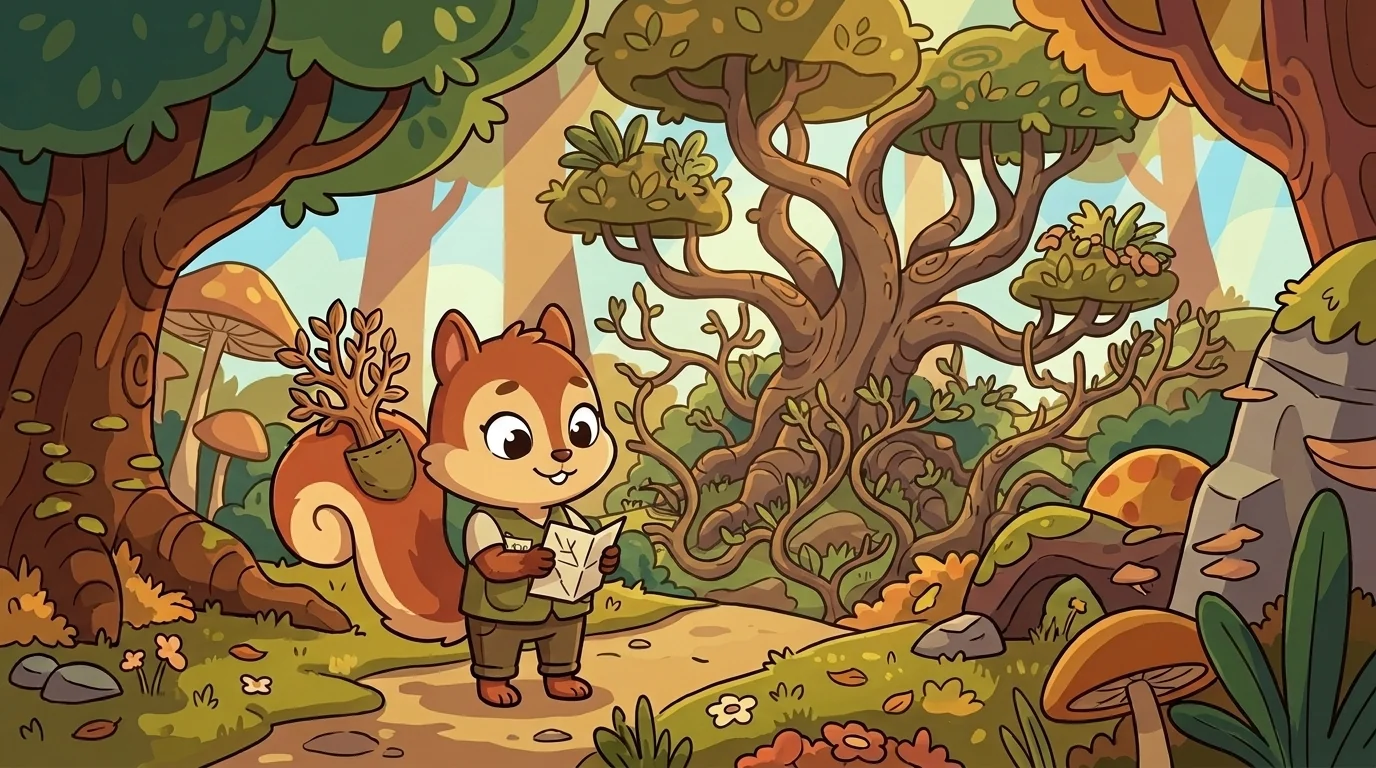
Branch hummed a quiet tune, her tail twitching as she arranged her workbench. Sunlight streamed through the high window of her FossilForge workshop, lighting dust motes dancing in the air. She smoothed a sheet of thick paper across the worn wood. It was her favorite tool: a hand-drawn cladogram, folded neatly into her side-pocket moments before.
Her fingers, quick and nimble, traced the lines on the diagram. Each line was a story, a path through time. Next to it, she placed a small, hand-carved wooden tree figurine. It wasn’t a grand oak, but a stylized bush, all tangled branches and leaves. No single trunk stood out. No leaf reached higher than the others.
"Alright, everyone," Branch chirped, her bright eyes scanning the faces of the new students gathered around. "Welcome to the Evolutionary Change workshop. I'm Branch." She tapped the cladogram. "And this is where we learn to read the tree."
A young badger, Barnaby, piped up, "Is it like a family tree?"
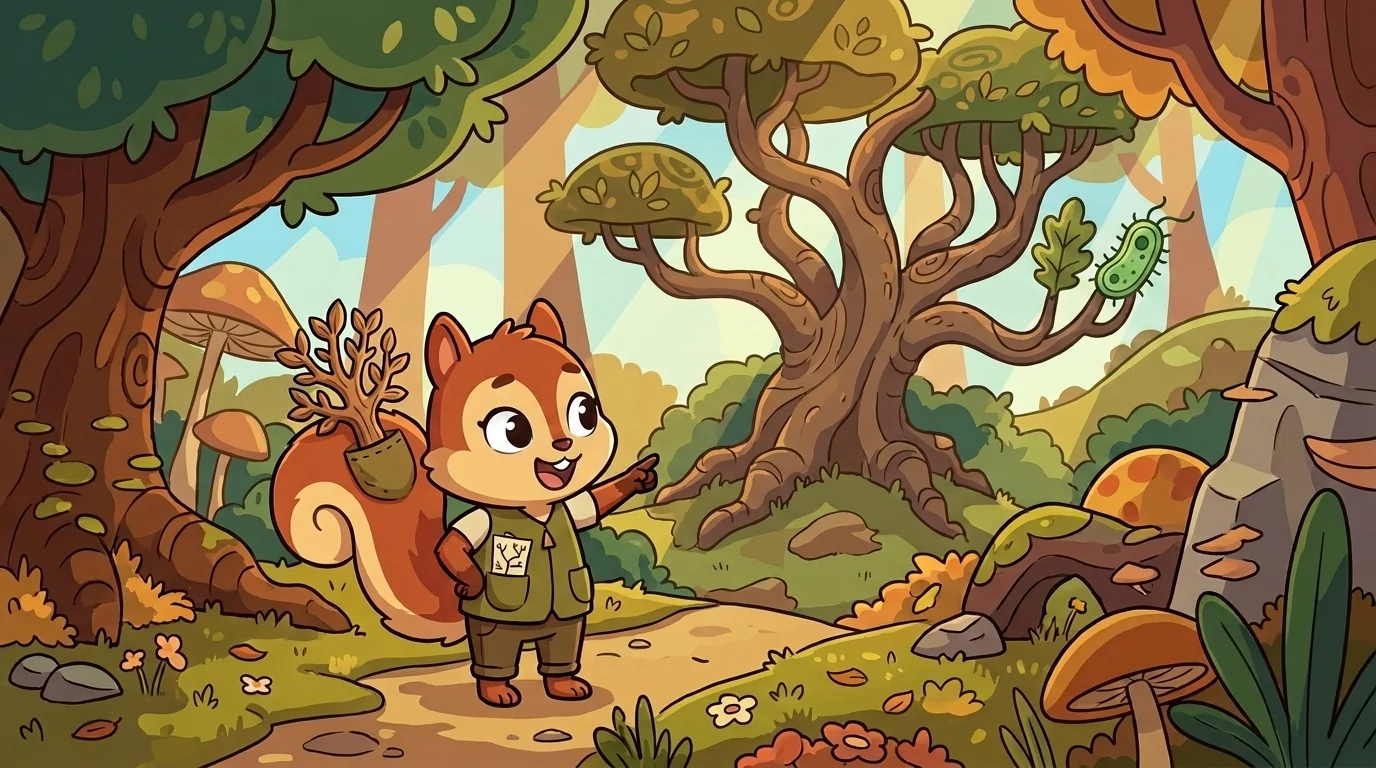
Branch smiled. "A little. But much, much bigger. And with a very important difference." She pointed to a tiny leaf-tip on the wooden figurine. "See this leaf? It's alive right now. Just like you, just like me. It's a modern species." She pointed to another leaf, far across the bush. "And this one? Also alive right now. A modern species too."
"So, like, one's at the top and one's at the bottom?" Barnaby asked, tilting his head.
Branch shook her head gently. "Ah, the ladder trap! That's the first thing we unlearn here. There's no 'top' leaf, Barnaby. No 'bottom' either. Every leaf on this tree, every branch-tip on this diagram, represents a species alive now. Or one that was alive, but isn't anymore."
She picked up the wooden tree. "Think of a real orchard. My family, we were orchard-keepers. We grew apples, pears, plums. Every branch on every tree was important. No branch was 'better' than another, just different. Each one reaching for its own bit of sun." She held the figurine out. "See? This is a bush, not a ladder. All the leaves are now-living. The branches are old questions about how they got here. The trunk, way down here," she tapped the base, "that's the common ancestor."
"So, like, a squirrel isn't 'more evolved' than a bacterium?" asked a small fox, Fina, looking thoughtful.
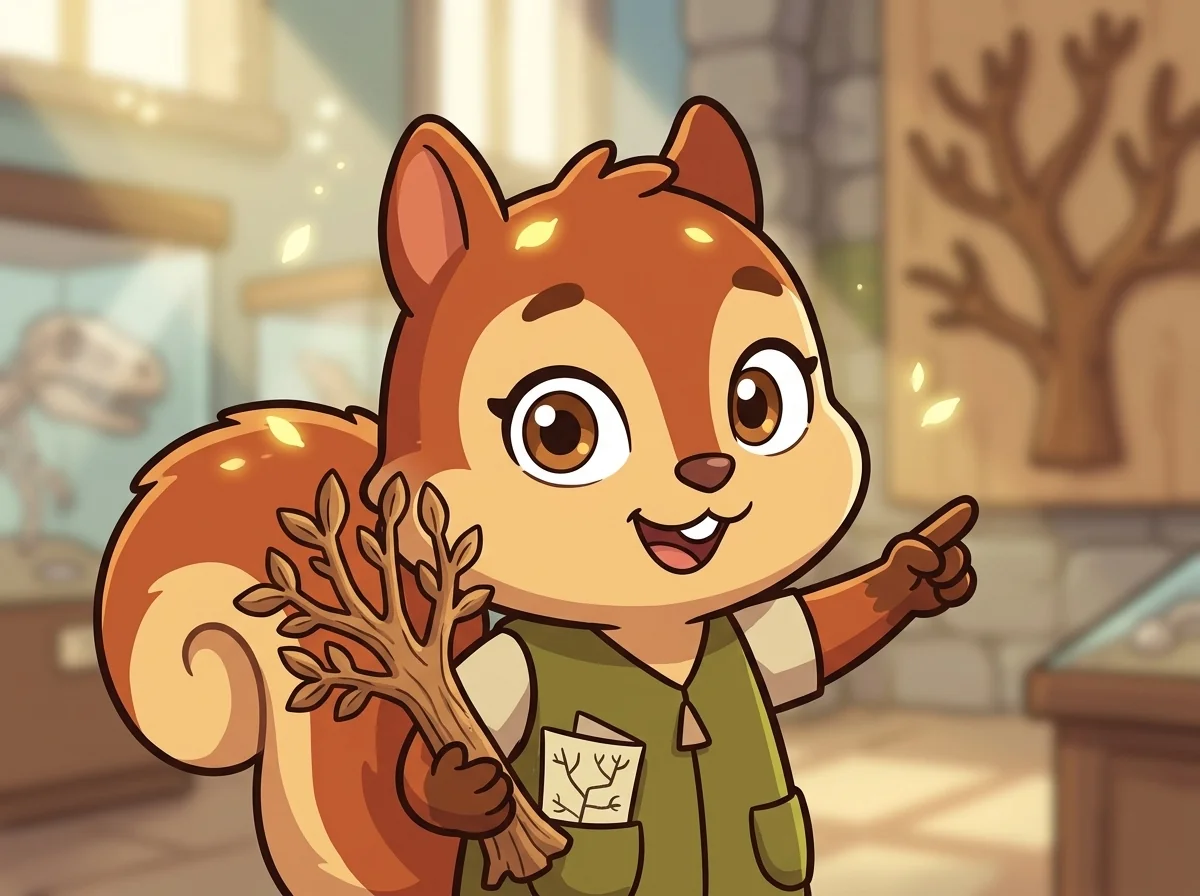
"Exactly!" Branch beamed. "A modern bacterium is a branch-tip, just like you are a branch-tip. Both have been evolving for billions of years. Neither is 'higher' or 'more advanced.' They're just different paths from a very, very old common ancestor." She paused, letting that sink in. It was a big idea, often tricky for new students to grasp.
"My job is to teach you *evolutionary change," Branch explained, her voice clear. "The move is branching-not-laddering*. We're learning to see the world as a tangled, vibrant bush, not a set of stairs."
She unfolded the large cladogram completely, smoothing out the creases. "Okay, let's look at how we read these. We call them cladograms. They show us how different organisms are related, and how they diverged from common ancestors."
"First rule," she said, tapping a section of the diagram. "Always look at the leaves first. The leaves are the now-living species. Start with what's alive today. What do you see?"
Barnaby pointed. "Lots of different animals! And plants too."
"Good," Branch affirmed. "Now, trace the branches backward. Each leaf connects to a branch. Each branch traces back to a junction. See these points where lines split?" She pointed to a Y-shape. "Each junction is a common ancestor with another branch. It's where two lines of life went their separate ways."
Fina leaned closer. "So, what happened at the split?"
"Excellent question, Fina! That's the third rule: read the junctions as questions. At each junction, we ask: What change happened here? What new trait first appeared? When did these two branches diverge, or split apart?" Branch paused. "For example, here," she traced a line, "we might ask when did the first backbone appear? Or when did feathers evolve?"
"And that ladder thing?" Barnaby asked, remembering.
"Ah, yes. The fourth rule: resist the ladder," Branch said, her tone firm but kind. "If you ever find yourself thinking, 'This organism is more advanced,' or 'This one came from that one,' pause. The cladogram has no top. It just shows relationships. An organism is a different branch-tip, not a higher rung on a ladder."
She drew a quick sketch on a small slate. "Someone might say, 'Reptiles evolved into mammals.' But that's not quite right. If we check our cladogram, we'd see that reptiles and mammals share a common ancestor, a very old one called a synapsid. The mammal-lineage and the modern-reptile-lineage diverged from that common ancestor. Neither came from the other."
"So they're like cousins?" Fina offered.
"Exactly! Distant cousins," Branch agreed. "And speaking of cousins, sometimes a branch-tip is extinct. That's our fifth rule: hold extinct-vs-living separately. Some branch-tips are extinct now. Others are still living. Extinct doesn't mean 'failed.' It just means that particular lineage ended at some point." She pointed to a faded branch on the cladogram. "Like these dinosaurs here. Their lineage ended. But others, like birds, kept going."
"And the last one, it's a bit tricky," Branch warned. "But it's important. Every branch-tip has been evolving for the same total time." She saw their puzzled faces. "Think about it. A bacterium living today, and you, a squirrel living today. Both have been evolving for roughly three and a half billion years since the very first common ancestor on Earth. The bacterium isn't 'older' or 'newer' than you. It's just taken a different path, for the same amount of time."
Branch looked around at her students. "Sometimes," she admitted softly, "I still catch myself using ladder-language. It's so ingrained in how people talk. But that's not a failure. The skill is catching it, noticing, and then switching back to the branching way of thinking."
"Is it hard to learn?" Barnaby asked, looking at the complex diagram.
Branch smiled, gathering the cladogram to refold it. "It's not hard. It's just reading the tree as a bush. Branching, not laddering. Every leaf is a now-living species. No top. No bottom."
She tucked the cladogram back into her side-pocket. The wooden tree figurine waited patiently in her tail-pouch. The next branch, the next question, waited to be traced.
The FossilForge ensemble
Branch is part of FossilForge's distributed-narrative cast. Each character embodies a different curricular primitive; together they teach the full subject.
-

Seam
Taxonomic + fossil-type classification — family-resemblance-matching (what KIND of organism?)
-
Span
Deep-time + geological chronology — scale-of-scales (WHEN did this organism live?)
-
Field
Paleoenvironment + ecosystem reconstruction — fossils-as-a-place-story
-

Last
Mass extinctions + extinction-event reasoning — witness-and-choose (cross-app cameo with EcoSphere Brink)