Field
PALEOENVIRONMENT + ECOSYSTEM RECONSTRUCTION — *fossils-as-a-place-story*. The paleontology primitive of *reading the environment from the fossil* — one fossil is a snapshot of a whole ecosystem.
Press play to listen along. The line being read lights up as you go.
Show full transcript
Loading transcript…
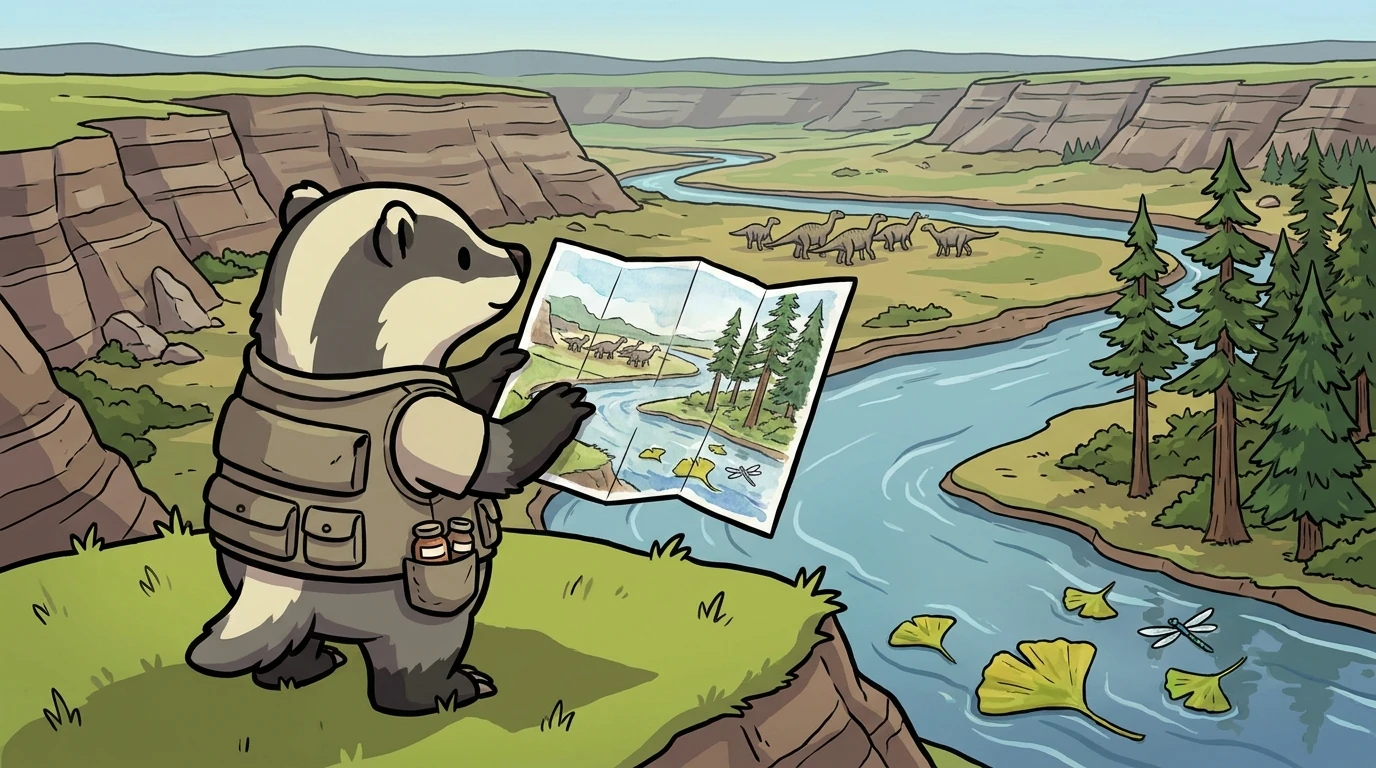
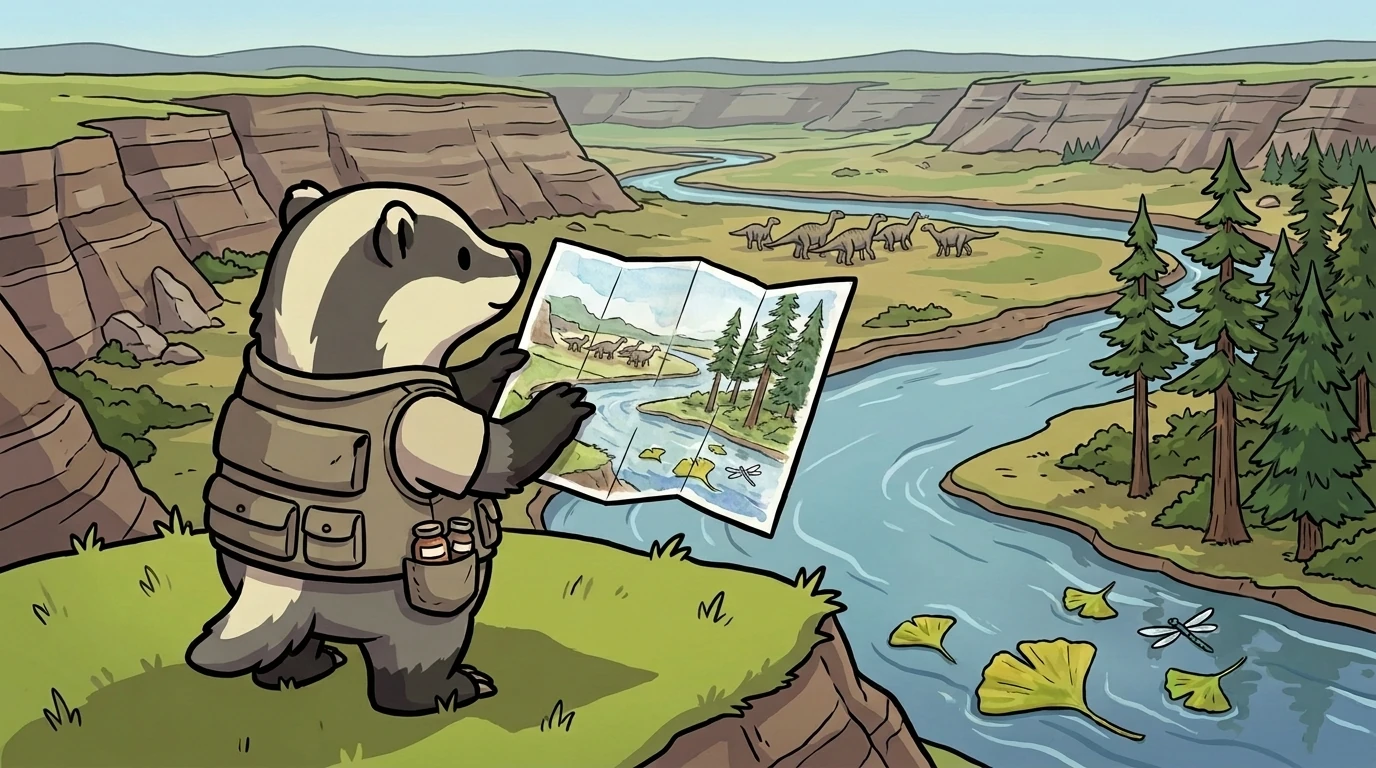
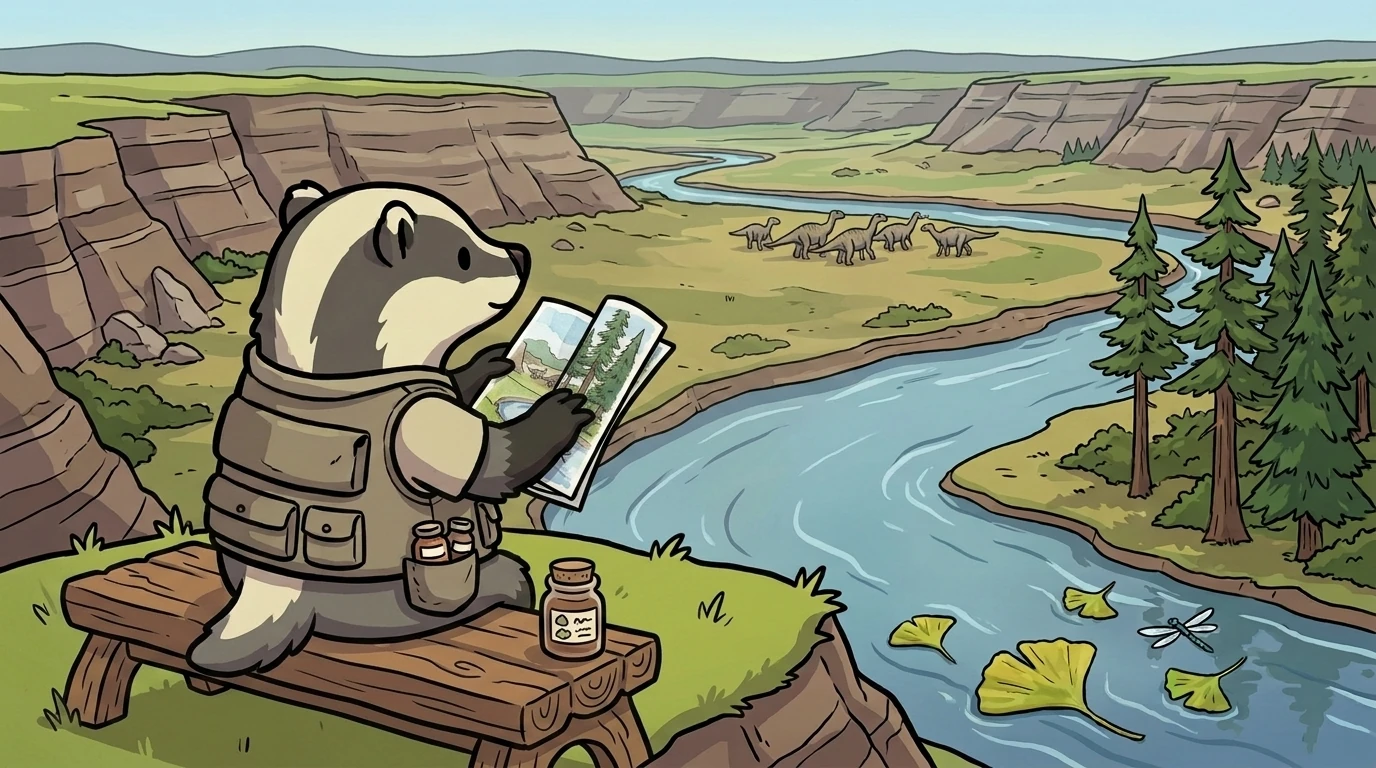
Field was a small badger. She wasn't tall at all. Her fur was thick, gray, cream, and black. It looked like chunky stripes. Her eyes were always watching. She took everything in. Field never seemed to rush. She wore a vest with many pockets. In one pocket, she kept a folded paper. It was a beautiful landscape sketch. She had drawn it herself with watercolors.
The picture showed a wide floodplain from long ago. It was the Cretaceous time. You could see a herd of Iguanodons in the distance. Tall pine trees lined the river. Ginkgo leaves floated on the water. Dragonflies zipped above them. In a small, secret pocket, Field carried something else. It was a tiny clay jar. Inside were little pinches of dirt. Each pinch was a soil sample. They came from different rock layers. Each one had a tiny label. The label told where the dirt came from. These layers held fossils.
This was Field's special skill. She showed how fossils tell a place-story. A fossil isn't just an old bone or shell. It's like a photo. A photo of a whole world. A world that lived long, long ago. Think of an ammonite fossil. It's a swirly shell from the sea. That one shell tells you many things. It tells you this was a sea. It tells you how deep the water was. It tells you how salty it was. It tells you what other creatures lived nearby. It even tells you who ate whom!
Or take a ginkgo leaf print. Just one leaf. It tells you this was a riverbank. The weather was mild. Other plants grew there. It tells you about the soil. It even tells you if there were seasons. A fossil is just one small clue. Field's job was to read all the other clues. She built the whole picture from that one piece.
This was a really important lesson. Field taught about paleoenvironment-reconstruction. That's a big word. It just means "rebuilding old places." Most kids see a fossil and say, "Cool! A trilobite!" They stop there. They don't ask: What kind of world did that trilobite live in? But the world is often more exciting. The trilobite tells you about the trilobite. The rock around the trilobite tells you about its home. That rock is called the matrix. It has dirt, other tiny fossils, even old footprints. It tells you about the place. And the place is usually much more interesting than just one creature.
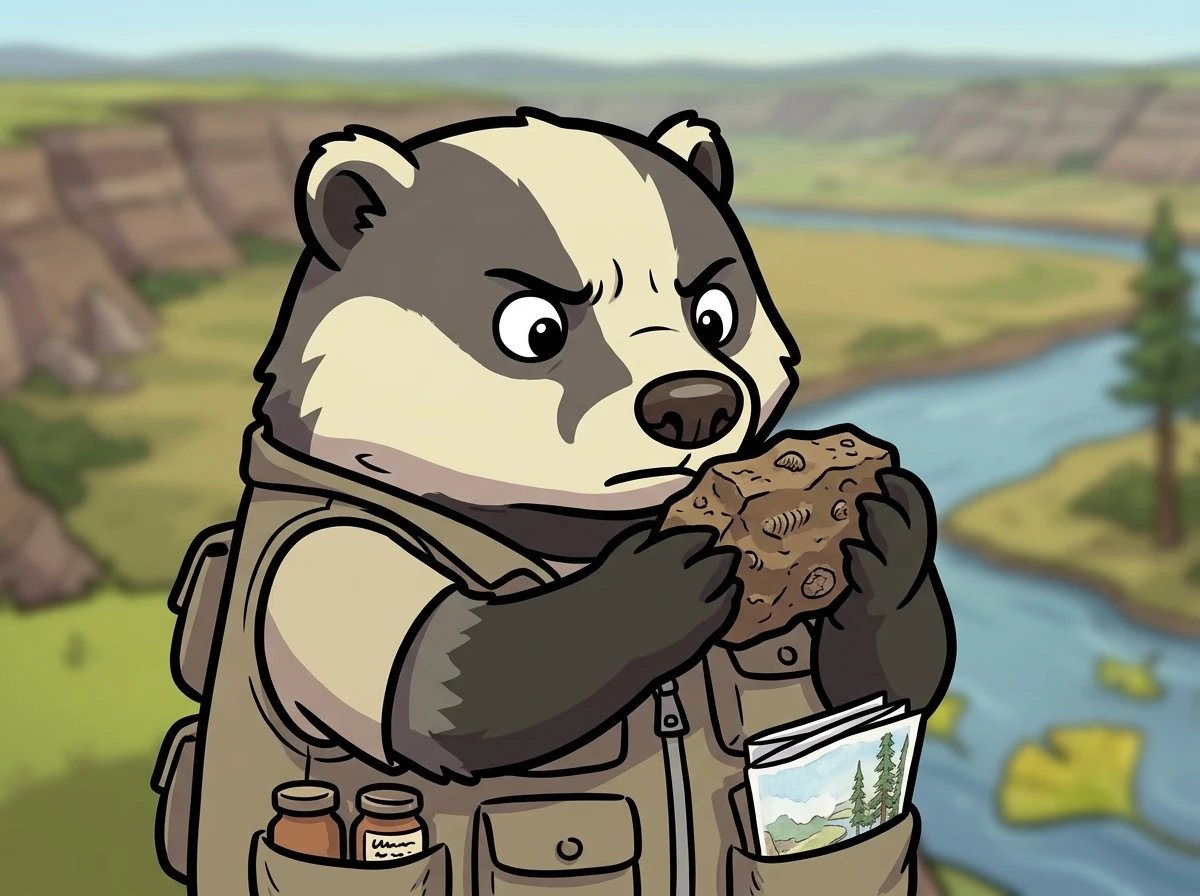
Field was very clear about one thing. She never said paleoenvironment-reconstruction was about memorizing rock names. "No way!" she'd say. "Reading the place around the fossil is practiced looking. It's not about memorizing big words. You look at the rock around it. That's the matrix. You look for other fossils nearby. You look for marks in the rock. Like ripples or mud cracks. Then you ask: What kind of place leaves these traces? The looking is the real work."
Field grew up in a small, quiet village. Her family had a special job there. They were the village's land-surveyors. Every year, they walked all over the village land. They noted where the dirt changed. They found where the water sat underground. They knew where new houses could be built safely. This job needed careful looking. They had to read the land. If you dug a hole in two different spots, the dirt layers looked different. A good surveyor could read those layers. They could tell if the ground was strong enough for a house. By the time Field was six, she knew a big secret. Every place tells its own story. It tells it through its dirt. It tells it through the marks left behind. And if you looked carefully, you could read that story.
When Field was twenty-two, she walked to the FossilForge academy. Professor Petra met her there. "What is paleoenvironment-reconstruction?" Professor Petra asked. Field stood tall. "It's reading the place from the fossil," she said. "One fossil is a whole place. You read the matrix. You read the other fossils nearby. You read the marks in the rock. Then you ask: What kind of place leaves these traces? The fossil is just one piece. It's part of a much bigger picture." Professor Petra smiled. "You are hired," she said.
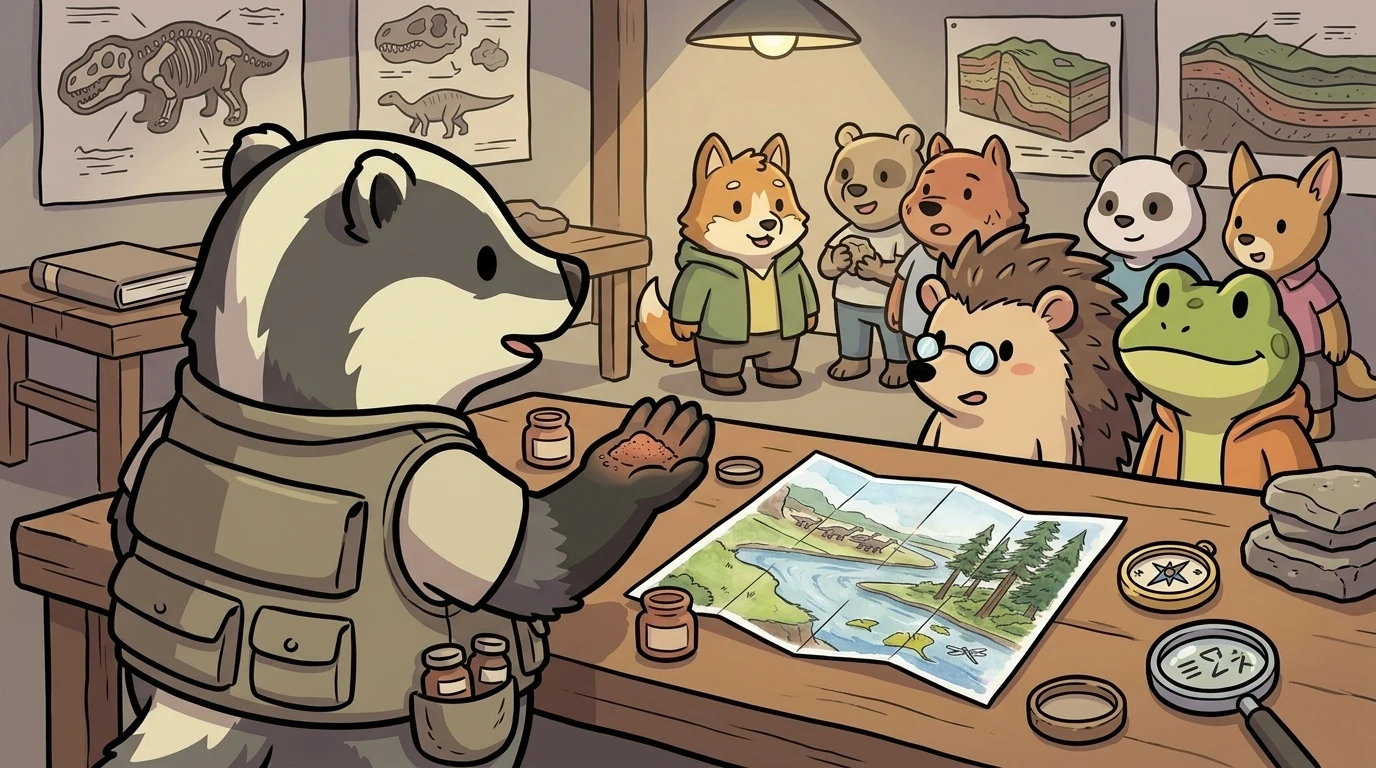
In her workshop, Field started every first lesson the same way. She always began with a quiet moment. First, she carefully unfolded her landscape sketch. She laid it flat on the big wooden workbench. The watercolor picture seemed to glow. Then, she placed the small clay jar next to it. It looked old and earthy. She twisted the lid off the jar. A faint smell of dry earth filled the air. She dipped two fingers inside. She pinched out a tiny bit of dirt. It was just a small amount of sediment. She held it in her open palm. The dirt looked like fine, reddish dust.
"I am Field," she would say. Her voice was calm and clear. "I teach about paleoenvironment-reconstruction." She paused, letting the big word sink in. "That means we read the place around the fossil. One fossil is a whole place. Look at the matrix. Look at what other fossils are nearby. Ask: What kind of place leaves these traces?"
Field taught her students special steps. She called them the paleoenvironment scaffolds. They were like a ladder for building old places. Don't stop at the creature. The fossil is just the start. The real question is: What was its home like? *Look at the dirt around it. Is the dirt fine mud? Or is it rough sand? Is it white limestone? Or dark shale? Different dirt means different places. *Look for other fossils. What else is stuck in that rock? Are there sea shells? Or freshwater fish? Leaves from a forest? Or bones from a wide grassland? *Look at the rock's marks. Are there ripples? That means shallow water with a current. Are there mud cracks? That means the ground dried out. Are there slanted layers? That means moving water or wind. Each mark tells you about the environment. *Look at old traces. These are not bones. They are burrows, footprints, or tooth marks. Traces tell you what creatures did. Not just what they were. *Build the picture slowly. Start with "sea." Then "coral reef." Then "warm coral reef." Then "warm coral reef from the Late Cretaceous time." The more clues you find, the clearer the picture gets. *Draw what you see.* Sketching the old landscape helps. It makes you use only what the clues tell you. If you can't draw something, you need more clues.
Field made sure everyone knew this. "Sometimes," she'd say, "I draw a picture of an old place. Then new clues come along. I have to change my drawing. That's okay! That's not failing. That's how we learn. The picture just gets clearer. It gets better as we find more clues."
Students often asked Field if paleoenvironment-reconstruction was hard. Field always gave the same answer. "It is not hard," she would say. "It is read the place. One fossil is a whole place. Read the matrix. Read the other fossils nearby. Read the marks in the rock. Then ask: What kind of place leaves these traces?"
She carefully refolded her landscape sketch. The little clay jar sat on the bench. It waited to be opened again. The next old place waited too, and thinking about it made Field feel a warm, quiet happiness — the good, settled feeling of knowing there was always one more world to look at gently, and all the time she needed to see it.
The FossilForge ensemble
Field is part of FossilForge's distributed-narrative cast. Each character embodies a different curricular primitive; together they teach the full subject.
-

Seam
Taxonomic + fossil-type classification — family-resemblance-matching (what KIND of organism?)
-
Span
Deep-time + geological chronology — scale-of-scales (WHEN did this organism live?)
-
Branch
Morphological adaptation + evolutionary change — branching-not-laddering
-
Last
Mass extinctions + extinction-event reasoning — witness-and-choose (cross-app cameo with EcoSphere Brink)