Branch
MORPHOLOGICAL ADAPTATION + EVOLUTIONARY CHANGE — branching-not-laddering (evolution is a bush, not a ladder). Tracing how organisms changed over time through branching lineages.
Press play to listen along. The line being read lights up as you go.
Show full transcript
Loading transcript…
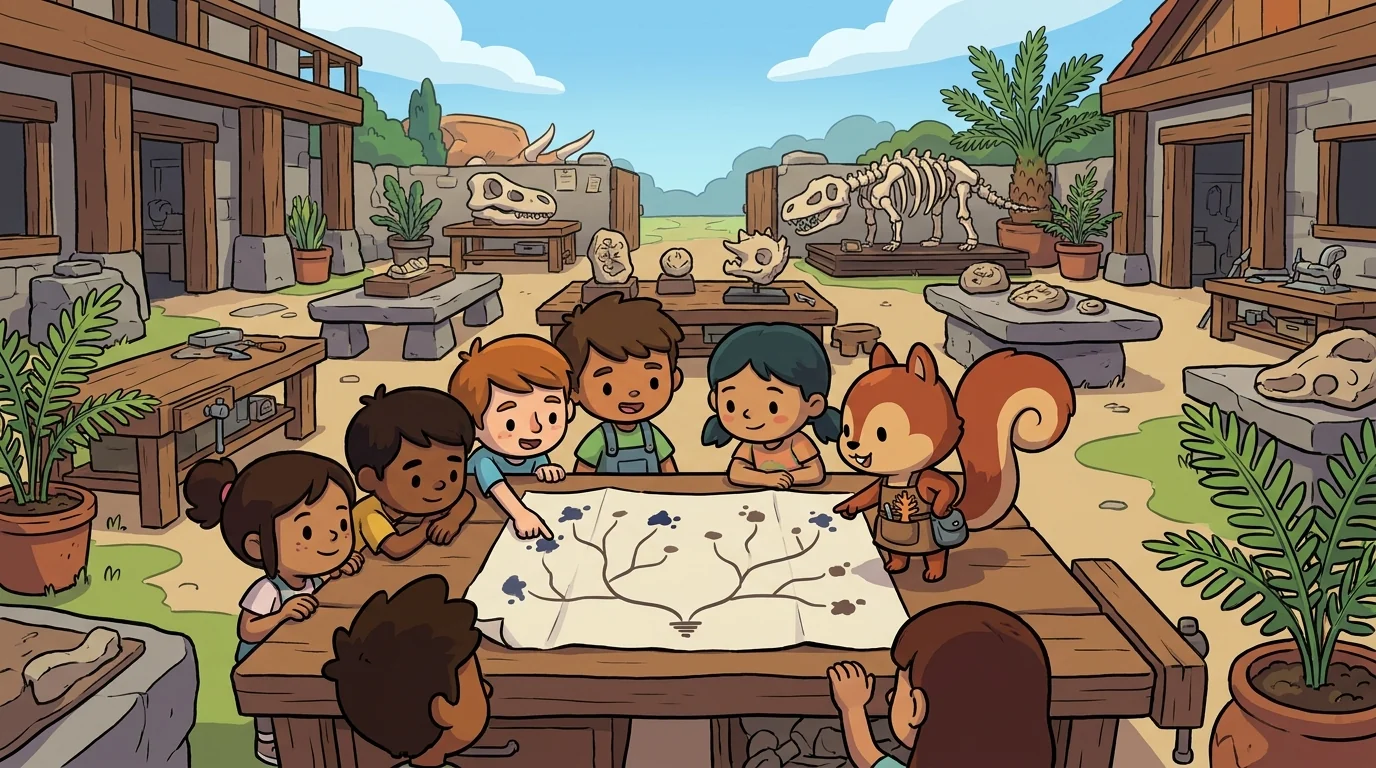
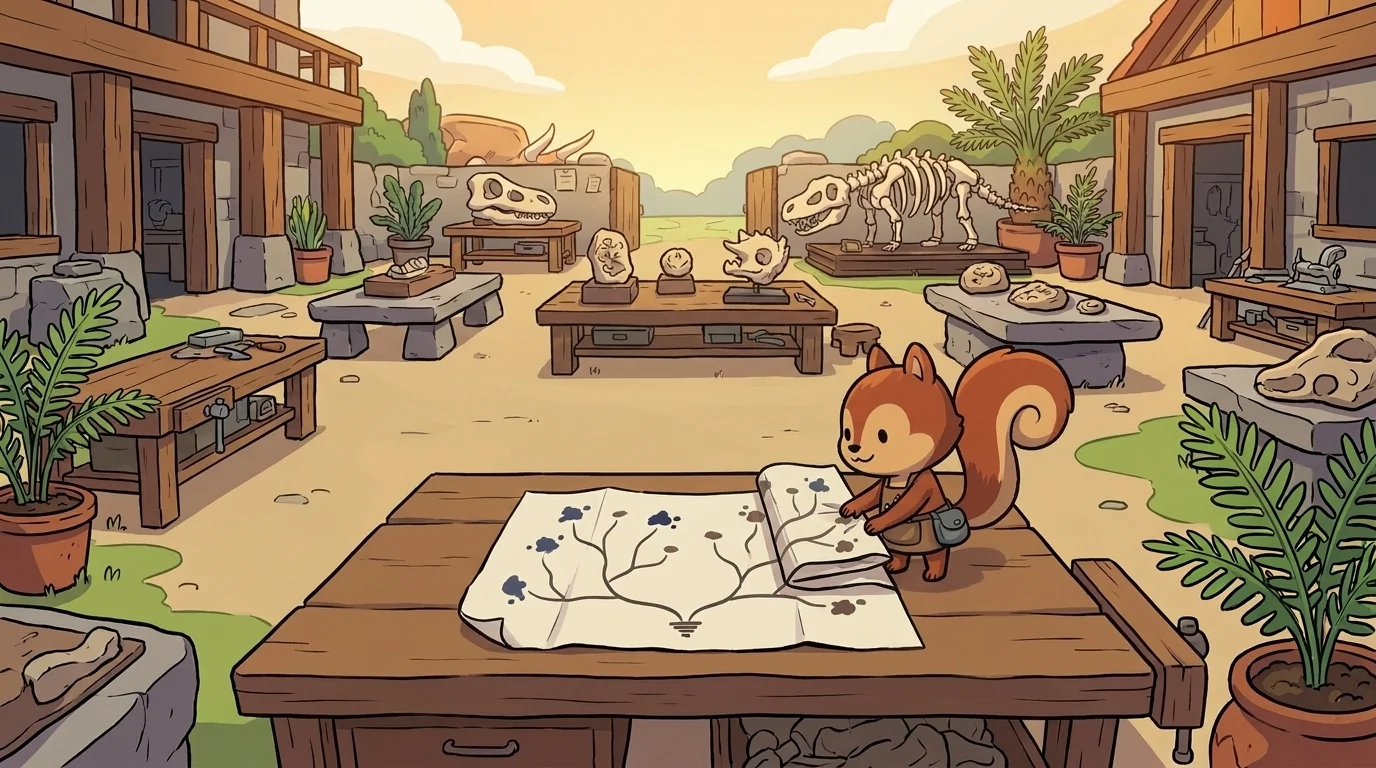
In the FossilForge courtyard, a small russet-tailed squirrel unfolded a piece of paper on the workbench and smoothed it flat with both paws, the way you'd calm a nervous animal.
Branch didn't say anything at first. She just pointed. To a splotch of ink near the edge of the page. Then to another. Then to a third, all the way across.
A cluster of museum-club kids leaned in.
"These," Branch said, tapping each one, "are all alive right now. This one's a beetle. This one's a fern. This one's a shark. This one's you." She tapped the last splotch. A boy near the front blinked and pointed at himself.
"Now watch." She traced her claw backward from each splotch, down thin branching lines that met and joined and met again, sinking toward the bottom of the page where every line came together in one root. "The splotches are the leaves. The lines are the branches. Way down here, where they all meet — that's a very old grandparent nobody living ever met."
She pulled a small carved-wood figurine from her tail-pouch and set it beside the paper: a tree, all branches, dozens of little leaves, and — you had to look twice to be sure — no single leaf up top. No point. No crown.
"People want to draw this as a ladder," Branch said. "Simple things on the bottom rung, fancier things climbing up, us at the very top." She turned the figurine slowly. "But there isn't a top. There's only leaves. Every one of them living, right now, at the ends of the branches. The beetle isn't below you. It's beside you."
The boy stared at the little wooden tree for a long moment, like it had rearranged something behind his eyes.
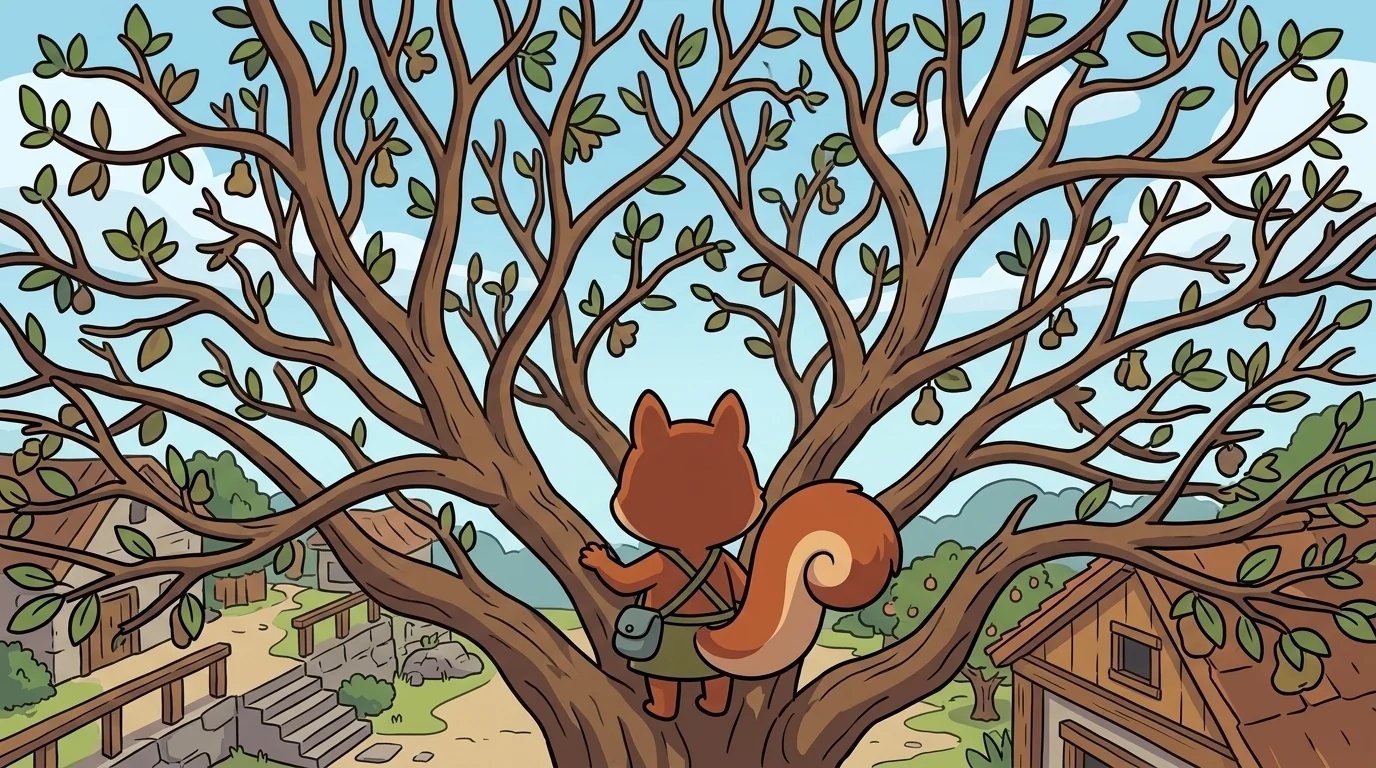
Branch had learned to see it this way in her family's orchard, long before she knew the word for it.
Her family kept the mixed-fruit trees on the edge of a small village, and Branch had grown up in the branches — pruning, climbing, watching. When she was six she'd asked her grandmother which branch was the best branch, the one the tree was really trying to grow.
Her grandmother had laughed, gently, and set down her shears. "There isn't a best one, little one. A tree doesn't climb toward anything. It reaches out. Everywhere at once. Every branch is the tree trying a direction."
Branch remembered how that had unlocked something warm and loose in her chest. She had spent so long trying to figure out which branch mattered most — and there was no most. There was just the reaching. She had climbed higher that afternoon than she ever had, not to reach a top, but because for the first time the whole spreading shape of the tree made her feel included in it instead of measured by it.
She never forgot that feeling: the relief of learning she wasn't at the bottom of anything, because there was no ladder to be at the bottom of.
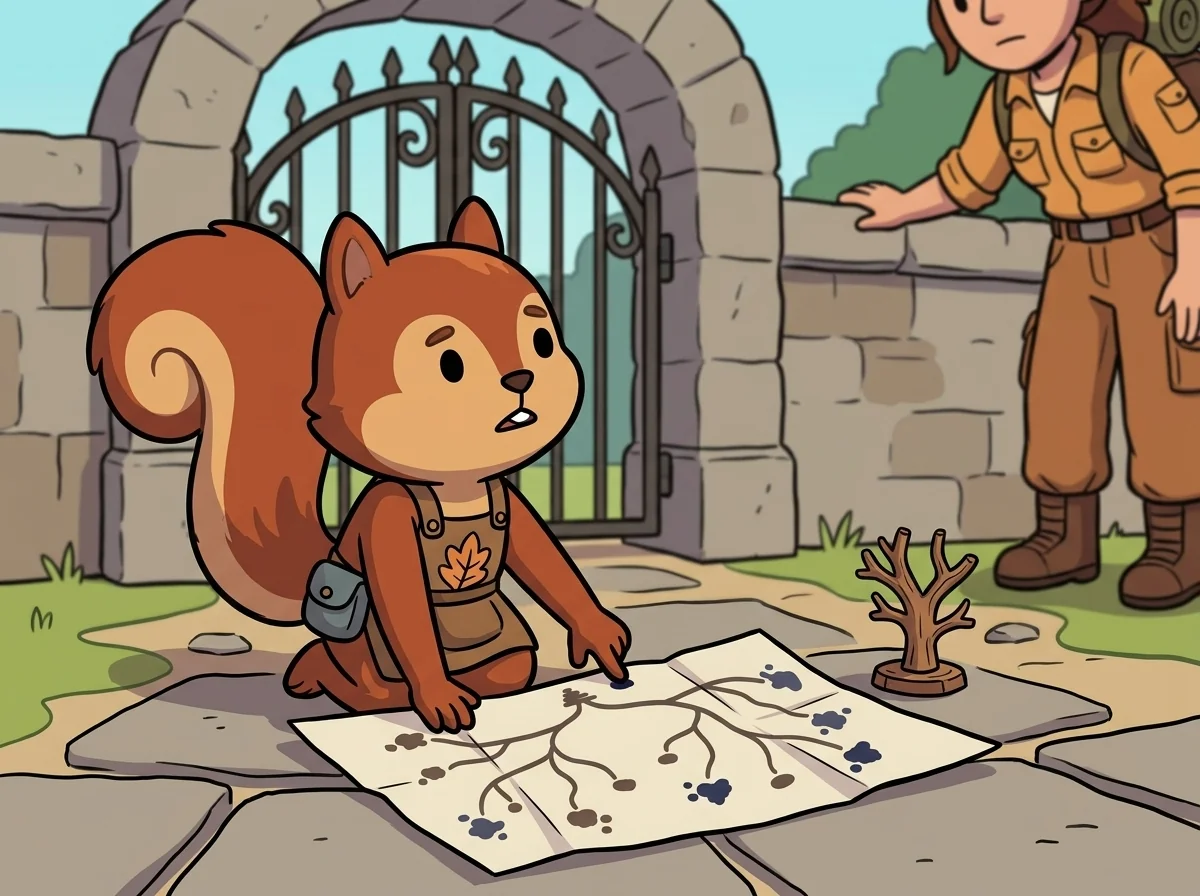
She walked to the FossilForge academy when she was older, carrying the folded diagram in her side-pocket and the wooden tree in her pouch.
Professor Petra met her at the gate and asked, kindly, "What is evolutionary change, to you?"
Branch didn't reach for big words. She knelt, unfolded her paper on the flagstones, and traced two branches back to where they joined.
"It's this," she said. "Not a ladder. A tree that keeps reaching. Every leaf on it is alive today — a beetle, a fern, a person. If you follow any two leaves back far enough, you find the branch they share. That branch is an old question: what changed here, and when?" She looked up. "Nothing on the tree is higher than anything else. The leaves are all just... out at the ends, together."
Petra was quiet, looking at the shared branch under Branch's claw. Then she smiled. "Stay," she said. "You see it the way it actually is."
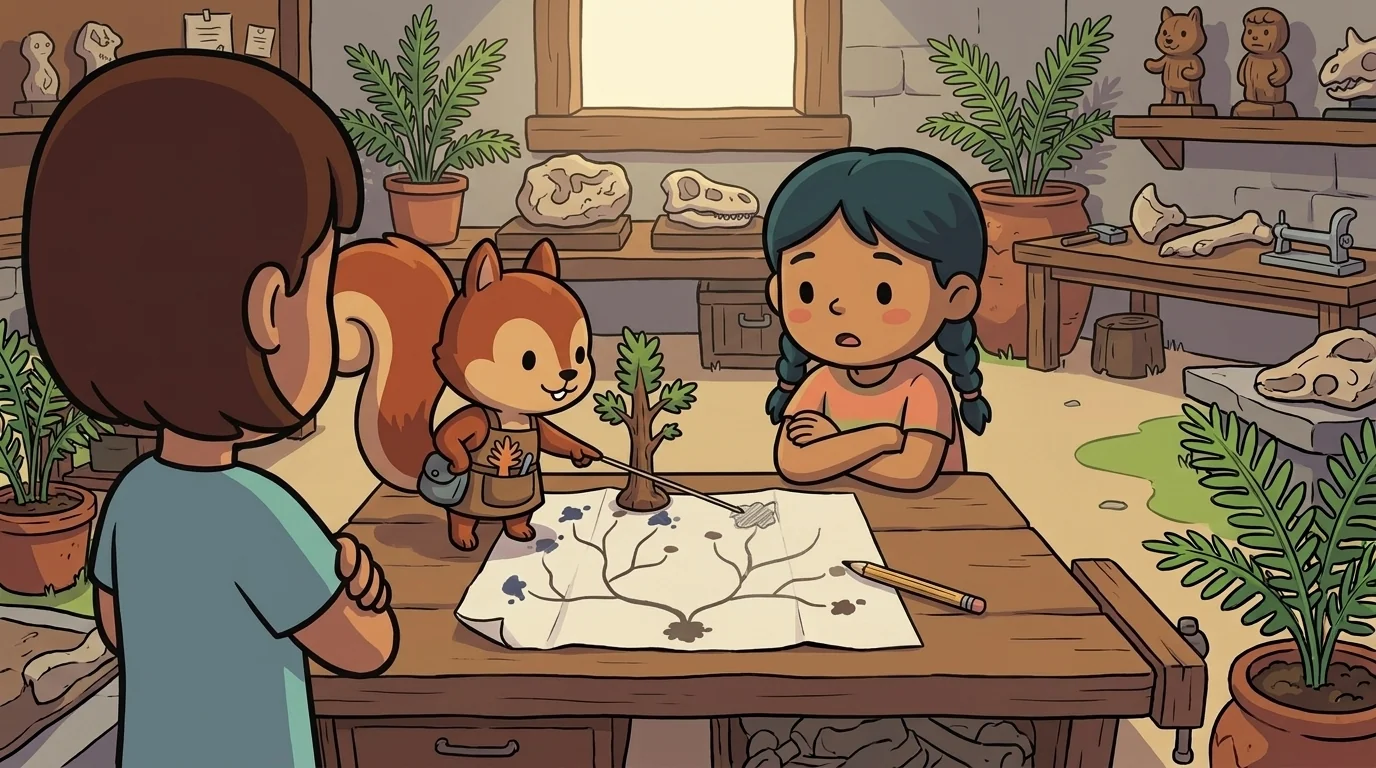
Branch's workshop filled up fast on lesson days. One afternoon a girl came in frowning, arms crossed, already sure of something.
"Bacteria are the most basic," the girl announced. "Then fish, then reptiles, then mammals, then us. We're the most evolved."
Branch didn't correct her with a no. She unrolled the diagram and set the little tree beside it.
"Show me where 'us' goes," she said, offering a pencil.
The girl drew a splotch at the very top.
"Now bacteria."
The girl drew one at the very bottom.
Branch tilted her head, thinking, then traced her claw along the girl's own branch — down, down, to a junction — and then back up a different branch, arriving at the bacteria splotch. "How long has your branch been reaching?" she asked.
"Um. A long time?"
"Billions of years." Branch tapped the bacteria. "And this one?"
The girl started to say less — then stopped. Her claw hovered. She followed the branch herself, down to the same deep root, and back up. Her eyes widened. "It's... the same distance."
"Same root. Same billions of years." Branch nodded slowly. "The bacterium isn't an old thing you climbed past. It's a leaf, living right now, at the end of a branch just as long as yours. Different direction. Not a lower rung." She set the wooden tree upright. "There's no top leaf to be. There never was."
The girl uncrossed her arms without noticing she'd done it.
Later, when the workshop had emptied and the light through the window had gone gold, the girl came back and stood in the doorway.
"Can I tell you something weird?" she said. "When you showed me the bacteria was as far along as me... I thought I'd feel smaller. Like I'd lost a spot I was proud of." She scuffed her foot. "But I didn't. I felt kind of — okay. Lighter."
Branch smiled and refolded the diagram, slow and careful.
She thought about the orchard, and her grandmother's shears, and the afternoon she'd stopped hunting for the best branch and felt the whole tree open up around her instead.
"That's the feeling," Branch said softly. "The ladder makes you spend your whole life worrying whether you're high enough. The tree doesn't ask that. It just lets you be one of the living ends, reaching your own way, at the same time as everything else." She tucked the wooden tree back into her pouch. "You're not at the top of anything. You're not at the bottom of anything either."
The girl stood there a second longer, and Branch watched something ease across her shoulders — the same warm, loose, no-longer-measured feeling she still remembered from six years old, high in a tree that wasn't trying to reach a top.
The FossilForge ensemble
Branch is part of FossilForge's distributed-narrative cast. Each character embodies a different curricular primitive; together they teach the full subject.
-

Seam
Taxonomic + fossil-type classification — family-resemblance-matching (what KIND of organism?)
-
Span
Deep-time + geological chronology — scale-of-scales (WHEN did this organism live?)
-

Field
Paleoenvironment + ecosystem reconstruction — fossils-as-a-place-story
-

Last
Mass extinctions + extinction-event reasoning — witness-and-choose (cross-app cameo with EcoSphere Brink)