Span
DEEP-TIME + GEOLOGICAL CHRONOLOGY — *scale-of-scales* (WHEN did this organism live?). The paleontology primitive of *holding the scale of Earth's history* — 4.5 billion years for the planet, 540 million for complex life, 66 million since dinosaurs.
Press play to listen along. The line being read lights up as you go.
Show full transcript
Loading transcript…
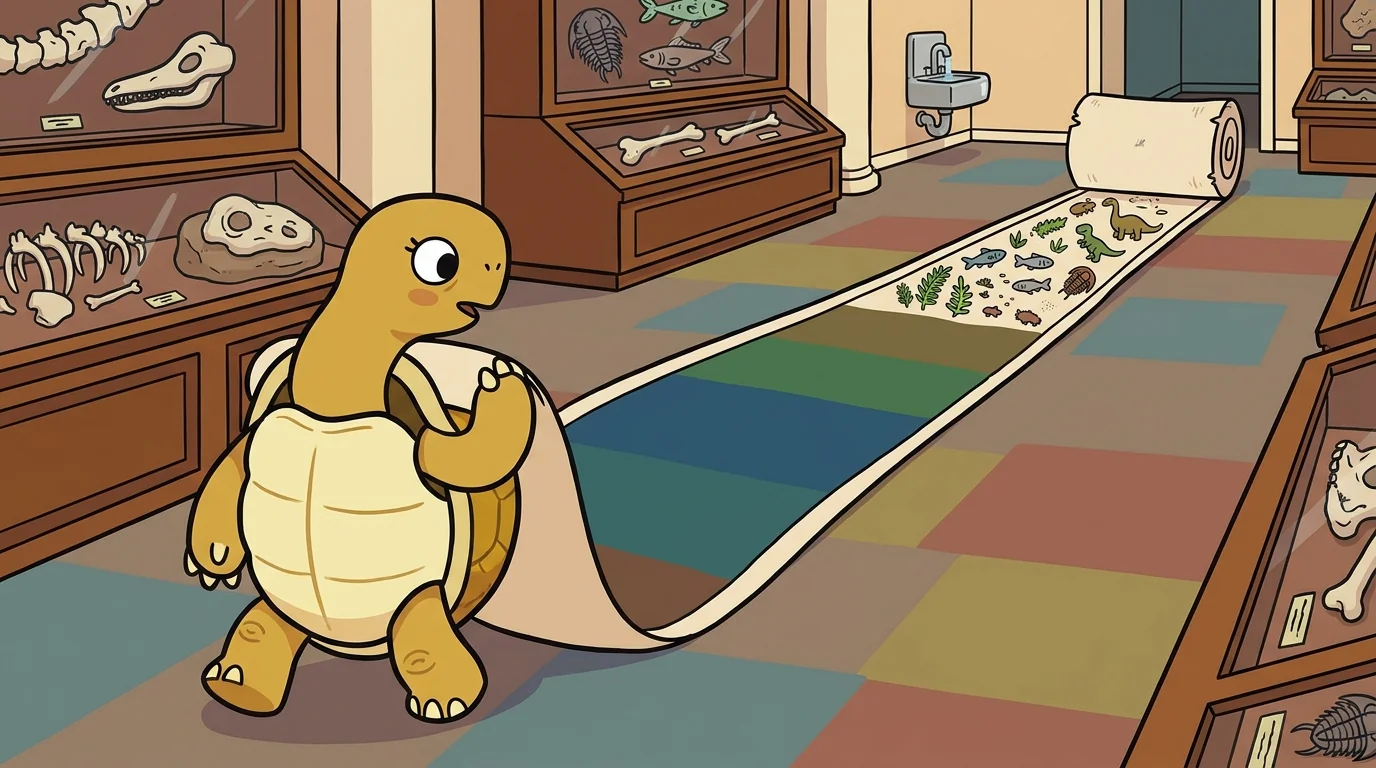
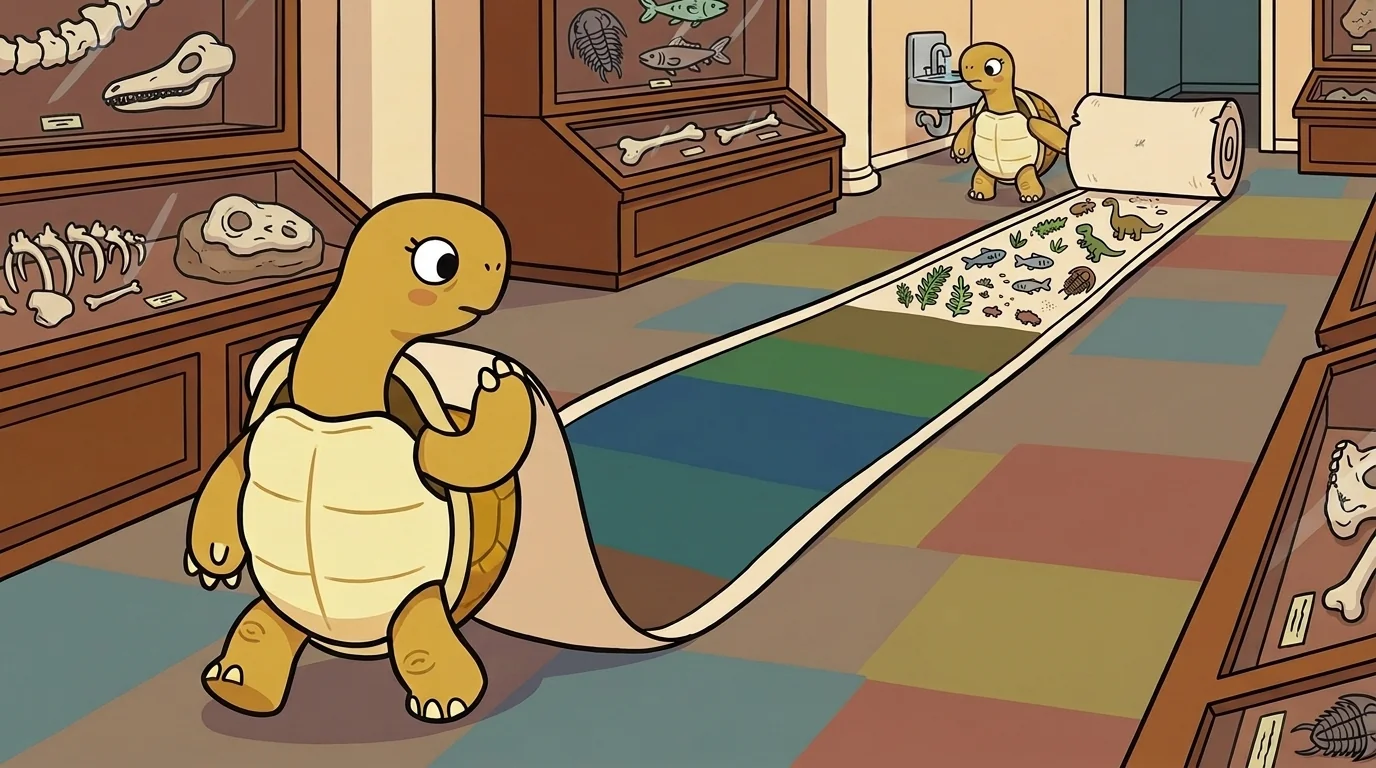
The scroll came off Span's shell in slow folds, and it kept unrolling. Span was a tortoise the size of a kid, gold and cream, patient-eyed, and she walked backward down the long museum table paying the scroll out hand over hand while it stretched past the fossil cases, past the water fountain, all the way to the far wall.
Most of its length was color with almost nothing drawn on it — vast, quiet, empty bands, one after another, the ages before there were bones to leave. Only at the very tail did the drawings crowd in: little ferns, little fish, a curl of trilobite, and near the end a great long stretch of dinosaurs. And then, right at the frayed right edge, so small she had to lean close to find it, sat a single fingernail-width mark. That mark was everything that had ever happened to people. Span stood at the far wall with the whole enormous ribbon of time stretched out between her and that tiny mark, and a warm, wide feeling opened in her chest — not fear, but the quiet marvel of standing next to something so much bigger than herself.
Span had been raised to hold long stretches of time in her head. Her family were almanac-keepers, back in her village — tortoises who wrote down the weather, the harvests, the floods, the good years and the lean ones, in ledgers that went back generations.
As a small tortoise she used to think a year was a long time. Then her grandfather sat her down with a stack of the old almanacs and had her lay them end to end across the floor and walk their length. "Now find the drought," he said. She couldn't, standing over any one page. But when she stepped back and took in the whole floor at once, there it was — a pattern of dry years that returned like a slow tide, visible only across lifetimes. She never forgot the feeling of stepping back until the pattern appeared. A short look showed only today. A long look showed the shape of everything.
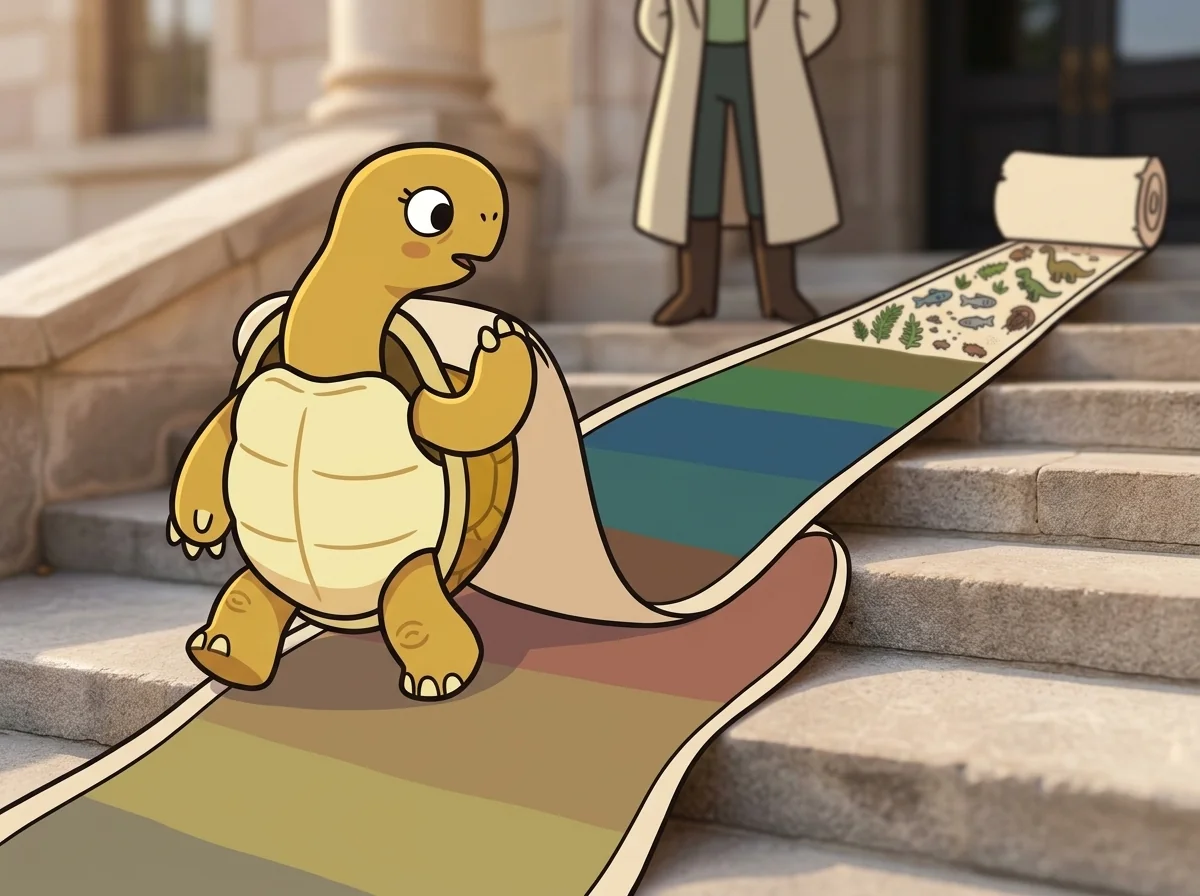
When she was grown she walked, slowly, up the hill to the FossilForge academy, and Professor Petra met her on the steps and asked her when the great creatures below in the museum had actually lived.
Span didn't answer with a number. She unslung her scroll and began to unroll it down the museum steps, backing away as it grew, letting Petra watch band after empty band go by before the first faint drawings even appeared.
"Here is when the planet formed," she said, tapping the far end, "and here — nearly all the way at the other end — is the first shell. The great reptiles ran along here for a stretch you'd get tired walking." She leaned down to the frayed edge. "And this little mark is us. All of it, this whole ribbon, came before anyone was here to see it. That isn't a sad thing. It's a wide, astonishing thing."
Petra looked down the long unrolled scroll and up at the patient tortoise holding its far end, and said, "Then walk them down it, the way you just walked me."
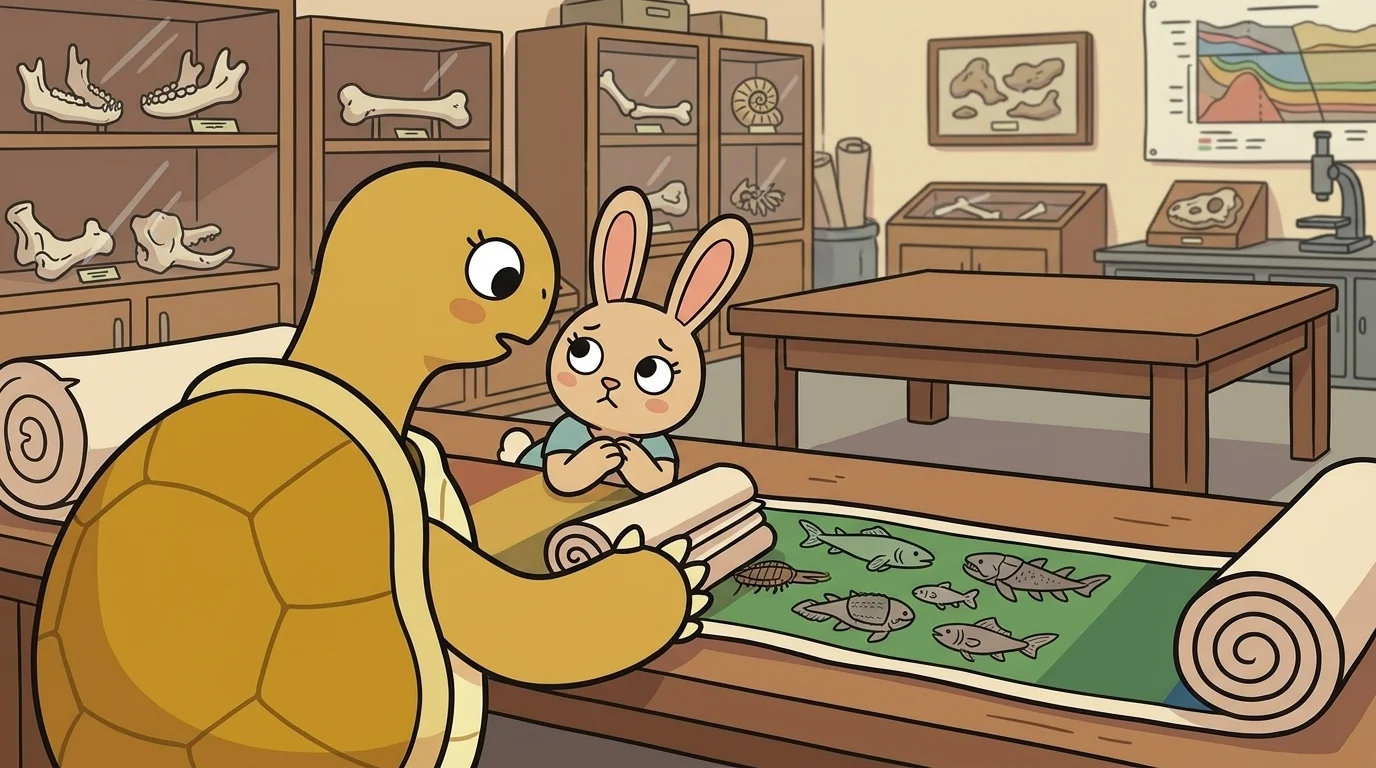
In her workshop Span always begins the same slow way, paying the scroll out across the bench until the tiny human mark appears at the end. One morning a young rabbit named Fen watched the empty bands go by and go by, and by the time the human sliver showed up she had gone very quiet and small.
"It's too big," Fen whispered. "We're nothing."
Span crouched to her level and set a gentle claw beside her. "The bigness you're feeling — sit with it a breath," she said. "That wide feeling isn't you're nothing. It's the same feeling you get looking up at all the stars. It's wonder." She let Fen breathe. "The great reptiles walked this long stretch. We've been here only this fingernail. That doesn't make you small and useless — it makes right now, this exact morning, rare and precious, because it's sitting inside this enormous before."
Fen's breathing began to slow. "But it's still so much," she said.
"Then we don't hold it all at once," Span said warmly, and she folded most of the scroll back up, leaving just one band open. "Look at only this stretch — just the age of the first fish. That's plenty. The rest of the scroll isn't going anywhere. It's patient. It'll wait, folded up safe, for whenever you're ready to unroll a little more." Fen put a paw on the single open band, and her shoulders, which had crept up, came down again.
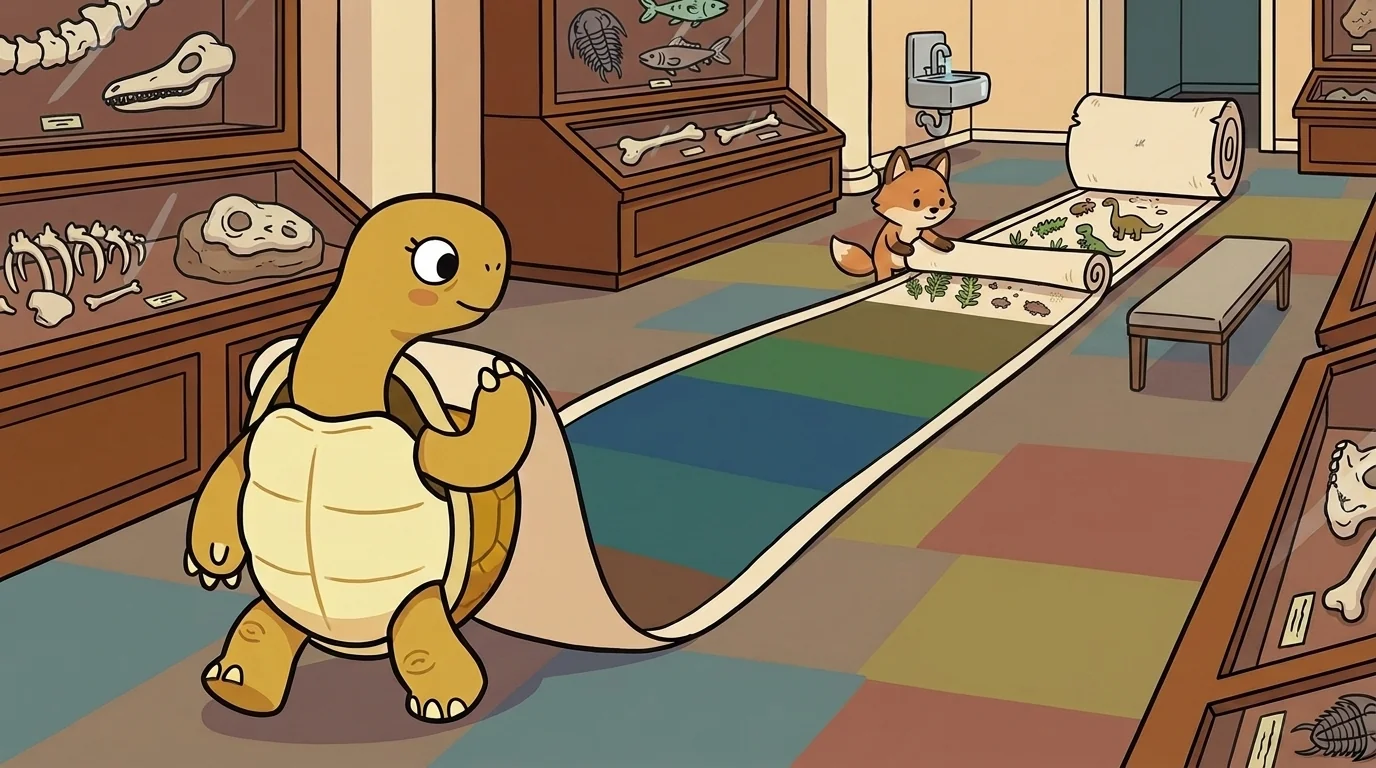
When the others had wandered off to the fossil cases, Fen stayed by the bench, one paw still resting on that single open band, and asked Span if she'd ever stop feeling so small next to all that time.
"You won't stop feeling small," Span said, slow and kind, "and that's the good part. Small and amazed, both at once. That wide, steadying feeling — that's not something to be scared of. That's the best thing this whole long scroll has to give you."
Fen nodded, and something eased and settled in her, calm now instead of scared. Span folded the scroll back onto her shell, one careful layer at a time, and felt the deep, grounded quiet she always felt at the end of the unrolling — small under all that time, and warm with wonder at getting to stand here, awake, in the tiny bright now.
The FossilForge ensemble
Span is part of FossilForge's distributed-narrative cast. Each character embodies a different curricular primitive; together they teach the full subject.
-

Seam
Taxonomic + fossil-type classification — family-resemblance-matching (what KIND of organism?)
-
Branch
Morphological adaptation + evolutionary change — branching-not-laddering
-
Field
Paleoenvironment + ecosystem reconstruction — fossils-as-a-place-story
-

Last
Mass extinctions + extinction-event reasoning — witness-and-choose (cross-app cameo with EcoSphere Brink)