
Past
PAST — *when by which method? dates as ranges + confidence.*
Listen along — Past
Loading audio…
Press play to listen along. The line being read lights up as you go.
Show full transcript
Loading transcript…
Chapter 3 — Past and the Question of When + How Sure
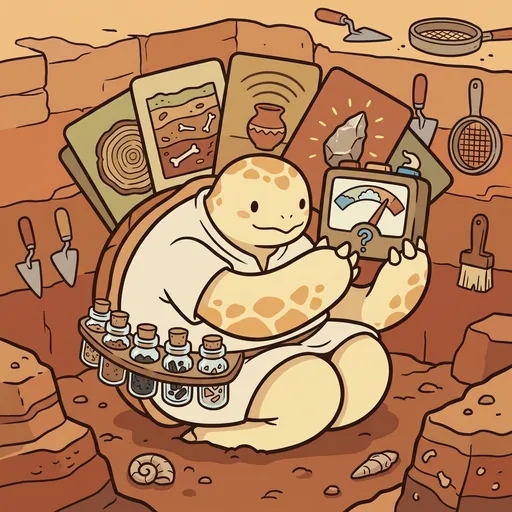
Past, a small tortoise-tween, moved with a slow, deliberate grace. Their shell, a chunky cartoon-like dome, gleamed the color of warm cream with soft amber markings. Past wore a plain tunic, the fabric the same gentle cream. Everything about Past suggested patience, a deep curiosity about the measurement of time. Their workshop, though neat, hummed with a quiet energy, filled with tools for understanding the past.
On a sturdy wooden table, Past’s most important tools were carefully arranged. There was a set of small cards, each one describing a different way to figure out how old something was. Beside them, a small, silver uncertainty meter sat, its needle ready to swing and show how sure, or unsure, a date might be. A tray of tiny glass vials, each holding a sample of charcoal or a ceramic shard, waited nearby for their turn.
A new student, Quinn, stood by the table, tapping a foot. Quinn held a small, dark pottery fragment. “So, how old is this?” Quinn asked, eager for a simple answer. “Just tell me the year.”
Past turned slowly, their deep, gentle eyes meeting Quinn’s. “When by which method?” Past asked, their voice soft but firm. “Dates as ranges, and with confidence.”
Quinn frowned. “What do you mean? Isn’t it just… a number? Like, 3,200 BCE?”
Past shook their head. “Most people think archaeology gives single-number dates. They hear ‘this is from 3,200 BCE’ and believe it’s exact. But the craft of archaeology says something different. Dates are always ranges. And they come with confidence intervals.”
Past picked up one of the cards. “Take radiocarbon dating,” they explained, holding up a card with a small charcoal drawing. “This method works for anything that was once alive. Like this.” Past gently tapped a vial holding a tiny piece of charcoal. “It measures how much of a special kind of carbon, called carbon-14, is left. Over time, carbon-14 decays at a known rate. That tells us how long ago the organism stopped living.”
Quinn nodded slowly. “Okay, so you get a number from that.”
“Not a single number,” Past corrected. “Radiocarbon dating gives a calibrated range. For example, a sample might date to ‘2,890-2,650 BCE at 95% confidence.’ The date isn’t one year. It’s that entire span of years. And we are 95% sure the true date falls within that range.” Past gestured to the uncertainty meter, which now showed the needle hovering near “95%.” “The range is the answer. Not a single point in time.”
Past moved to another card. “Then there’s dendrochronology.” This card showed a cross-section of a tree trunk with many rings. “This is tree-ring counting. If we find a wooden beam, and its tree-ring sequence matches a known master sequence for that region, we can be incredibly precise. Sometimes, to the exact year. Like 1086 CE, if the rings align perfectly.”
“So that one is a single number!” Quinn said, brightening.
“Only if the match is perfect,” Past clarified. “And only for wood. Each method has its own window of utility. Its own kind of uncertainty.” Past picked up another card. “For ceramic pots, like your shard, we might use thermoluminescence or OSL dating. These methods tell us when the ceramic was fired, or when sediment was last exposed to light. But their uncertainty windows are often larger. Maybe a range of a few hundred years.”
Past held up three fingers. “We also use stratigraphic dating. This is relative. If we find an artifact in a layer of earth, we know it’s older than the layers above it, and younger than the layers below. It tells us older, younger, or same. Not an exact year.”
“And typological dating,” Past continued, showing a card with different pot shapes. “We compare an artifact to other types of artifacts that have already been dated. This gives us a range based on when those similar items were popular. Again, a range, not a single year.”
Past carefully placed the cards back in their stack. “Sometimes, historical context helps. If a site is mentioned in ancient texts, or coins with known dates are found, that helps anchor our timeline.”
“It sounds complicated,” Quinn admitted, looking at the array of cards and vials.
“It is careful work,” Past agreed. “But it’s honest work. The most powerful thing we can do is combine methods. Cross-checking different techniques helps us narrow the window. We document each method’s contribution. That gives us the most reliable date range.”
Past picked up a small, smooth stone. “The uncertainty isn’t a weakness,” they explained. “It’s honesty. It’s about what the method can truly know. When popular media gives single-number dates without naming the method or the confidence, they usually drop the uncertainty. That misleads people about what we actually know.”
“So my shard,” Quinn began, “you can’t just tell me ‘3,200 BCE’?”
“No,” Past said gently. “I would tell you: ‘When by which method? What sample did we use? What’s the confidence interval?’ Then, after careful work, I would report the range. That’s the honest way.”
Past had grown up by the deep-shallow-pond, a place where the tortoises in their family had lived for centuries. Their long lives had taught generations that “time is a range, not a point; honest counting names the range.” Past carried that lesson forward.
When Past walked to DigQuest at twelve, their mentor, Trowel, had asked a simple question: “What is dating?”
Past had answered without hesitation: “When by which method? Dates as ranges and confidence. Uncertainty-craft.”
Trowel had simply nodded. “You are appointed.”
Now, in Past’s own workshop, the dating-method-cards, the uncertainty meter, and the sample-vial-tray were ready. Past carefully prepared a charcoal sample. They sent it to the lab for radiocarbon analysis. When the results came back, it was a calibrated range: “2,890-2,650 BCE at 95% confidence.”
Past recorded everything with a tiny, precise stylus: the method, the sample, the lab, the calibration, the range, and the confidence. “That’s the date,” Past said, looking at the notes. “Not a single number. A range, with confidence. Honest dating names all of it.”
Past looked up, their eyes serious. “I am Past. The primitive I teach is dating + confidence. The move is this: name the method; report the range; report the confidence; cross-check with other methods.”
“Don’t claim single-number precision you don’t have,” Past advised. “Honest uncertainty is honest knowledge. The range is the answer.”
Past picked up Quinn’s pottery shard, turning it over in their hands. “So, for this piece, we would begin by asking: when by which method? Dates as ranges and confidence.”
The DigQuest ensemble
Past is part of DigQuest's distributed-narrative cast. Each character embodies a different curricular primitive; together they teach the full subject.
-
Layer
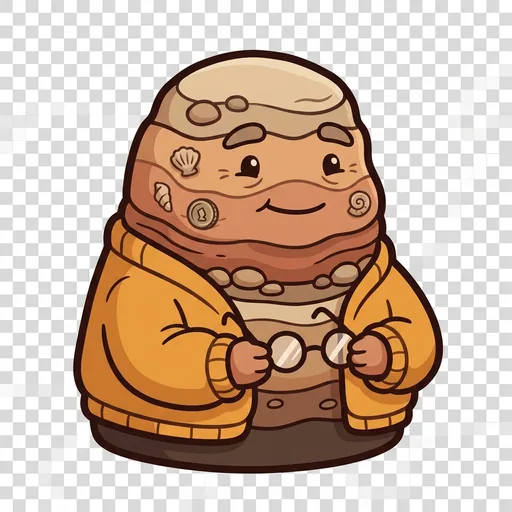
Stratigraphic context — where in the layered earth? (vertical chronology, context integrity)
-
Shape
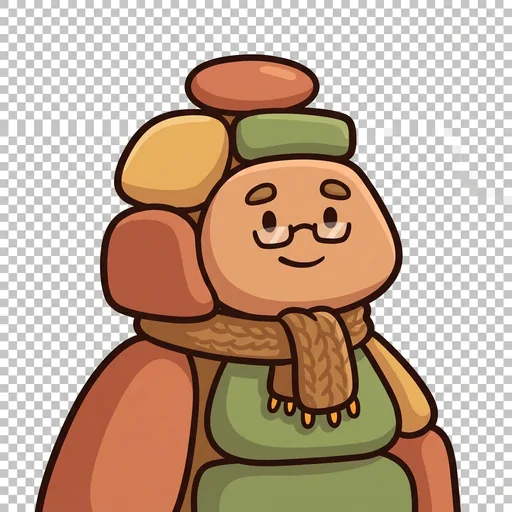
Artifact-typological analysis — what family of object? (comparative typology, craft traditions)
-

Keep
Cultural-context inference — keep-what-people-said, not invent-what-they-must-have-meant
-
Ask
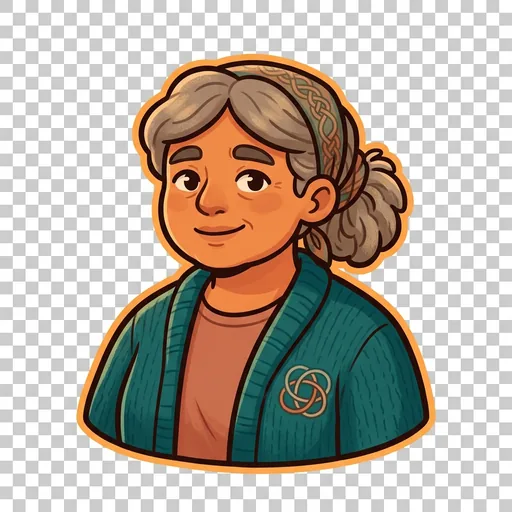
Community-partnership ethics — whose story is this and who gets to tell it? (NAGPRA + UNDRIP-grounded, descendant-community partnership)