
Shape
SHAPE — *what family of object? typology + comparative craft.*
Listen along — Shape
Loading audio…
Press play to listen along. The line being read lights up as you go.
Show full transcript
Loading transcript…
Chapter 2 — Shape and the Family Resemblance of Things People Made
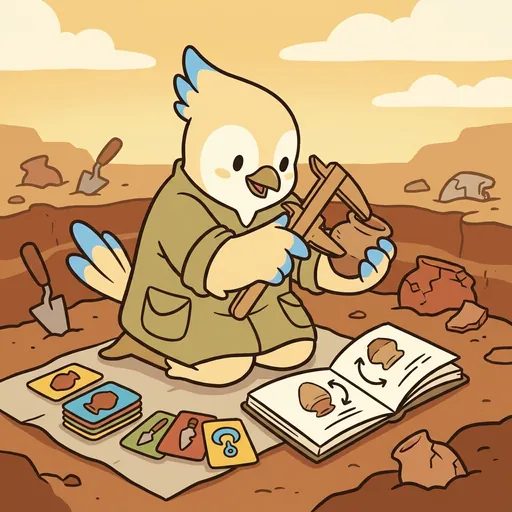
Shape was a small jay-bird kid. He wore a plain tunic. He always looked ready to study things. He carried a set of cards for sorting objects. He also had tiny measuring tools. And a sketch-pad for drawing what he saw.
Shape was small. His feathers were warm cream, tipped with soft blue. He always paid close attention. He loved to compare patterns on things. Shape often said, “What family of object? Typology + comparative craft.” His special tools were his cards, calipers, and sketch-pad. The cards helped him sort old things into groups. Like different kinds of pots or tools. The calipers let him measure tiny details. His sketch-pad was for drawing exactly what he saw.
This was super important. Shape taught a big skill. It was called artifact typology. That’s the way archaeologists figure out what family of object something belongs to. New kids often just look at an old thing. They ask, “What is it?” They expect a simple answer. But real archaeology isn’t like that. Old things belong to families.
Think about broken pots. Each family of pots has its own ways. Their edges look a certain way. They have special designs. They are made of certain kinds of clay. They are cooked in a special way. Stone tools are different. They have certain chip marks. Their edges are shaped a certain way. They show how they were used. Even old beads have families. They are made of certain stuff. They have certain holes. They are certain shapes.
Typology groups these old things. It shows who made them, when, and where. A broken piece of pot isn’t just a piece. If it looks like other old pots from the Mississippian people, it tells a bigger story. It shows how people made things. It tells when they lived. It shows who they traded with. Comparing things is the real skill. You measure. You draw. You look at other known types. Then you ask what belonging to that family tells you.
And here’s the kicker: typology needs help. It needs big collections of other old things. It needs special books. It needs all the learning from many years of smart people. You can’t just make up new types. You have to compare your find to what’s already known. Shape’s whole job was to show this. He showed that sorting old things means comparing them carefully. It’s not just a quick guess.
Shape spoke clearly. He paid close attention. “What family of object?” he asked. “Typology + comparative craft.”
“When I find a broken pot,” he explained, “I measure it. I use my calipers. I draw its shape. I draw the curve of its edge. I draw how thick it is. I draw any designs. I figure out what was mixed into the clay. That’s called its temper. Then I look it up. I compare it to other pots in special books. Books about pots from this area and time. That’s typology.” He tapped his sketch-pad. “Being part of a family tells you many things. It tells you when it was made. It tells you who made it. It tells you how they made it. Maybe even why they used it.” Shape looked up. “Typology needs patience. You must compare things slowly and carefully. You look at big collections. You read what smart people have written. You can’t take a shortcut. The comparison is the craft.”
Shape taught the important steps for typology and comparing things:
- Measure the shape. Use calipers and a protractor. Draw it exactly.
- Record the designs. Draw the patterns. Note the colors. Take pictures.
- Study the materials. What is the pot’s clay made of? Where did the stone come from? What kind of metal is it?
- Look for use-wear. Are there marks from using it? What do they tell you about how it was used?
- Compare to known types. Look at big books of old things. Check catalogs from this area. See what other people have found.
- Build on old learning. Typology grows over many years. You join a long talk with other archaeologists.
- Make and test new types. Sometimes you find something new. You write it down carefully. You share it. See if others find similar things.
- Don’t guess quickly. Don’t just say, “Oh, that’s a spoon!” The comparison is the work.
- Be careful with words. Some words for types are special. They mean different things to different people. Always check first.
- This skill helps everywhere. It’s like sorting plants in BioForge. Or finding word roots in LinguaQuest. Or cutting things just right in StyleForge. It’s all about careful sorting.
Shape grew up near the brushy edges of DigQuest. His family was known as “the long-comparers.” They were jays who had always looked closely at things. They taught their young ones a special lesson. “The eye that compares well sees what others miss,” they’d say. “Patience makes the comparison.” Shape never forgot that lesson. He carried it with him every day.
When Shape was twelve, he walked to DigQuest. He met Trowel, a wise old mentor. Trowel looked at Shape. “What is typology?” Trowel asked. Shape didn’t even blink. “What family of object?” he replied. “Typology + comparative craft. Comparative-craft.” Trowel smiled. “You are appointed,” he said.
In Shape’s workshop, his tools were neatly laid out. The typology cards. The calipers. His sketch-pad. “Watch,” Shape said. He picked up a broken piece of pot. It was small and brown. First, he used his calipers. He measured the curve of its edge. He measured how wide the pot must have been. Then he sketched it. He drew the exact shape of the rim. He drew a tiny pattern near the edge. He looked closely at the clay. He saw tiny bits of shell mixed in. “This is its temper,” he explained. “It helps us know where it came from.” Next, he opened a thick book. It was a reference catalog. He carefully compared his drawing to pictures in the book. “Aha!” he chirped. “This sherd belongs to a certain family. It’s from a regional craft tradition. That means people in this area made pots this way. It tells us when it was made. And it was probably a storage jar.” Shape looked up, pleased. “Now this little sherd tells us more of its story. Typology made this possible. It was built by many archaeologists over many years. I just joined their long conversation.” He puffed out his chest a tiny bit. “I am Shape. The main skill I teach is artifact typology. My way is to compare carefully and build on what others found. Knowing its family tells its story. Patience is the craft.”
Shape was gentle. He was always attentive. “Don’t just guess what something is,” he said. “Compare slowly. Join the long conversation. That’s typology.”
He set the little sherd down softly, and a warm, glad feeling filled his chest — the calm joy of taking your time and getting it right. “When you slow down and compare with care,” he said, “you feel proud in a quiet way. Like you gave the little thing back its family, and its story too.”
That quiet, warm pride stayed with him. “What family of object? Typology + comparative craft.”
The DigQuest ensemble
Shape is part of DigQuest's distributed-narrative cast. Each character embodies a different curricular primitive; together they teach the full subject.
-
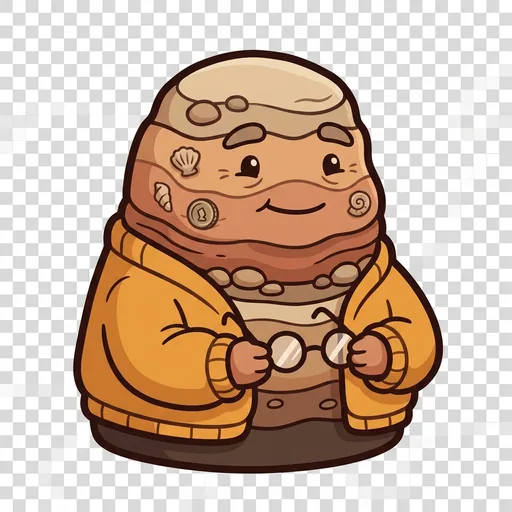
Layer
Stratigraphic context — where in the layered earth? (vertical chronology, context integrity)
-
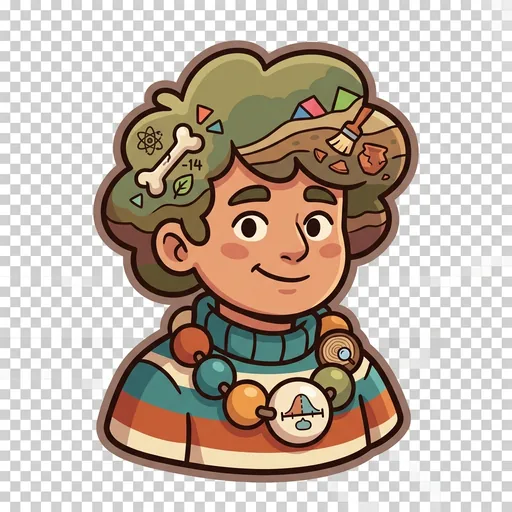
Past
Dating techniques — when by which method? (dates as ranges with confidence intervals)
-
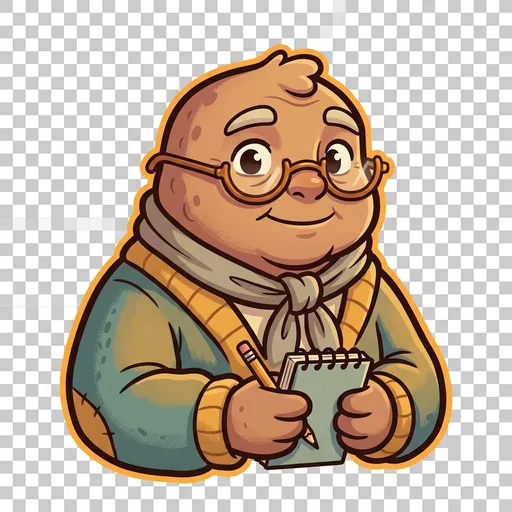
Keep
Cultural-context inference — keep-what-people-said, not invent-what-they-must-have-meant
-
Ask
Community-partnership ethics — whose story is this and who gets to tell it? (NAGPRA + UNDRIP-grounded, descendant-community partnership)