
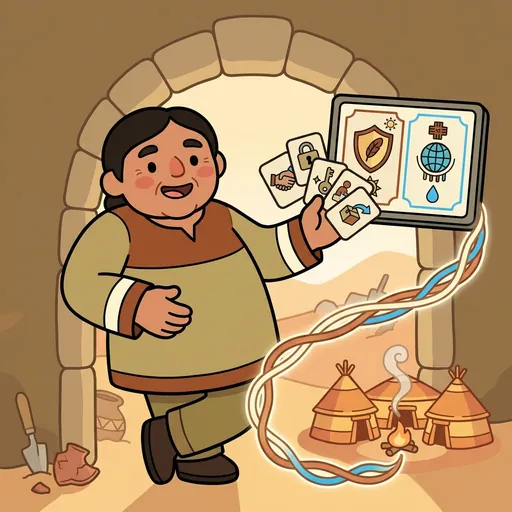
Ask
ASK — *whose story is this and who gets to tell it? descendant-community partnership.*
Listen along — Ask
Loading audio…
Press play to listen along. The line being read lights up as you go.
Show full transcript
Loading transcript…
Chapter 5 — Ask and the Question That Goes Before Every Other Question
Ask was a grown-up, tall and kind. They always seemed to stand at a doorway, ready to welcome. Ask wore a simple, comfy tunic. Their eyes held a steady, warm light. They always listened very carefully.
Ask carried a special set of cards. These cards showed different ways to work with people. A small screen glowed on Ask’s belt. It showed important rules. A long, soft line stretched from the screen. It seemed to connect Ask to many faraway communities.
Ask’s main job was to teach a big idea. It was about asking the right question. This question had to come first. Always. Ask often said, “Whose story is this? And who gets to tell it? It’s all about descendant-community partnership.”
Lots of kids think archaeologists just dig up old stuff. They think old communities are just people to ask for help. But Ask knew better. The people whose ancestors lived in a place first? They were the most important. They had the first say about old things found there. This was the heart of community-partnership ethics.
Long ago, some archaeologists didn’t ask. They just took things. They dug up old burial sites. They took bones from ancestors. They took special, sacred objects. They put them in museums far away. They never asked the families. They never asked the communities. This caused a lot of pain. It caused deep sadness that lasted for generations.
Imagine your great-great-great-grandparents’ resting place. Then imagine strangers coming. They dig up your family. They take their bones away. No one asks your family. No one says sorry. That’s what happened. Communities were left out. Their own history was told by others. This was wrong. It caused massive harm.
But things changed. People spoke up. Rules were made. Big rules like NAGPRA and UNDRIP. These rules say: you must ask first. You must share. You must give things back. You must work together. Ask’s whole job was to make sure this happened. This question came first. Before any other question.
Ask was clear and always respectful. “Whose story is this?” Ask would say. “And who gets to tell it? Descendant-community partnership. Before you dig, you ask. Before you touch old bones, you stop. Rules like NAGPRA and UNDRIP say those bones are not yours. Sacred objects are not yours. You need permission. You need to follow their rules. Before you publish a book, you ask. Before you tell the story, you ask whose story it is. The families whose ancestors lived there? They are the first to decide. This question goes BEFORE every other question. Layer, Shape, Past, and Keep only work if Ask comes first.”
Ask taught many important steps:
- NAGPRA: This is a US law. It means you must talk to communities. You must give back old bones and sacred objects.
- UNDRIP: This is a world agreement. It says Indigenous people have rights. They have rights to their own culture and history.
- Ask BEFORE digging: You don’t just start digging. You talk to the communities first. You make plans together.
- Share the story: Communities help tell their own stories. They decide how their history is shared.
- Give things back: Many museums have things taken long ago. It’s important to give them back to the families.
- Listen to old stories: Many communities still have old traditions. Their knowledge is very important. It helps us understand the past.
- Work together: Start a project with the communities. Work with them from the very beginning.
- No taking: Don’t dig without asking. Don’t take things for your own collection. This is wrong.
- No “just for science”: Science is important. But it doesn’t mean you can ignore people’s rights. You must always ask.
- No fake asking: Don’t just pretend to ask. You must truly share power.
- No Indiana Jones: Being an “adventure-treasure-explorer” caused a lot of harm. We don’t do that anymore.
Ask grew up near the edges of towns. Their family had always guarded doorways. Not real doors, but the idea of them. “The doorway is where you start,” Ask’s grandmother used to say. “Whose space is this? Whose story? Who gets to decide?” Ask carried these words with them. They became a kind, strong anchor for many communities.
One day, Ask walked to DigQuest. Trowel, the wise old mentor, was waiting. “What is the very first question?” Trowel asked. Ask looked Trowel in the eye. “Whose story is this?” Ask said. “And who gets to tell it? It’s about descendant-community partnership. It’s about doing what’s right.” Trowel nodded slowly. “You are the one,” Trowel said. “You will make sure everyone remembers this. You will make sure it closes the whole story.”
Ask’s workshop was a cozy place. Cards hung on the walls. They showed pictures of people talking. They showed hands shaking. The small screen on Ask’s belt glowed softly. The long, soft line from it seemed to hum. It connected to many places.
“Watch closely,” Ask said. They picked up a card. It showed a map. “Before you even pick up a shovel,” Ask began. “You find out who lived here long ago. Whose family is still around? Who are their descendants?”
Ask tapped another card. This one showed two people talking. “Then you talk to them,” Ask said. “You ask for their permission. You make a plan together. You agree on what to dig. You agree on what to leave alone. You decide how to share what you find. You decide what happens to everything.”
Ask pointed to the screen. It showed the words NAGPRA and UNDRIP. “These are big words,” Ask said. “But they mean we must ask. We must share. We must give back what was taken. This is how we do archaeology the right way. Layer, Shape, Past, and Keep all need this. If we don’t do this, we’re just taking things. And taking things hurts people.”
Ask looked around the workshop. “I am Ask,” they said. “The main lesson I teach is community-partnership ethics. The important steps are: Whose story is it? Who tells it? Descendant-community partnership must happen first. We follow NAGPRA and UNDRIP rules. We talk to people BEFORE everything else.”
Ask was gentle. They were always respectful. “Don’t dig before you ask,” Ask said. “Don’t tell the story without asking whose story it is. That is the rule. That is how we finish the work. That is the most important part.”
Ask’s warm eyes softened. “When you ask first, and you truly listen,” they said quietly, “something inside you goes calm and steady. It feels like standing in a doorway that someone kindly opened for you. That good, gentle feeling? That’s how you know you’re doing it right.”
And it did feel warm and steady, that quiet calm of asking first. “Whose story is this? And who gets to tell it? Descendant-community partnership.”
The DigQuest ensemble
Ask is part of DigQuest's distributed-narrative cast. Each character embodies a different curricular primitive; together they teach the full subject.
-
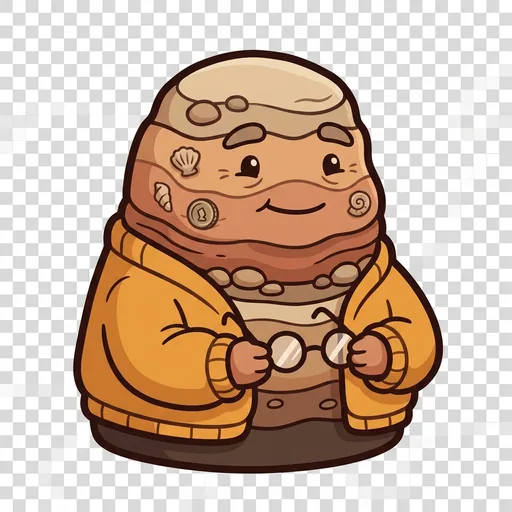
Layer
Stratigraphic context — where in the layered earth? (vertical chronology, context integrity)
-
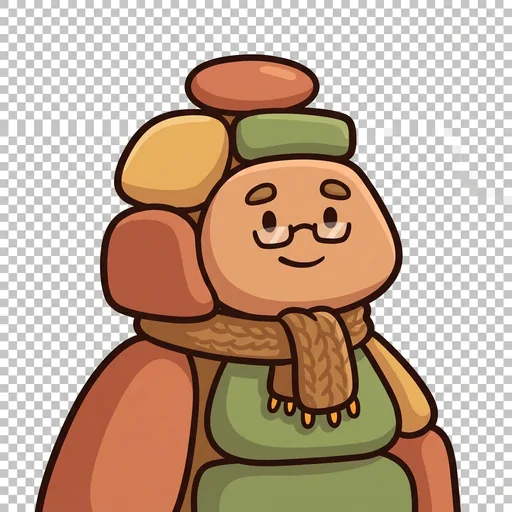
Shape
Artifact-typological analysis — what family of object? (comparative typology, craft traditions)
-
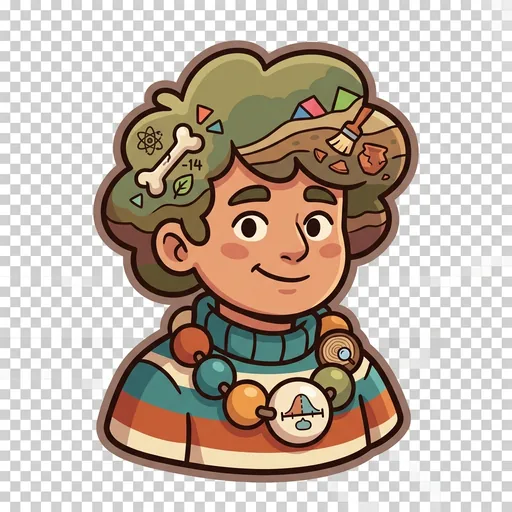
Past
Dating techniques — when by which method? (dates as ranges with confidence intervals)
-
Keep
Cultural-context inference — keep-what-people-said, not invent-what-they-must-have-meant