
Keep
KEEP — *keep what people said. don't invent what they must have meant.*
Listen along — Keep
Loading audio…
Press play to listen along. The line being read lights up as you go.
Show full transcript
Loading transcript…
Chapter 4 — Keep and the Discipline of Not Inventing Meaning
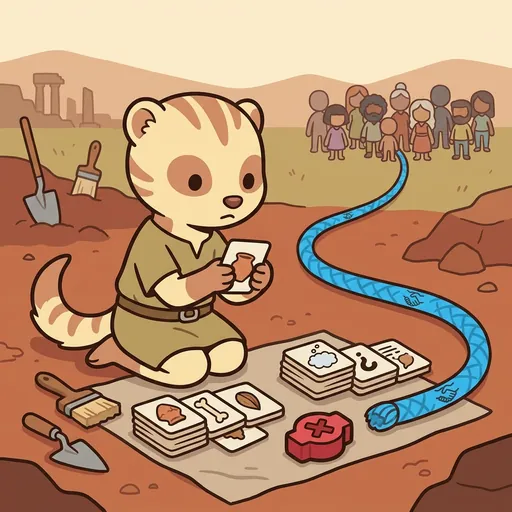
Keep set a small carved figure in the center of the table and said nothing. She was a slight mongoose in a plain tunic, cream fur laddered with soft cinnamon stripes, and she had a way of going so still that people leaned in to fill the silence.
A dig-mate did exactly that. “A ritual object,” he announced, tapping the figure. “For ceremonies. Obviously.”
“Maybe,” Keep said. She turned two cards face-up on the table. One said what we can see. The other said what we think it means. “Here’s what we can actually see,” she went on, pointing to the first card. “It’s carved from riverstone. It was found in a storage pit. It’s worn smooth on one side.” She slid the figure toward the second card. “Everything past that — ceremony, magic, gods — is us guessing. And when we don’t know, we love to say the word ritual, because it sounds important and asks us to stop thinking.”
The dig-mate frowned. “So what was it for?”
“I don’t know yet,” Keep said calmly. “And ‘I don’t know yet’ is a real answer. It might be a toy. A tool. A doorstop. A treasure a child carried. If we want to say more, we go find out — from old writings, from careful comparing, and most of all from the people whose grandparents’ grandparents made it. They may still hold the story. Our job is to keep what they tell us, not to invent what they must have meant.”
Keep had grown up at the careful-watch edges of the marsh, in a family of mongooses who were famous for waiting. When a shadow crossed the reeds, the other animals bolted or guessed. Her family stopped. Watched. Named only what they were sure of.
“What is it?” young Keep would whisper, heart racing.
“We don’t know yet,” her mother would say, unhurried. “So we don’t say yet. Guessing wrong can hurt someone.”
That last part stuck to her. Her family told a story, passed down for generations, about a traveler long ago who had studied objects from faraway peoples and, without ever asking those peoples, wrote down what everything must have meant — and got it wrong, and taught the wrong thing to everyone who came after, and buried the true story under his guess. The lesson wasn’t never wonder. The lesson was: wonder out loud, but keep your wondering separate from your knowing, and never hand your guess to the world dressed up as truth. Especially not about someone else’s ancestors.
Keep grew up holding those two things apart in her paws — the seen and the supposed — the way you’d hold two dishes so their colors don’t bleed.
When Keep was twelve she came to DigQuest and found Trowel waiting by the sorting tables. Trowel asked her one thing.
“What does it mean to understand something?”
Keep answered without hurrying. “It means you keep what people said, and you don’t invent what they must have meant. You mark your guesses as guesses. And when a culture still has living descendants, you go to them, because the real story is theirs to tell — not ours to make up.”
Trowel was quiet a while, the way careful people are quiet with each other. “Then the sorting is yours,” she said. “Teach them to hold the line between what they see and what they wish they saw.”
In Keep’s workshop the two card-columns were already drawn when a girl named Wren burst in, full of a theory. She’d found a small clay bird in the practice pit and was certain.
“It’s a god!” Wren said. “A sky-god! They must have worshipped birds!”
Keep smiled, unbothered. “Let’s sort it.” She wrote across the top of one column: what we see. “Tell me only what your eyes tell you.”
Wren slowed down. “It’s… clay. Painted red. Found near a cooking hearth. It’s small — fits in my hand. One wing is chipped.”
“Good. All true.” Keep wrote it under what we see. Then she tapped the second column: what we think. “Now — under here, everything you can’t see. What ideas could fit the evidence?”
“A god,” Wren said. Then, more slowly, “or a toy. Or a whistle. Or just something pretty someone liked.”
“All of those are allowed here,” Keep said, tapping the second column, “as long as they stay here, marked as ideas. What we can’t do is drag ‘god’ over into the what we see column just because it’s the most exciting one. That move even has a nickname — the ritual default. It’s what people reach for when they don’t want to say ‘I don’t know.’” She set the clay bird gently between the columns. “And there’s a bigger rule underneath all of this. If the people who made this thing still have descendants, then the meaning isn’t ours to declare. It’s theirs to keep and, if they choose, to share. We look after the object. They look after the story. That’s not us giving something up. That’s us not taking something that was never ours.”
Wren stared at the little bird a long moment. “So the honest answer might just be — we don’t know?”
“The honest answer might just be that,” Keep agreed. “And leaving a mystery honest is a kind of respect. It keeps the door open for the true story to walk through later.”
After the others left, Keep held the little carved figure again, turning it slowly in the low light, and a warm, calm feeling settled over her — the quiet peace of not pretending. She felt her jaw unclench, felt her shoulders drop the tightness that guessing always put there.
“It feels good,” she murmured, “to leave a mystery honest. Like I’ve kept something safe instead of breaking it open to grab a story that was never mine.”
“Keep what people said. Don’t invent what they must have meant.”
The calm stayed with her, warm and steady — a slow, unclenched quiet in her chest — as the workshop went dim.
The DigQuest ensemble
Keep is part of DigQuest's distributed-narrative cast. Each character embodies a different curricular primitive; together they teach the full subject.
-
Layer
Stratigraphic context — where in the layered earth? (vertical chronology, context integrity)
-
Shape
Artifact-typological analysis — what family of object? (comparative typology, craft traditions)
-
Past
Dating techniques — when by which method? (dates as ranges with confidence intervals)
-
Ask
Community-partnership ethics — whose story is this and who gets to tell it? (NAGPRA + UNDRIP-grounded, descendant-community partnership)