
Keep
KEEP — *keep what people said. don't invent what they must have meant.*
Listen along — Keep
Loading audio…
Press play to listen along. The line being read lights up as you go.
Show full transcript
Loading transcript…
Chapter 4 — Keep and the Discipline of Not Inventing Meaning
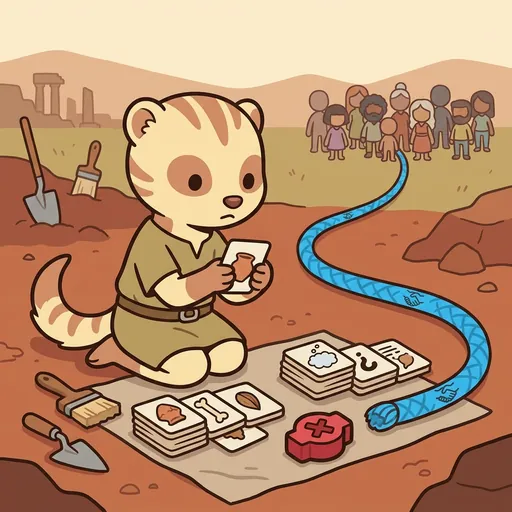
Keep was small, even for a twelve-year-old. They moved with the quiet attention of a mongoose, always watching, always listening. Their plain tunic, a warm cream with soft cinnamon stripes, seemed to blend into the dusty corners of the DigQuest workshop. Today, Keep was hunched over a new find: a small, intricately carved wooden figure, no bigger than their thumb.
Next to Keep lay their tools: a small stack of rectangular cards, some blank, some pre-printed with “EVIDENCE” or “INFERENCE.” A slender, bright red marker lay across the stack, like a tiny stop sign. And from the bottom card, a thin, shimmering line of copper wire stretched out, connecting to a small, polished stone. This was Keep’s evidence-inference-card-set, their restraint-marker, and their descendant-community-connection-line.
The figure was beautiful. Its smooth wood, dark with age, showed a creature with wide, gentle eyes and a swirling pattern on its back. “It’s a spirit animal,” a voice chirped from behind Keep. It was Pip, a younger DigQuest recruit, all bright eyes and eager guesses. “Definitely for a ritual. Look at those patterns! It must have been used in some ancient ceremony.”
Keep didn’t turn. They just picked up the figure with careful fingers, turning it slowly. “That’s a story,” Keep said, their voice soft but firm. “A good story. But is it archaeology?”
Pip frowned. “What do you mean?”
Keep picked up a blank card. “See this figure?” They pointed to the wood. “The carved lines, the type of wood, how old it is – that’s all evidence. It’s what we can physically observe, what’s right in front of us.” Keep wrote “Carved wooden figure, dark wood, swirling pattern, wide eyes” on an EVIDENCE card.
Then Keep picked up another card, this one pre-printed “INFERENCE.” “When you say ‘spirit animal’ or ‘ritual object,’ that’s an inference. It’s a conclusion we draw, a guess about what the evidence might mean.” Keep tapped the red restraint marker. “And this marker? It reminds us to be careful with those guesses.”
“But it looks like a ritual object,” Pip insisted. “Doesn’t it?”
“It could be,” Keep agreed. “But when we don’t know what something was for, it’s easy to say ‘it must be ritual.’ Archaeologists call that the ritual default. It’s a way of filling in the blanks without real proof. It tells us very little, really.” Keep placed the red marker on the INFERENCE card. “And sometimes,” Keep continued, their gaze distant, “we accidentally put our own ideas onto the past. We imagine they thought like us, or believed what we believe. That’s called projection. It’s like seeing your own face in a mirror and thinking it’s someone else’s.”
Keep then gently touched the copper connection-line. “This line,” they explained, “reminds us of descendant communities. These are the people who are still connected to the culture that made this figure. They might have living knowledge, stories, or traditions that tell us exactly what this figure was for. We don’t invent meaning when the real meaning might still be known by someone.”
Pip looked at the figure, then the cards, then the line. “So, we don’t just guess?”
“We make careful guesses, yes,” Keep clarified. “But those guesses need to be bounded. They need to be checked. We look at typology – comparing this figure to other known figures from the same time and place. Do they have similar carvings? Are they found in similar contexts?” Keep paused. “We also look for ethnographic-historical support – written accounts or living traditions that explain what these symbols mean.”
Keep remembered their own family, the long-careful-watchers. Mongooses, they were called, for their attentive listening and careful engagement. The most important move is often NOT to act on the first reading. Wait. Listen. Check. That was the family motto, passed down through generations. Keep had carried that lesson to DigQuest.
When Trowel, the head mentor, had asked Keep during their appointment, “What is interpretation?” Keep hadn’t hesitated. “Keep what people said. Don’t invent what they must have meant. Restraint-craft.” Trowel had simply nodded. “You are appointed.”
Now, Keep laid out three INFERENCE cards next to the EVIDENCE card. “Possibility one,” Keep said, writing on the first. “A decorative carving, perhaps an ornament.” “Possibility two,” on the second. “A tool handle, shaped like an animal for grip or luck.” “Possibility three,” on the third card. “A symbolic figure whose meaning is currently unknown.” This would require further cultural-context inference from descendant communities or inscriptions.
Keep picked up the red marker and placed it firmly on the third card. “This is where we need the most restraint. We don’t know its specific meaning yet. To claim ‘it must have been a spirit animal for a ritual’ would be to ignore the missing pieces. It would be an anti-pattern – a bad habit in archaeology.”
Pip nodded slowly. “So, ‘function unknown’ is better than ‘ritual object’ if we don’t have proof?”
“Exactly,” Keep said. “Honest archaeology means honoring what the evidence does say, and being clear about what it doesn’t. It means acknowledging when there are multiple plausible interpretations and not picking one just because it sounds exciting. It means rejecting Western-projection on non-Western contexts – not assuming other cultures thought like us.”
Keep looked at Pip, a gentle smile touching their lips. “Don’t fill in what you don’t know. Restraint IS the craft. Partnership IS the source.”
The small wooden figure lay on the table. It was no longer a mystery to be solved with a quick story. Instead, it was a puzzle to be carefully, respectfully, and truthfully understood.
“Keep what people said,” Keep murmured, mostly to themself. “Don’t invent what they must have meant.”
The DigQuest ensemble
Keep is part of DigQuest's distributed-narrative cast. Each character embodies a different curricular primitive; together they teach the full subject.
-

Layer
Stratigraphic context — where in the layered earth? (vertical chronology, context integrity)
-

Shape
Artifact-typological analysis — what family of object? (comparative typology, craft traditions)
-
Past
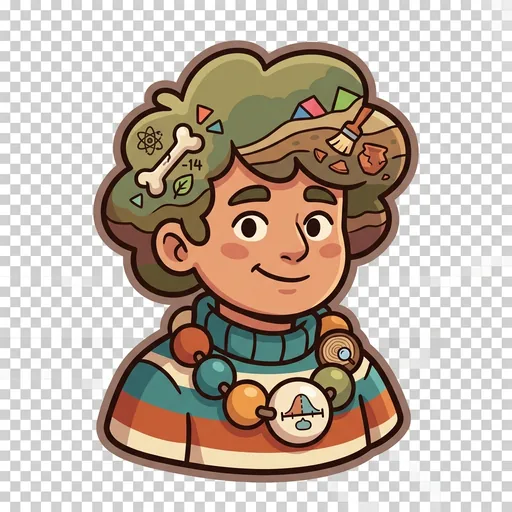
Dating techniques — when by which method? (dates as ranges with confidence intervals)
-
Ask
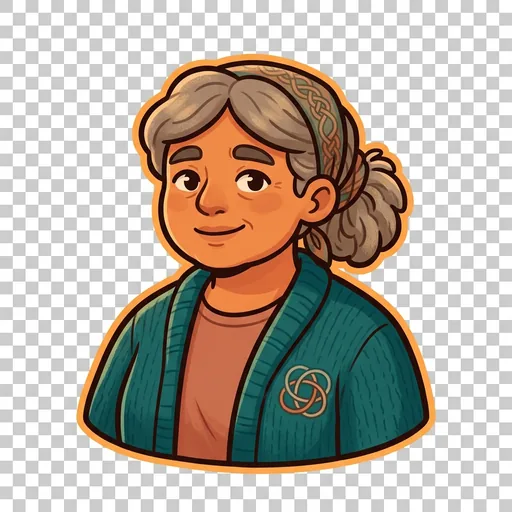
Community-partnership ethics — whose story is this and who gets to tell it? (NAGPRA + UNDRIP-grounded, descendant-community partnership)