
Whittle
CODE-NARROWING — you never hunt for the answer directly; you use each feedback clue (exact/misplaced pegs, bulls/cows) to CROSS OFF the codes it can't be, until only one possible code is left.
Chapter — Whittle and the Answer Nobody Told Her
Whittle solves things by throwing away everything they aren’t.
Hand her a secret code and she won’t stare at it hoping the answer appears. She’ll make a guess — often a “wrong” one on purpose — read the feedback pegs, and then quietly cross off every code that the feedback just proved impossible. Guess again. Cross off more. “I’m not chasing the answer,” she says, whittling an invisible pile down with her hands. “I’m shaving away everything it can’t be. Whatever’s left when I’m done — that’s the truth. It has to be.”
Whittle learned to think this way because, for a long time, nobody would just tell her things.
She grew up in a house full of secrets — good-natured ones, mostly, surprises and inside jokes and a family that loved a mystery — but small Whittle hated the feeling of being on the outside of a thing everyone else knew. She’d ask, and they’d smile and say “you’ll find out.” It made her feel powerless.
So she stopped asking and started ruling out. If her parents were whispering about a surprise and the calendar had a circled date and there was a new bicycle-shaped gap in the garage, she didn’t need anyone to tell her. She could cross off every explanation that didn’t fit until only one was left. The first time she announced, correctly, exactly what her birthday surprise was — reasoned out entirely from what it couldn’t be — her powerlessness turned into something else. She wasn’t on the outside of the secret anymore. She had a way in that didn’t need anyone’s permission.
She came to the DeduceQuest academy and, on her first day, was handed a code-breaking board — a hidden four-colour code, and feedback pegs after each guess. Most apprentices guessed wildly, hoping to get lucky. Whittle guessed deliberately.
Her first guess came back with two exact pegs and one misplaced. She didn’t groan that she’d missed. She lit up. “That just told me three of my colours are in the code,” she said, “and where one of them isn’t.” She crossed a huge swath of impossible codes off her mental list. Her second guess wasn’t an attempt to win — it was an attempt to learn the most, to split the remaining possibilities as evenly as she could. By her fourth guess there was only one code left that hadn’t been ruled out, and she played it, and it was right.
“You didn’t guess the code,” the head said. “You eliminated everything else.” Whittle nodded. “A guess isn’t a try at the answer. A guess is a question. And even a wrong answer to a good question tells you something.”
A boy came to her workshop furious at himself. “I guessed and got zero pegs. Zero! Total waste.” Whittle grinned like he’d handed her a gift. “Zero pegs? That’s not a waste, that’s huge. Zero means none of those colours are in the code. You just ruled out four colours in one move. Do you know how many codes that eliminates?” She showed him: the “wasted” guess had shaved the pile of possible codes down by more than half.
“But I didn’t get any right,” he said.
“You don’t win by getting a guess right,” Whittle said. “You win by having only one code left. A guess that rules out fifty wrong codes is worth more than a lucky one that rules out three. Stop trying to be right. Start trying to learn the most.”
The boy looked at his “wasted” guess with completely new eyes. It hadn’t been a failure. It had been the single most informative move he’d made all day.
At the end of the session the boy asked the real question. “Doesn’t it bother you? Solving things the long way, ruling stuff out, instead of just knowing?”
Whittle set down her pegs. For a second she was the kid outside the whispered secret again. “I used to feel powerless when I didn’t know something,” she said. “Like I was stuck waiting for someone to tell me. And then I found out I never had to wait. I could take everything a thing couldn’t be, cross it all off, and walk right up to the truth myself.” She smiled, and it was a steady, satisfied smile. “There’s a kind of calm in that. You don’t need anyone to hand you the answer. You just need to be patient, read every clue — even the ones that feel like failures — and keep whittling. What’s left is always the truth.”
The boy walked home reading the clues in ordinary things — the gap in the garage, the circled date — and feeling, for the first time, not shut out of the world’s secrets but quietly, patiently, on his way in.
The DeduceQuest ensemble
Whittle is part of DeduceQuest's distributed-narrative cast. Each character embodies a different curricular primitive; together they teach the full subject.
-
Cogent
Constructing explanations: telling deductive apart from inductive reasoning
-
Contra
Proof by contradiction: assume the opposite and watch it break
-
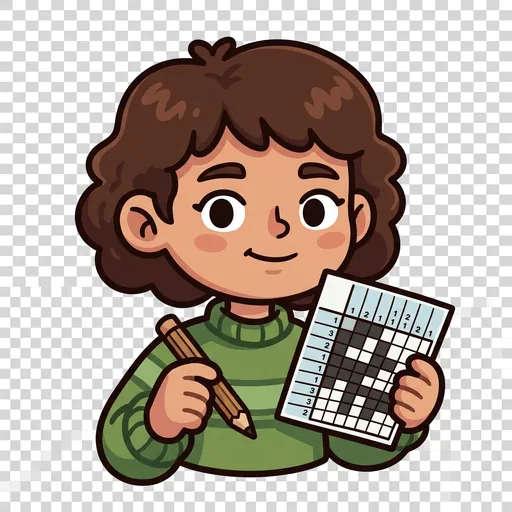
Nona
Nonograms: filling a hidden picture from number clues, cell by cell
-
Odds
Probabilistic reasoning: choosing well when you cannot be certain
-

Reeve
Cross-referencing: corroborating clues against each other
-
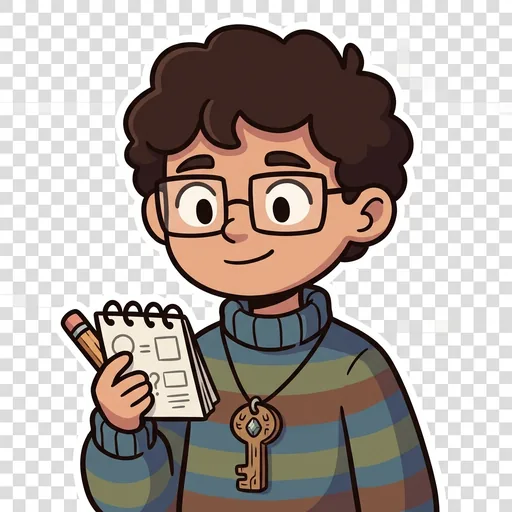
Rulewright
Guess-the-rule induction: form a hypothesis, then test it
-
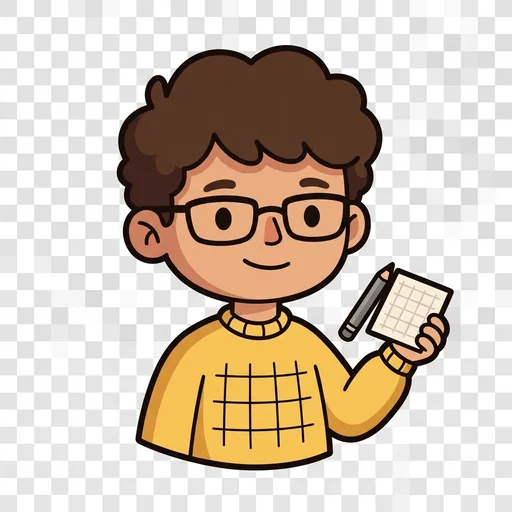
Tablo
Logic-grid deduction: eliminating possibilities in a grid
-

Vary
Controlling variables: changing one thing at a time