
Tablo
LOGIC-GRID DEDUCTION — lay out every possibility as a grid, and use each clue to cross off (✗) the cells it makes impossible and confirm (✓) the ones it forces. One match per row and column; what survives is the answer.
Chapter — Tablo and the Grid That Held Everything
Tablo cannot think without a grid, and he’s stopped apologizing for it.
Give him a tangle of clues — who owns which pet, who sits in which seat — and he doesn’t try to hold it all in his head. He draws a grid: every person down one side, every possibility across the top. Then he reads each clue and marks the grid. A ✗ where a clue makes something impossible. A ✓ where a clue forces something true. “One clue at a time,” he says, pencil moving. “I don’t solve the puzzle. I let the grid hold it, and I just keep crossing off what can’t be, until the answer is the only thing left standing.”
Tablo makes grids because, as a kid, his head felt like a room with too much furniture.
He was the sort of child who worried about everything at once — every possibility, every what-if, all crowding in together until he couldn’t tell which fears were real and which were impossible. It was overwhelming. He’d lie awake with a dozen tangled worries and no way to sort them.
A school counselor gave him a trick that changed his life: write it down. Make columns. Put each worry in its own box. And then, one by one, ask of each: is this actually possible, or can I cross it off? Tablo did it, and something extraordinary happened — most of the tangle dissolved. Half his worries crossed themselves off the moment they had to sit in a box and be looked at directly. The few that were left were manageable, because they were few, and separate, and clear.
He’d discovered that a grid doesn’t just organize information. It tames it. Anything, however tangled, becomes solvable once you make it hold still in rows and columns.
He arrived at the DeduceQuest academy and, on his first day, was handed a logic puzzle: three friends, three colours, a fistful of clues. The other apprentices tried to reason it out in their heads and got lost. Tablo drew a 3×3 grid and got quiet.
He read the first clue — “Ann doesn’t like red” — and put a ✗ in one cell. He read the next — “the blue one is Cy” — and put a ✓ there, then crossed off the rest of Cy’s row and blue’s column, because one match per row and column meant the rest were now impossible. Clue by clue the grid filled with ✗s, and then, in the spot where every other possibility had been eliminated, a single ✓ became forced — not because a clue said so directly, but because it was the only cell left.
“You didn’t deduce the last answer,” the head observed. “The grid did.” Tablo nodded. “That’s the point. I don’t have to be clever. I just have to be honest — mark every ✗ the clues demand, and never skip one. The grid does the rest.”
A girl came to his workshop overwhelmed. “There are too many clues, I can’t keep track.” Tablo didn’t tell her to concentrate harder. He handed her graph paper. “Don’t keep track in your head,” he said. “Your head isn’t built for it. Put every possibility in a box, and let the paper remember for you.” He watched her mark one ✓ and then reminded her: “Now cross off the rest of that row and that column — one ✓ makes six cells impossible.” Her eyes widened as a single confirmed fact rippled out and erased a whole cross of possibilities.
“It’s getting easier,” she said, halfway through, surprised — because every mark she made narrowed what was left, and the more she knew, the faster the rest fell into place.
“That’s what a grid does,” Tablo said. “The overwhelm was never about the clues being too hard. It was about trying to hold them all at once. Don’t hold them. Lay them down. Let the grid carry the weight.”
Later she asked why he was so calm about hard puzzles. Tablo looked at his grid — neat rows, honest marks, the tangle tamed. “Because I used to feel buried under everything I couldn’t sort out,” he said, and for a moment the worried kid showed through. “And I learned that you don’t have to carry a tangle in your head. You lay it out where you can see it, you cross off what can’t be true one honest mark at a time, and the thing that felt impossible turns out to be” — he tapped the single ✓ left standing — “just the last box nobody had crossed off yet.” He slid her a fresh grid. “Whatever’s overwhelming you, give it rows and columns. It gets so much smaller when you can see it.”
The girl walked home lighter, already drawing invisible grids around the messy things in her life, and finding — the way Tablo had — that most of the tangle crossed itself off the moment she made it hold still.
The DeduceQuest ensemble
Tablo is part of DeduceQuest's distributed-narrative cast. Each character embodies a different curricular primitive; together they teach the full subject.
-
Cogent
Constructing explanations: telling deductive apart from inductive reasoning
-
Contra
Proof by contradiction: assume the opposite and watch it break
-
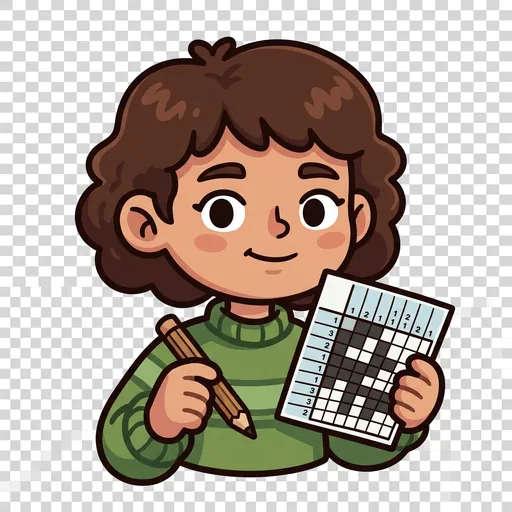
Nona
Nonograms: filling a hidden picture from number clues, cell by cell
-
Odds
Probabilistic reasoning: choosing well when you cannot be certain
-
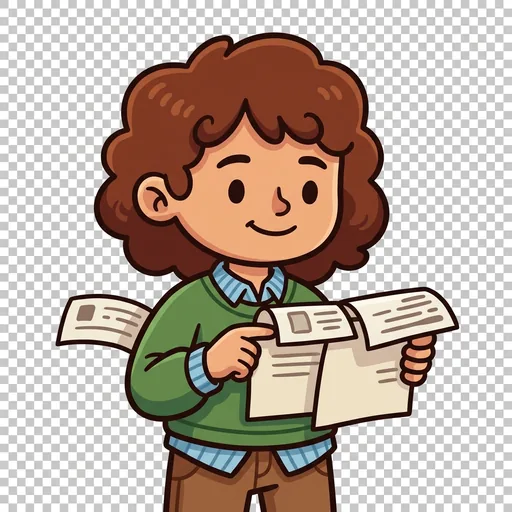
Reeve
Cross-referencing: corroborating clues against each other
-
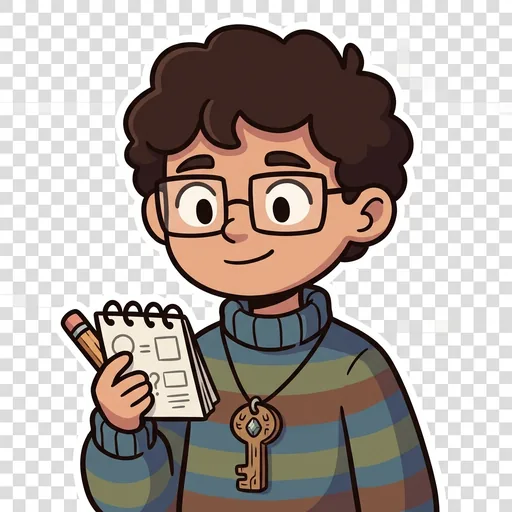
Rulewright
Guess-the-rule induction: form a hypothesis, then test it
-

Vary
Controlling variables: changing one thing at a time
-
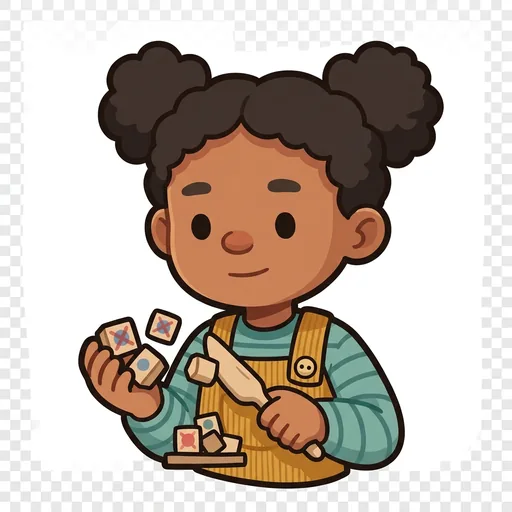
Whittle
Code-narrowing: you never hunt for the answer, you narrow toward it