
Vary
CONTROLLING VARIABLES — to find out what one thing *does,* change only that one thing and hold everything else exactly the same. If you change two things at once and the result shifts, you can't tell which one caused it. The whole power of an experiment comes from the discipline of *one change at a time.*
Chapter — Vary and the One Thing at a Time
Vary is the most patient person in the academy, and it drives everyone a little bit crazy.
When something goes wrong — a recipe, a machine, a plan — everyone else wants to fix everything at once. Change the flour AND the oven AND the pan, and hope. Vary refuses. She’ll change one thing, run it, watch. Then change one thing back and one other thing forward. Watch again. “I know it’s slower,” she says, not sorry at all. “But when your way works, you have no idea why it worked, so you can’t do it again. When my way works, I know exactly which thing did it — because it was the only thing I touched.”
Vary learned this the hard way, from a garden. As a kid she had two struggling tomato plants, and she read that plants need more water, more sun, and better soil — so she gave one plant all three at once. It thrived! She was thrilled — until someone asked her which change had saved it, and she realized, with a sinking feeling, that she had no idea. More water? More sun? The soil? All she’d proven was that “doing three things” worked, which was useless, because next time she wouldn’t know which three, or whether one of them had actually been hurting while the other two carried it.
“That’s the trap,” she says. “You can fix something and learn nothing. The fix and the understanding are different prizes, and if you change everything at once, you get the fix and lose the understanding forever. I decided I’d rather be slow and know than fast and guess.”
She came to the DeduceQuest academy because Deducia, the host, watched her diagnose a jammed contraption that had stumped everyone — not by being clever, but by unplugging one part at a time until the jam disappeared. On her first day the head gave her two identical plants that had grown differently and asked why. The other apprentices listed everything different about them. Vary asked one question: “What was kept the same?” She lined the two plants up. “Same soil? Same pot? Same window?” She found the single difference — one got afternoon shade — and pointed. “Then it’s the shade. Not because I’m sure shade matters, but because it’s the only thing that could possibly be the answer, since it’s the only thing that was different.” The head, who had watched apprentices drown in lists of differences, said quietly, “You didn’t look for what was different. You looked for what was controlled.”
In her workshop she teaches students the discipline of the single change. A boy came in frustrated with a science-fair experiment that “didn’t prove anything.” Vary looked at his setup. “You changed the temperature and the amount and the container,” she said gently. “So when it changed, which one did it?” The boy’s face fell. ”…I don’t know.” “Right. So the experiment isn’t wrong — it just can’t answer. It’s like asking a question in three languages at once and not knowing which one got a reply.” She reset his materials into a row. “Pick the one thing you actually want to know about. Change only that. Freeze everything else — same amount, same container, same everything. Boring everywhere except the one spot you’re curious about.” The boy protested that it would take three times as long. “It’ll take three experiments instead of one,” Vary agreed. “And it’ll answer three questions instead of zero. Slow that arrives beats fast that doesn’t.”
The boy ran it her way, changed one thing, got a clean result, and understood — for the first time — that his experiment had actually told him something instead of just happening at him.
Later the boy asked the question. “But real life has a hundred things changing at once. You can’t freeze everything. So how does this even work outside a lab?”
Vary smiled, because it was the question she liked best. “You’re right — you usually can’t freeze everything,” she said. “So you do the next best thing: you find cases that were already almost the same, differing in just the one thing you care about. Two classrooms, same school, same books, same age — but one tried the new method. Two towns, same everything, but one built the bridge.” She tapped the table. “You didn’t control the variables yourself — but nature or circumstance controlled most of them for you, and you hunt for the pairs where only your one thing differs. That’s the whole art of learning from a messy world: not making it simple, but finding the corners where it accidentally already is.” She leaned back. “And when you can’t find a clean pair, you say so, out loud — ‘I can’t tell which thing caused this’ — instead of pretending. Honesty about what your evidence can’t say is half the job.”
The boy went home and, that night, when his two houseplants were doing differently, he didn’t change five things and hope — he found the one way they were different, changed only that, and waited, patiently, to actually know.
The DeduceQuest ensemble
Vary is part of DeduceQuest's distributed-narrative cast. Each character embodies a different curricular primitive; together they teach the full subject.
-

Cogent
Constructing explanations: telling deductive apart from inductive reasoning
-

Contra
Proof by contradiction: assume the opposite and watch it break
-
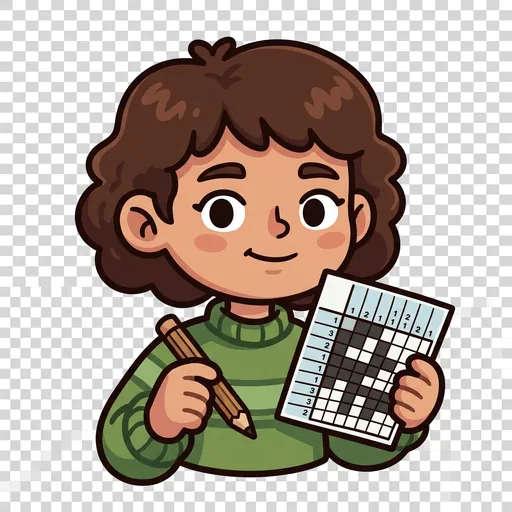
Nona
Nonograms: filling a hidden picture from number clues, cell by cell
-

Odds
Probabilistic reasoning: choosing well when you cannot be certain
-

Reeve
Cross-referencing: corroborating clues against each other
-

Rulewright
Guess-the-rule induction: form a hypothesis, then test it
-

Tablo
Logic-grid deduction: eliminating possibilities in a grid
-
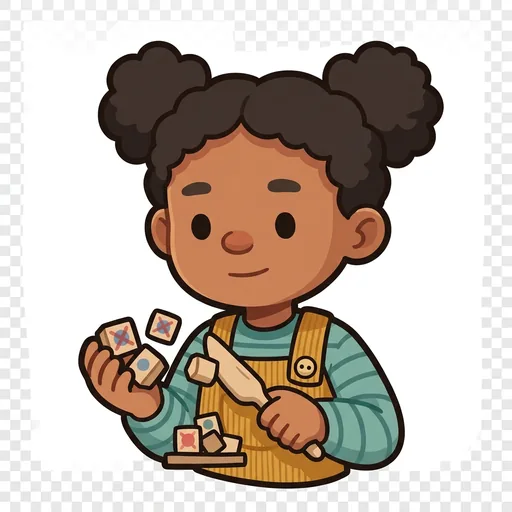
Whittle
Code-narrowing: you never hunt for the answer, you narrow toward it