
Cogent
CONSTRUCTING EXPLANATIONS (deductive vs inductive) — an answer isn't finished until you can show *why* — the chain that connects the evidence to the conclusion (the warrant). And you name your certainty honestly: *deductive* reasoning is airtight (if the premises hold, the conclusion MUST follow); *inductive* reasoning is strong-but-not-certain (the evidence makes it *likely,* patterns can break). Knowing which kind you've got is knowing how much to trust it.
Chapter — Cogent and the Answer That Had to Show Its Work
Cogent is not impressed by right answers. He is impressed by because.
You can walk up to Cogent with the correct conclusion, perfectly correct, and he’ll nod politely and say the four words everyone at the academy dreads and needs: “Walk me through it.” Not because he doubts you — often he already knows you’re right — but because, he insists, an answer you can’t explain is an answer you got by accident, and an accident can’t be repeated, taught, or trusted. “The answer is only half the work,” he says. “The other half is the bridge from what you knew to what you concluded. Show me the bridge, or for all I know you jumped.”
Cogent was a kid who got good grades and couldn’t say why. He felt the answers — they arrived, correct, from somewhere he couldn’t see. Then one day a teacher asked him to explain one, in front of everyone, and he froze: he had the answer and no bridge to it whatsoever. It was humiliating, and it was the best thing that ever happened to him, because it revealed that “knowing the answer” and “understanding why” were completely different skills, and he’d been getting by on only the first one. He started forcing himself to build the bridge every time — out loud, step by step — and slowly the answers stopped feeling like magic and started feeling like reasoning.
“An unexplained answer is a guess wearing a nice coat,” he says. “It might be right. But you can’t stand on it, because you don’t know what’s holding it up. The explanation isn’t showing off. The explanation is the foundation.”
He came to the DeduceQuest academy after Deducia, the host, watched him refuse to accept his own correct guess until he could trace it. On his first day the head handed him two conclusions — both correct — and asked what the difference was. Cogent read them. “This one,” he said, “follows for sure. ‘All the doors are locked; this is a door; so this is locked.’ If the first two are true, the third can’t not be — that’s deductive, airtight.” He tapped the second. “But this one — ‘the last four puzzles were about ciphers, so the fifth probably is too’ — that’s inductive. Strong! Worth betting on. But not certain — the pattern could break.” He set them side by side. “Both are good reasoning. But if you treat the second like the first — if you say ‘the fifth must be a cipher’ — you’ve claimed more than your evidence can pay for.” The head, who’d watched apprentices confuse “probably” with “certainly” for years, said quietly, “You didn’t just reason. You labeled how much your reasoning was worth.”
In his workshop he teaches students to build and grade their own explanations. A girl came in with a right answer and total silence when asked why. “I just knew,” she said, embarrassed. Cogent lit up. “That feeling — the answer arriving without a bridge — I know it exactly,” he said. “It’s not cheating. Your brain built the bridge so fast you didn’t watch it happen. So let’s watch it in slow motion.” He walked her back. “What did you notice first? Okay — and that made you think what? And why did that point here and not there?” Step by step, the invisible bridge appeared under her own answer, and she could suddenly see it. “Now,” Cogent said, “one more question: does each step have to follow, or does it just probably follow?” She checked. “The first part’s airtight. The last step is more of a… strong hunch.” “Perfect,” he said. “Now you don’t just have the answer. You have the answer, the reasons, AND an honest label on how sure each reason is. That’s the whole thing. That’s understanding.”
The girl realized her answer had been true the whole time — she’d just never seen what was holding it up.
Later the girl asked the question. “But if my reasoning is inductive — just ‘probably’ — isn’t it worse? Shouldn’t I always try to be airtight?”
Cogent shook his head. “Airtight is lovely when you can get it,” he said. “But most of the real world doesn’t hand you airtight. You rarely get ‘this must be true.’ You mostly get ‘this is the best explanation for everything I’m seeing.’” He tapped the table. “And that’s not weak — it’s how science works, how detectives work, how you work every day. The trick isn’t to pretend your strong hunch is a proof. The trick is to build the best explanation you can, show every step, and then label it honestly: ‘this part is certain, this part is likely, this part is a guess.’” He smiled. “A person who says ‘I’m sure’ about everything is either lying or hasn’t checked. A person who can tell you exactly which parts are solid and which are probably — that’s someone you can trust, because they’ve told you where to lean and where to be careful.”
The girl went home and, that night, when her little brother asked how she knew their cat was hiding under the bed, she didn’t just say “I know” — she showed him the bridge, step by step, and labeled the last plank honestly: “…so, probably. Let’s check.”
The DeduceQuest ensemble
Cogent is part of DeduceQuest's distributed-narrative cast. Each character embodies a different curricular primitive; together they teach the full subject.
-

Contra
Proof by contradiction: assume the opposite and watch it break
-
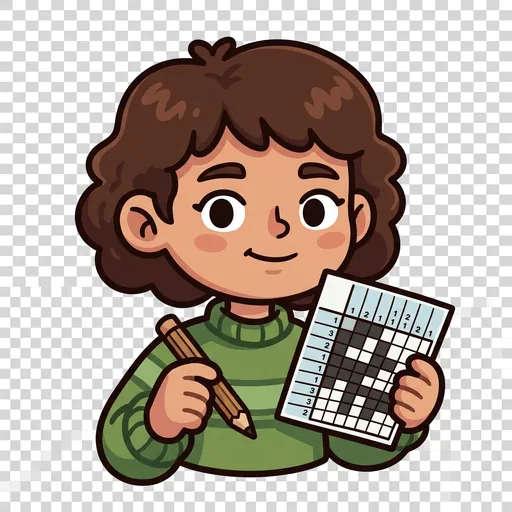
Nona
Nonograms: filling a hidden picture from number clues, cell by cell
-

Odds
Probabilistic reasoning: choosing well when you cannot be certain
-

Reeve
Cross-referencing: corroborating clues against each other
-

Rulewright
Guess-the-rule induction: form a hypothesis, then test it
-

Tablo
Logic-grid deduction: eliminating possibilities in a grid
-

Vary
Controlling variables: changing one thing at a time
-
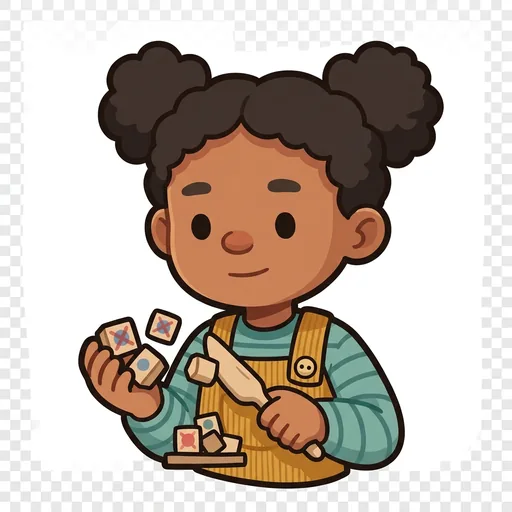
Whittle
Code-narrowing: you never hunt for the answer, you narrow toward it