
Deducia
THE PREDICT-OBSERVE-EXPLAIN FRAME — Deducia doesn't embody one mechanic; she frames them all as science. Commit a prediction BEFORE the reveal, observe what actually happens, then explain the difference. A wrong prediction isn't a failure — it's the most useful information you can get.
Chapter — Deducia and the Guess She Made Out Loud
Deducia, who runs the DeduceQuest agency, makes everyone guess before they get to see.
It drives new detectives a little crazy. They want to wait, to gather more, to be sure before they commit. Deducia won’t let them. “Predict first,” she says, tapping the covered clue. “Out loud. Say what you think will happen before I turn it over. Then we’ll look. Then you’ll tell me why you were right — or, better, why you were wrong.” She calls it the detective’s real method, and she insists it’s exactly how scientists work too: predict, observe, explain. “A guess you commit to teaches you ten times more than a fact someone hands you.”
Deducia learned this the hard way, from years of being the smartest person in the room who was quietly afraid to be wrong in it.
As a young investigator she was brilliant and cautious — too cautious. She’d never commit to a theory until she was certain, which meant she committed to almost nothing, which meant she learned slowly and took the credit for very little. She thought she was being careful. She was actually just protecting herself from the small sting of a wrong guess. And that protection was costing her every mistake she might have learned from.
An old mentor of hers, a retired scientist, finally called it out. He set a covered box in front of her and asked what was inside. She said she couldn’t know yet. He said, “I didn’t ask what you know. I asked what you predict. Commit. Be wrong if you’re wrong.” She forced herself to guess — and she was wrong — and in the instant the box opened, the gap between what she’d expected and what was actually there taught her more, faster, than a hundred careful non-committals ever had. Her wrong prediction had made the truth stick, because she’d had something to compare it against.
“You’ve spent your whole career,” her mentor said, “afraid of a feeling that’s actually the best teacher you’ll ever have.”
She built her whole agency around that lesson. Every case at DeduceQuest runs the same three-beat rhythm, and Deducia enforces it like a drumbeat: predict, observe, explain.
When a new detective faces one of Whittle’s codes, or Tablo’s grids, or Nona’s number-pictures, or Rulewright’s rule-puzzles, Deducia doesn’t let them peek and then rationalize. She makes them say what they expect first. Then they act, and see what really happens. Then — the part she cares about most — they explain the difference: why did the result match, or why didn’t it? “The prediction is the hook,” she says. “Without it, the answer just washes over you and leaves nothing behind. With it, the answer lands on something — your guess — and it sticks.”
A girl came to the agency who refused to guess. “I don’t want to say it if I might be wrong.” Deducia recognized that fear instantly; she’d worn it for years. She didn’t push. She just asked a tiny prediction — “which of these two doors do you think hides the clue?” — small enough to risk. The girl guessed. She was wrong. And Deducia, instead of moving past it, stopped. “Good. Now — why did you think it was that door? And what does the real answer tell you that your guess didn’t?” The girl explained, and in explaining, understood the case better than any of the detectives who’d waited to be sure.
“See?” Deducia said gently. “The wrong guess didn’t cost you anything. It bought you the understanding. You’d never have looked that closely at the real answer if you hadn’t had a guess to compare it to.”
The girl started guessing after that — small at first, then bravely — and learned faster than anyone in her cohort, because every guess gave the truth something to land on.
At the end of a long day the girl asked Deducia the question under the fear. “Doesn’t it ever feel bad, being wrong in front of everyone?”
Deducia considered it honestly. “It used to feel like the worst thing in the world,” she said. “I spent years never committing, just to avoid it. And all that carefulness bought me was slowness and a very tidy record of things I never learned.” She uncovered a fresh case. “Here’s what I know now: a wrong prediction isn’t a mark against you. It’s information. It’s the map showing you exactly where your thinking and the world don’t match yet — and that gap is the only place learning ever happens. The detectives who are brave enough to guess out loud, and then explain their surprises, run circles around the ones who wait to be sure.” She smiled, warm and certain. “So predict. Observe. Explain. And when you’re wrong — and you will be — get curious, not ashamed. That’s the whole method. That’s the whole job.”
The girl walked home making little predictions about everything — which way the cat would jump, which sock she’d find first — and checking, and being wrong sometimes, and feeling, each time, not smaller but sharper.
The DeduceQuest ensemble
Deducia is part of DeduceQuest's distributed-narrative cast. Each character embodies a different curricular primitive; together they teach the full subject.
-

Cogent
Constructing explanations: telling deductive apart from inductive reasoning
-

Contra
Proof by contradiction: assume the opposite and watch it break
-
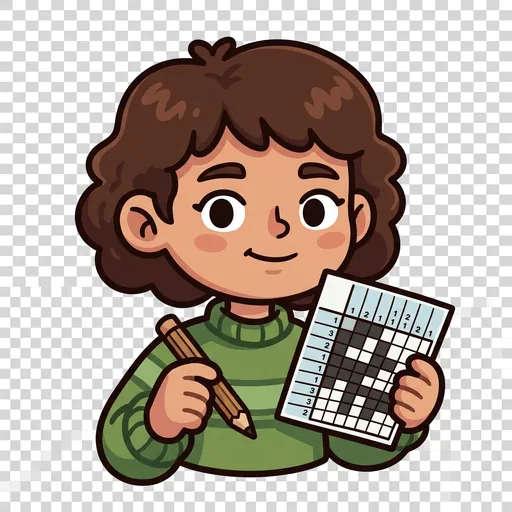
Nona
Nonograms: filling a hidden picture from number clues, cell by cell
-
Odds
Probabilistic reasoning: choosing well when you cannot be certain
-

Reeve
Cross-referencing: corroborating clues against each other
-
Rulewright
Guess-the-rule induction: form a hypothesis, then test it
-

Tablo
Logic-grid deduction: eliminating possibilities in a grid
-

Vary
Controlling variables: changing one thing at a time
-
Whittle
Code-narrowing: you never hunt for the answer, you narrow toward it