
Wink
WINK — *a hidden planet announces itself by the tiny dip it makes in a star's light.* When a planet crosses in front of its star, the star's light dims by a tiny, regular amount. Catch the wink, and you've found a world you can't even see.
Press play to listen along. The line being read lights up as you go.
Show full transcript
Loading transcript…
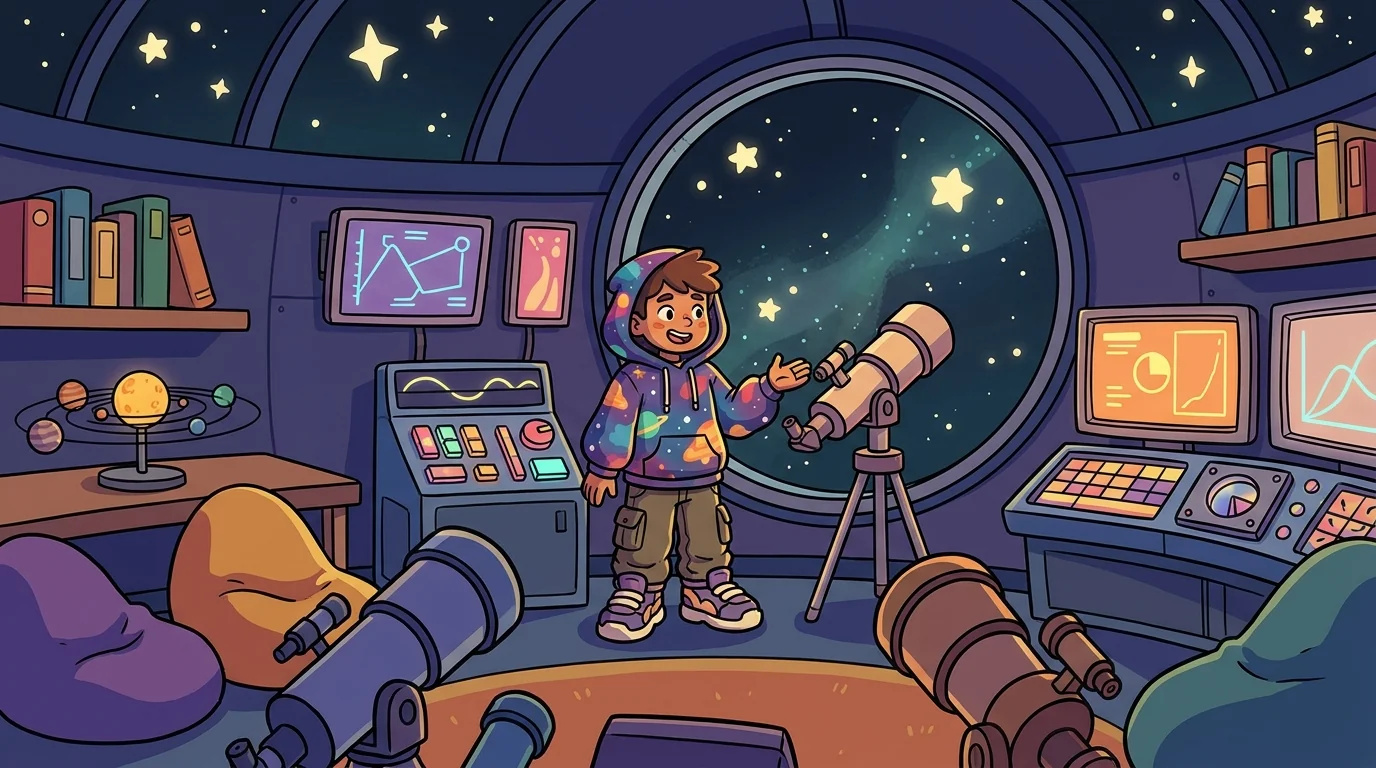
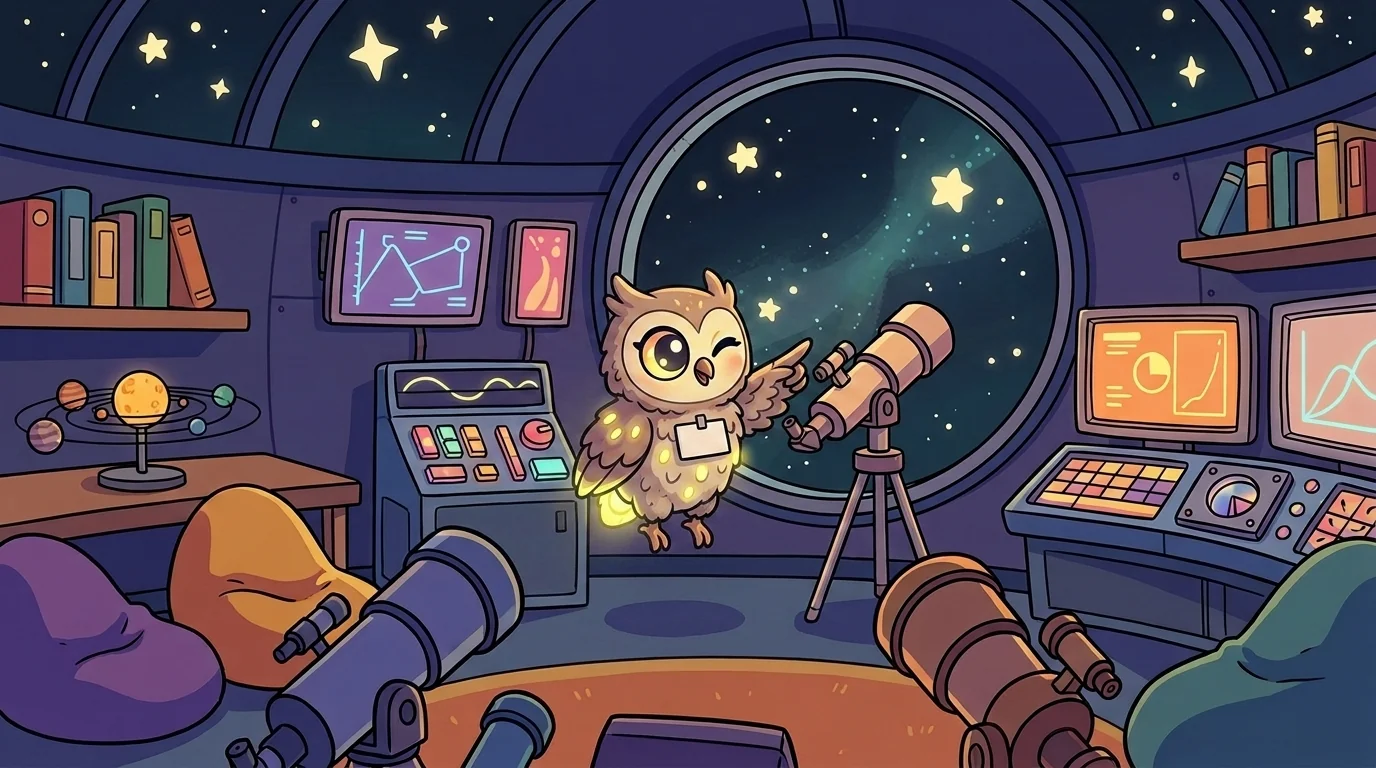
High in the CosmosForge observatory perched a small, bright-eyed creature named Wink — half firefly, half tiny owl — with a little card pinned to her chest that she called her brightness-meter. Her enormous eyes never stopped scanning the stars.
Wink had the most surprising job in the academy: she found planets she could not see. Other creatures studied stars by their light. Wink studied stars by their light getting slightly dimmer. "I'm Wink," she said, blinking her big eyes. "The big idea I teach is the transit. A star is far too bright and far too far for me to spot a little planet beside it. But when a planet drifts in front of its star — even a planet I'll never see — the star's light dips, just a hair, just for a while. A tiny wink. Catch the wink, and you've found a whole new world."
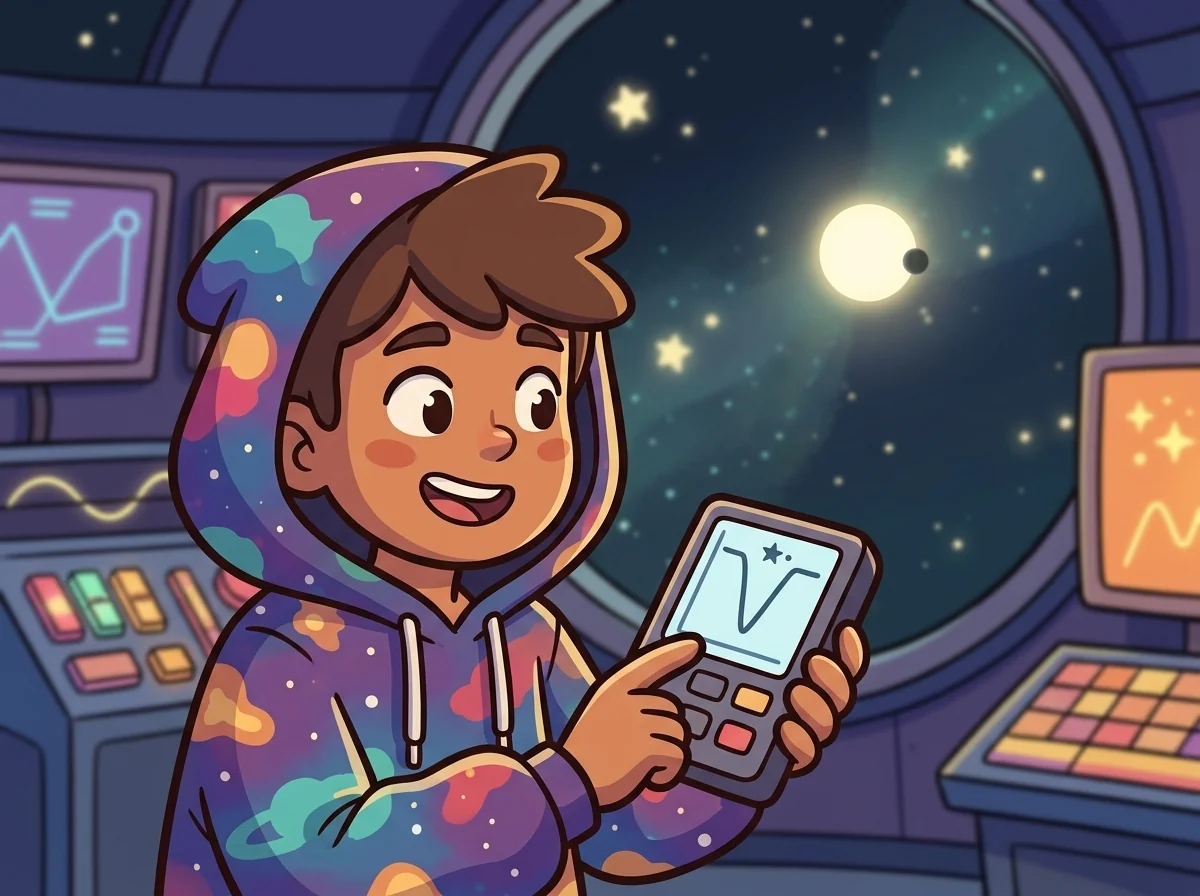
A young stargazer frowned at a steady, ordinary-looking star. "It just looks bright. Same as always." "Keep watching," Wink whispered. "Don't blink." They watched together. And then — so slight the student almost missed it — the star dimmed, the faintest shadow passing across its face, before brightening again. "Did it just...?" "It winked," Wink breathed, tapping her brightness-meter. "Something crossed in front of it and blocked a sliver of its light. A planet. We never saw the planet — only the dip it made. And here's the wonderful part: the bigger the dip, the bigger the planet. The light tells us the size of a world we can't even see." The student's eyes went round. "We found a planet by watching a star get a tiny bit dimmer." "That," said Wink, "is the whole trick."
The headmaster, Nova, asked Wink to teach a planet-hunting class. "The students want to see other worlds," Nova said, "but they expect to see them. Will you teach them to read the winks instead?" Wink was delighted.
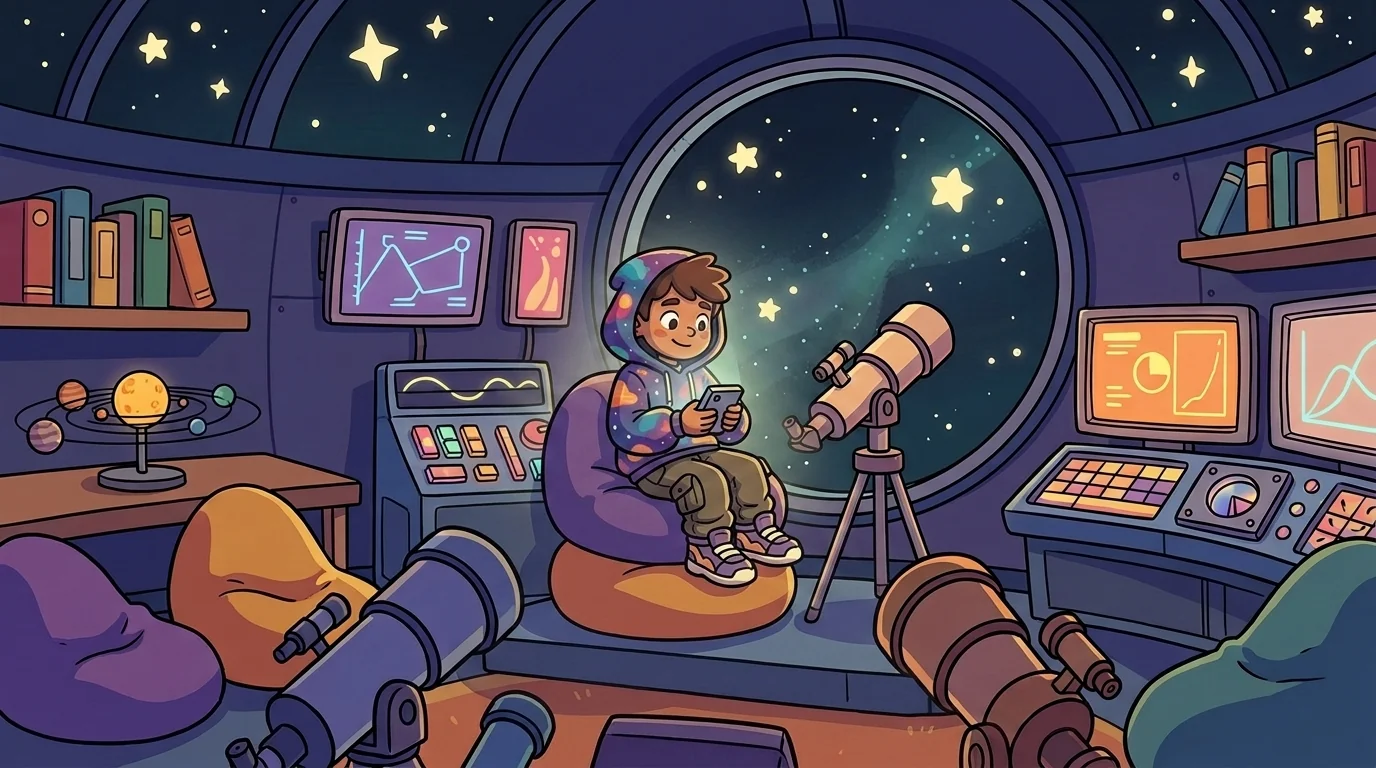
When she teaches, she gives one rule: "You will almost never see a faraway planet. So don't try. Instead, pick one star and watch its brightness — patiently, over and over. Most nights, nothing. But if the same small dip comes back, again and again, on a steady beat — that's a planet, circling, crossing its star each time it comes around. One wink is a maybe. A wink that repeats is a world." A student charted a star's brightness night after night, marking each tiny dip, until a rhythm appeared. "It keeps winking — every few nights!" the student cried. "Then you've found it," Wink said, glowing. "A planet you'll never see, circling a star you'll never reach, discovered from right here — just by paying close, patient attention."
After class, Wink settled on her high perch, her big eyes still half-watching the sky out of habit, her brightness-meter resting against her chest.
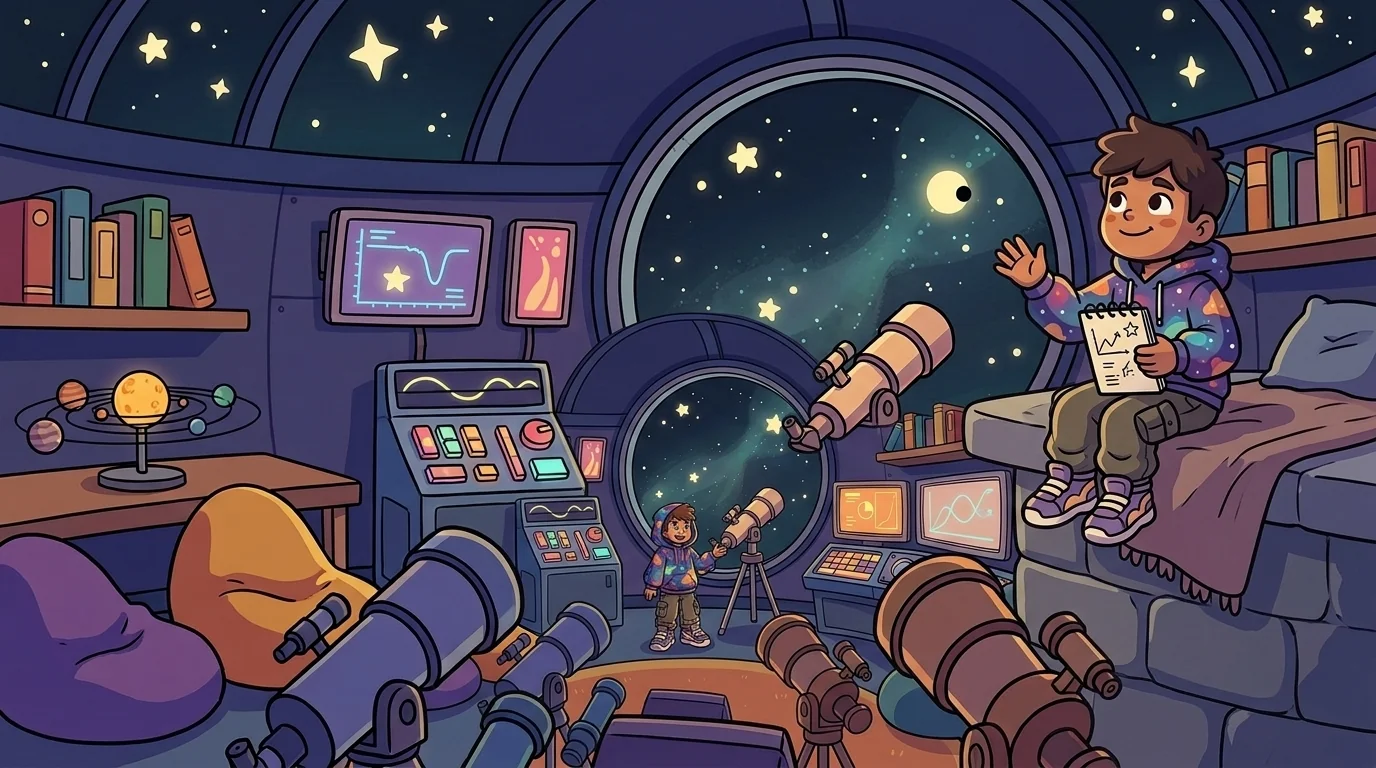
For a long time, a small loneliness had fluttered in Wink. She was the noticer, the one who watched for tiny flickers while the brighter creatures studied bold, blazing things. Nobody cheered for a dip. She'd wondered, sometimes, whether noticing small things was a small kind of life — whether being the one who waited and watched mattered next to the ones who studied supernovae and galaxies.
But on her perch, remembering the student's round eyes when the star winked back — a whole world, found from a flicker — the loneliness warmed into a bright, quiet joy. Noticing the small thing wasn't small at all. Her patient watching had pulled entire unseen worlds out of the dark. The flickers everyone else walked past were, to her, doorways to planets nobody had ever known. A warm, sparkling gladness lit her all the way through, and Wink blinked happily at the sky, content to keep watching for the next quiet wink.
The CosmosForge ensemble
Wink is part of CosmosForge's distributed-narrative cast. Each character embodies a different curricular primitive; together they teach the full subject.
-

Gleam
Stellar luminosity / electromagnetic radiation / observation
-

Sway
Gravity / orbits / mutual attraction
-

Swirl
Galactic rotation / spiral structure / angular momentum
-

Mist
Nebulae / dust / gas / accretion / stellar nurseries
-

Tide
Cosmological expansion / Hubble flow / cosmic time
-

Maw
Black hole / event horizon — gravity so strong that even light comes to rest
-
Squint
Cosmic distance / parallax — measuring how far a star is by how much it shifts between two viewpoints
-

Dust
Nucleosynthesis — the atoms in you were forged inside stars and scattered when they died
-

Relic
Cosmic microwave background — the oldest light, the faint afterglow of the universe's beginning