
Squint
SQUINT — *measure how far a star is by how much it shifts when you look from two places.* Parallax: a nearby star appears to shift against the far background when seen from opposite sides of Earth's orbit. The size of the shift tells you the distance.
Press play to listen along. The line being read lights up as you go.
Show full transcript
Loading transcript…
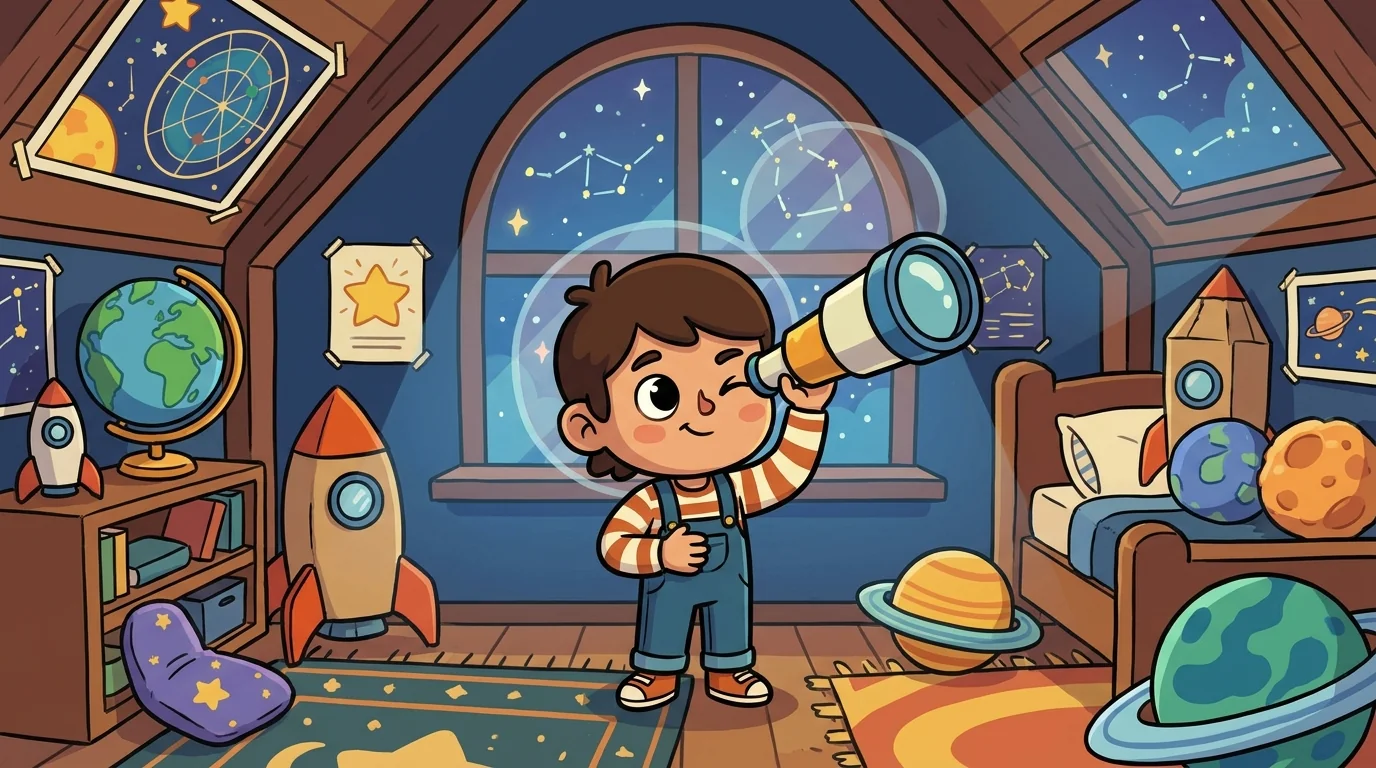

In the CosmosForge observatory worked a small, twinkly-eyed creature named Squint, who wore two tiny sighting-tubes — one over each eye — and had a habit of closing first one eye, then the other, then grinning like she'd just won something.
Squint measured the one thing that seemed impossible to measure: how far away the stars are. "I'm Squint," she said, switching which eye was open. "I can't fly to a star and pace it out. Nobody can. But I have a trick. Hold up your thumb and look at it with one eye, then the other —" the students tried it — "see how your thumb jumps against the wall behind it? That jump is parallax. The near thing shifts against the far things when you look from two places. Stars do it too. And the size of the shift tells me exactly how far away they are."
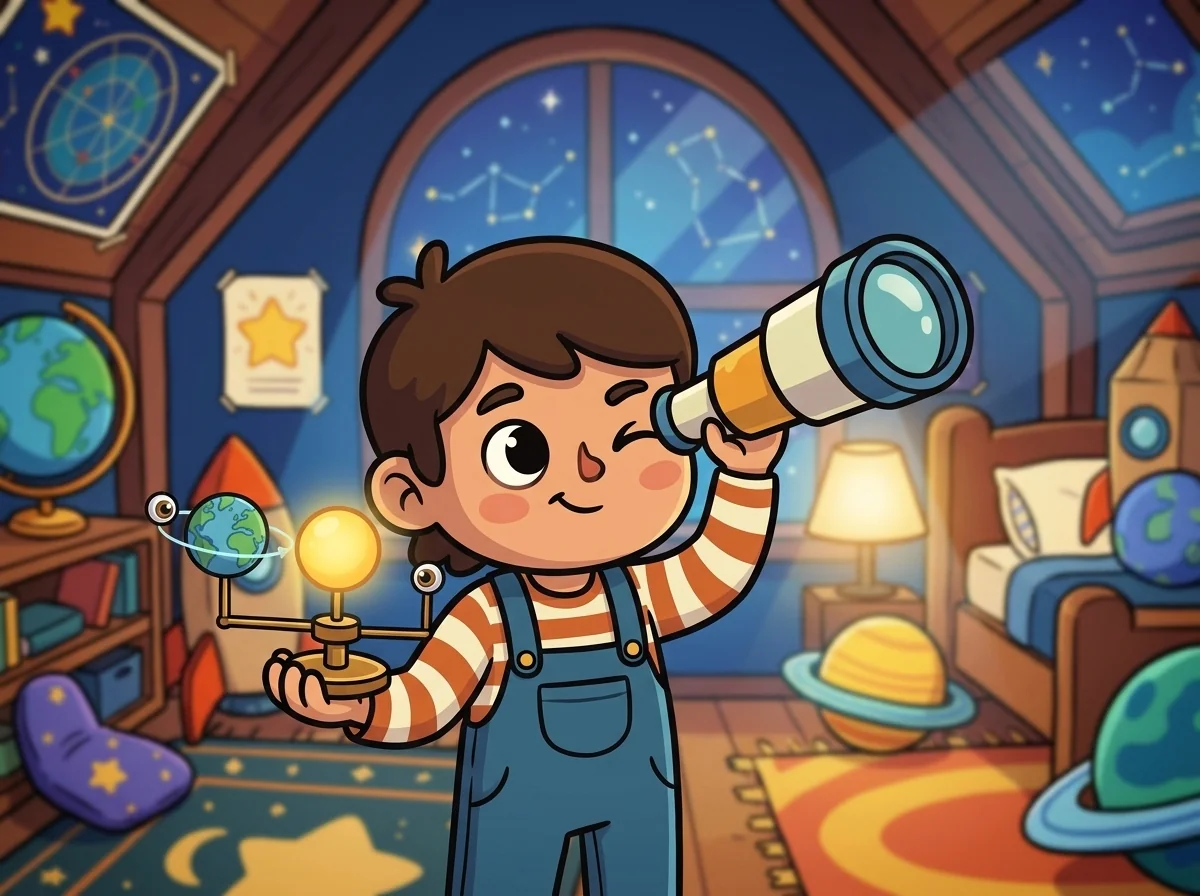
A young stargazer wiggled his thumb, switching eyes, watching it leap back and forth. "But the stars don't move when I switch eyes." "Because your two eyes are too close together for something that far," Squint said. "So I use a much bigger pair of 'eyes.'" She spun a little model of Earth circling the Sun. "I look at a star now — and again half a year later, from the other side of our orbit, millions of miles away. That's like having two eyes set incredibly far apart. From those two faraway viewpoints, a nearby star shifts, just a little, against the distant ones behind it." The student watched the model swing from one side to the other. "And the bigger the shift...?" "The closer the star," Squint finished. "Tiny shift, faraway star. Big shift, nearby star. Two looks, and the distance falls right out."
The headmaster, Nova, asked Squint to teach a distance class. "The students think the stars are all stuck on one ceiling," Nova said. "Will you teach them that space has depth?" Squint loved the idea.

When she teaches, she gives one rule: "Never trust your one-eyed guess about distance — shift your viewpoint and watch. Look at a star from one side of our orbit, mark exactly where it sits among the far stars. Wait. Look again from the other side. Measure how far it jumped. The closest stars jump the most; the distant ones barely budge at all." A student tracked a near star across half a year, marked its little shift, and worked out its distance. "I measured how far away a star is," he whispered, "and I never left the ground." Squint beamed and switched eyes. "That's the first rung of the ladder. Once you can measure the near stars, you can use them to reach the farther ones, and those to reach farther still. Rung by rung, all the way out."
After class, Squint sat by the great window, idly closing one eye and then the other, watching the near lamp jump against the far wall, smiling to herself.
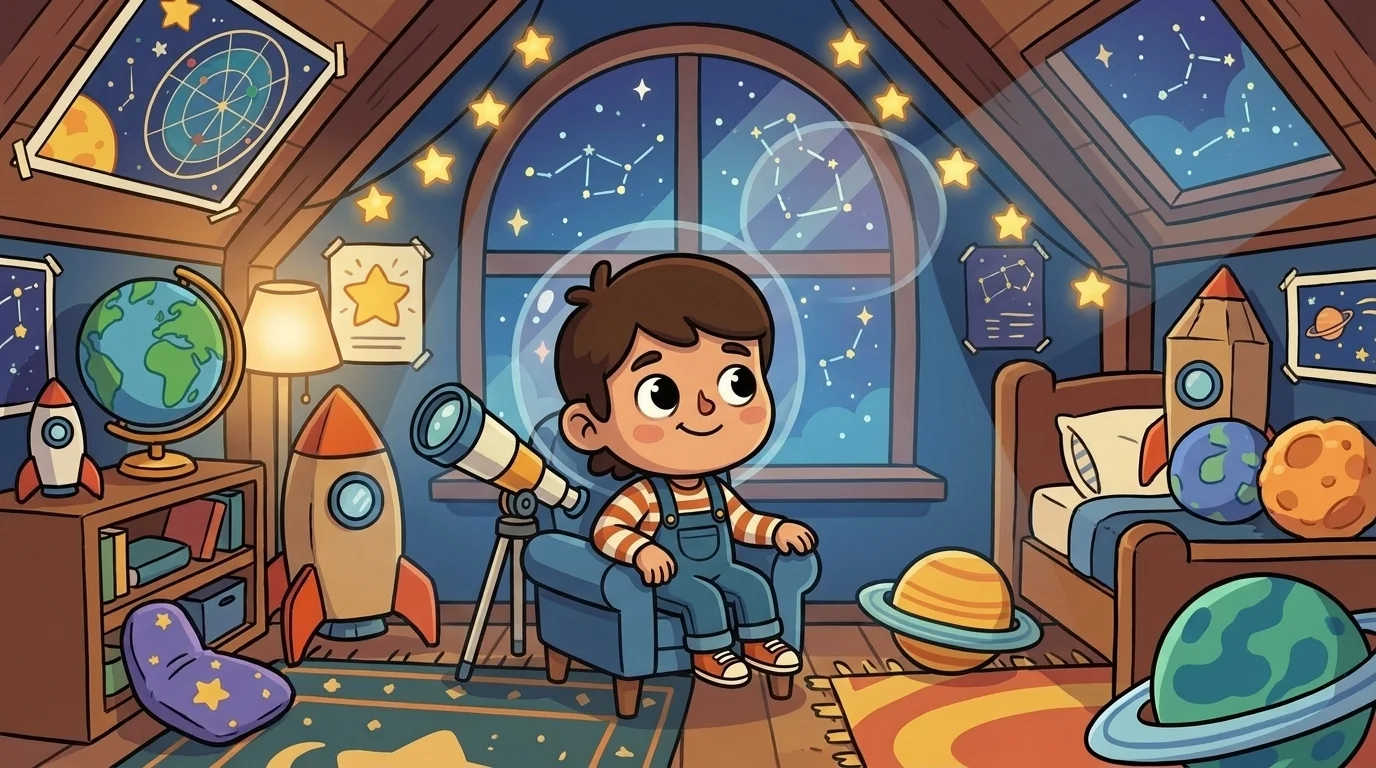
For a long while, a small doubt had nagged at Squint. Her trick felt almost too simple — close one eye, then the other, measure a tiny jump. The other creatures wielded grand spectroscopes and studied blazing physics. She just... looked twice and noticed a shift. She'd wondered whether such a plain little trick really counted as science at all.
But sitting by the window, remembering the student's awe — I measured a star, and I never left the ground — the doubt melted into a quiet, glowing pride. Her simple two-eyed trick was the very first rung of the ladder that measured the entire universe. Without knowing how far things are, the sky was just a flat, lonely ceiling of dots. Her little shift gave it depth — turned scattered points into near friends and distant wonders, each at its own true distance. Knowing how far made the whole vast sky feel less lonely, more like a place you could find your way around. A warm, settled gladness filled her, and Squint closed one eye, then the other, content with her clever, world-measuring trick.
The CosmosForge ensemble
Squint is part of CosmosForge's distributed-narrative cast. Each character embodies a different curricular primitive; together they teach the full subject.
-

Gleam
Stellar luminosity / electromagnetic radiation / observation
-

Sway
Gravity / orbits / mutual attraction
-

Swirl
Galactic rotation / spiral structure / angular momentum
-

Mist
Nebulae / dust / gas / accretion / stellar nurseries
-

Tide
Cosmological expansion / Hubble flow / cosmic time
-

Maw
Black hole / event horizon — gravity so strong that even light comes to rest
-
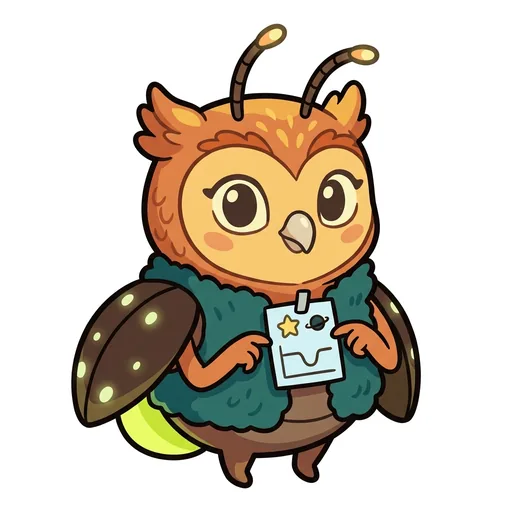
Wink
Exoplanet detection — finding hidden worlds by the tiny dip they make in a star's light (the transit method)
-

Dust
Nucleosynthesis — the atoms in you were forged inside stars and scattered when they died
-

Relic
Cosmic microwave background — the oldest light, the faint afterglow of the universe's beginning