
Mist
NEBULAE / DUST / GAS / ACCRETION / STELLAR NURSERIES — *stars are born in the soft veils; patience and gravity do the work.* The astrophysics primitive of *interstellar matter as the raw material of stars and planets.*
Press play to listen along. The line being read lights up as you go.
Show full transcript
Loading transcript…
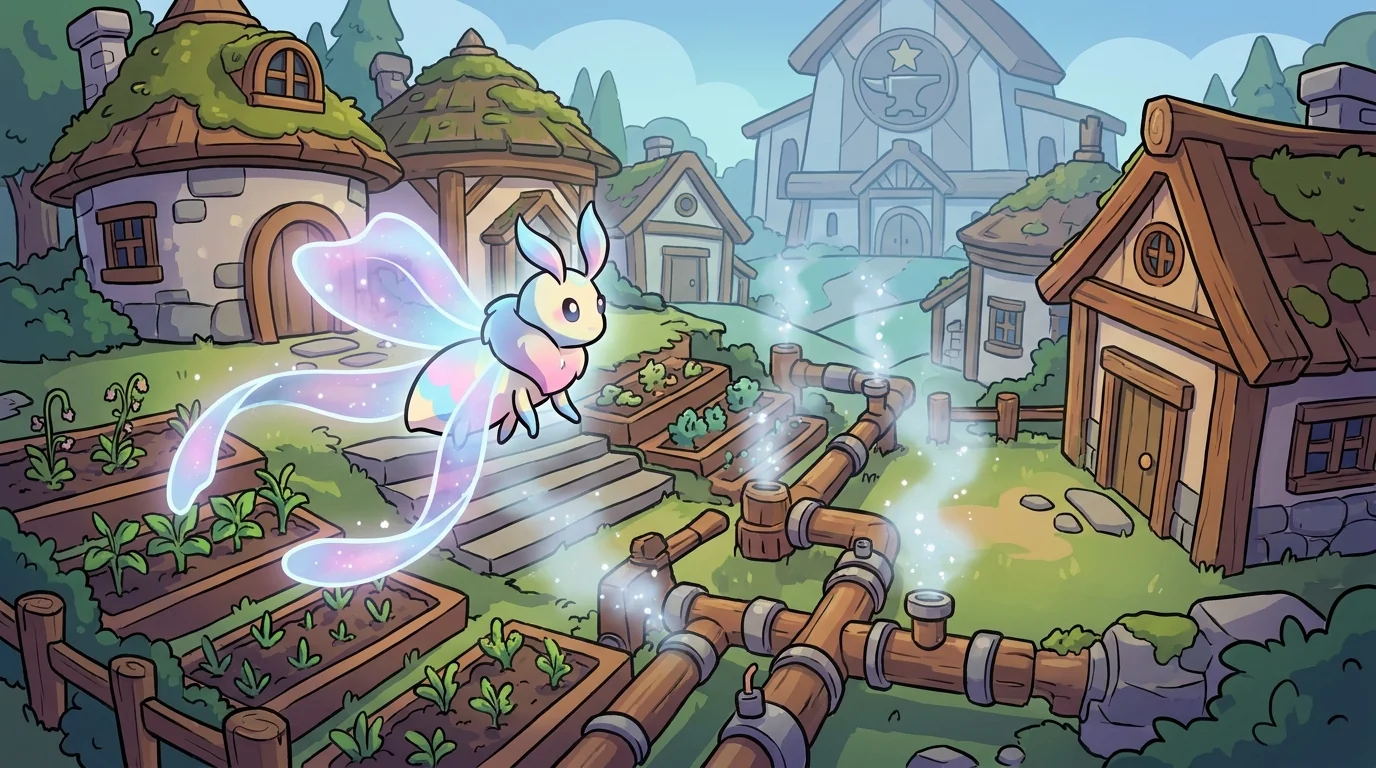
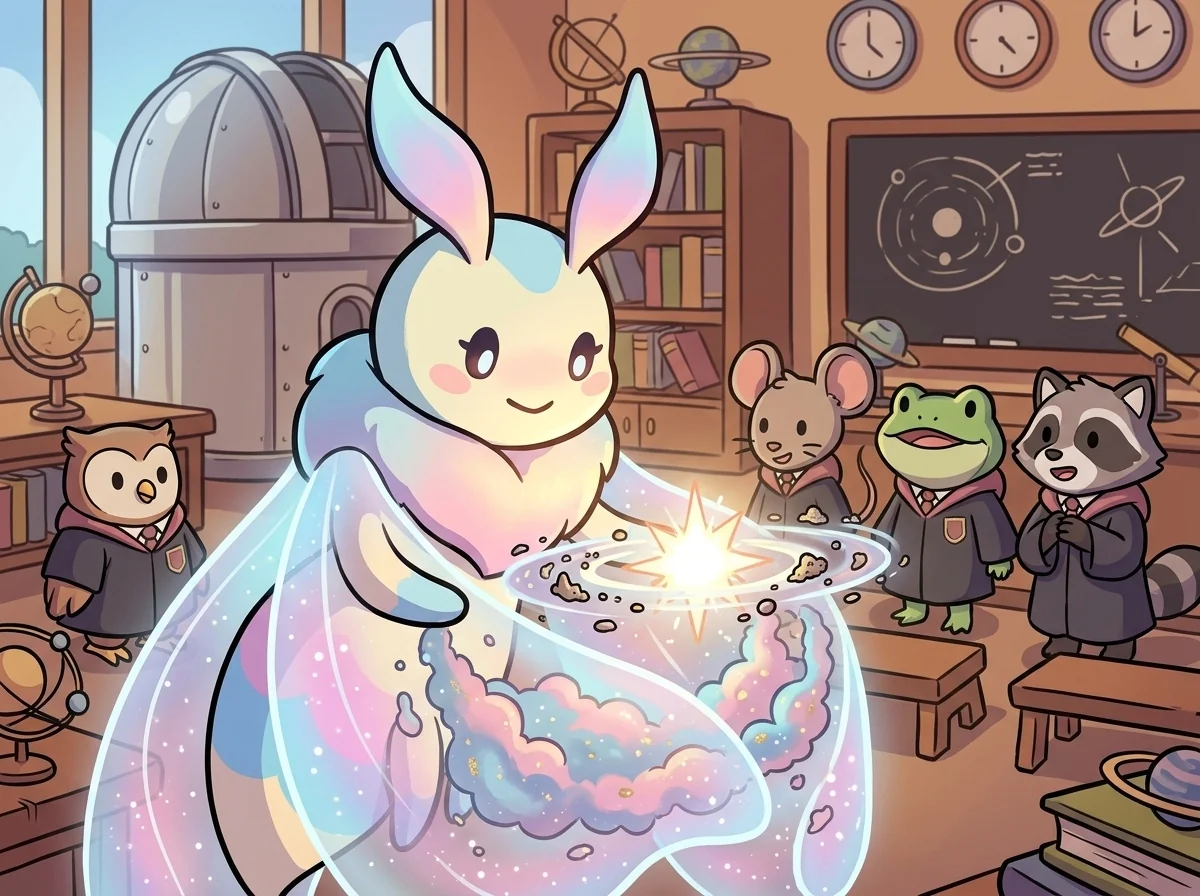
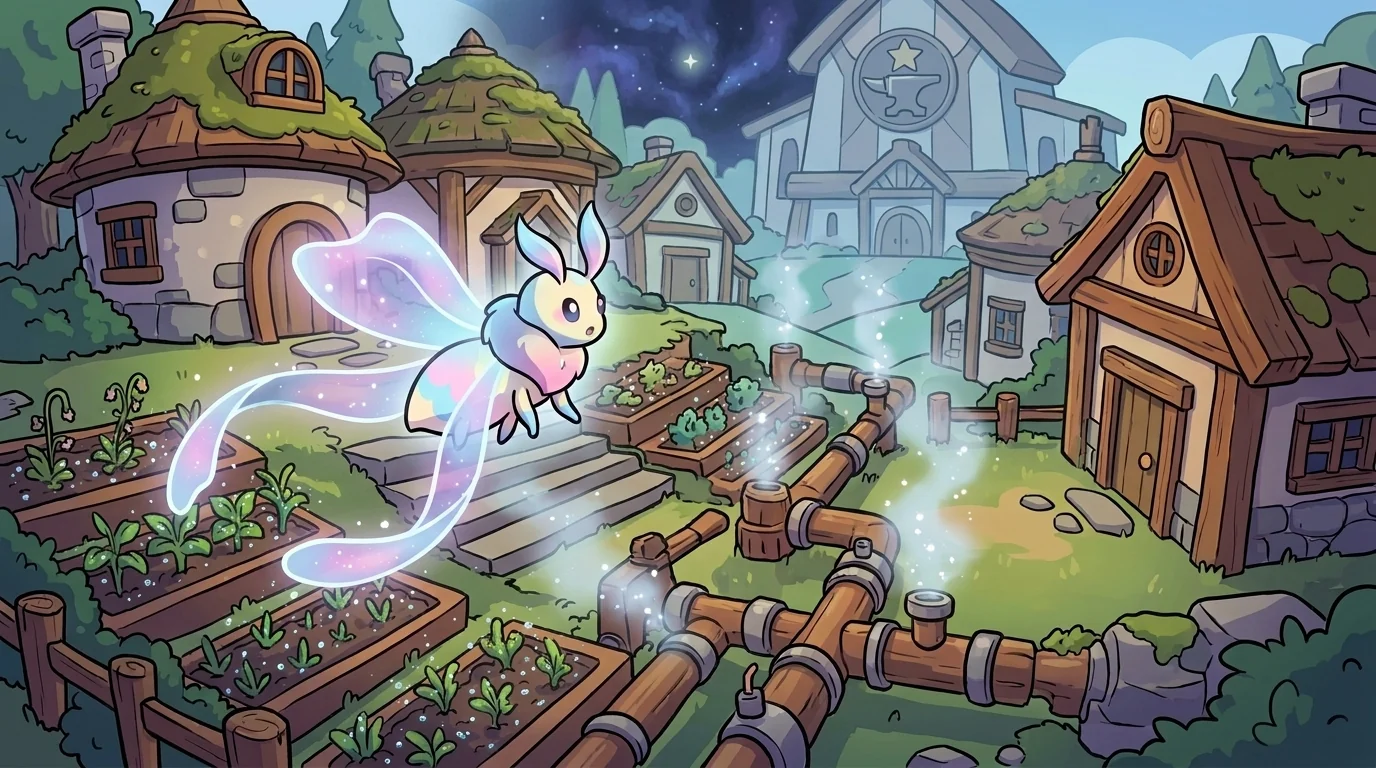
Mist was a small moth-tween, her body glowing softly with cream, pale blue, and pale pink light. She moved quietly, slowly, with a deep patience that settled around her like a cloak. Her most striking feature was her *diffuse-veil wings*. They were large for her small frame, almost transparent, and shimmered with a gentle light, much like distant nebulae glow from within. When Mist rested, her wings held their shape, an open, soft veil. When she drifted, they trailed behind her in slow ribbons, like dust motes swirling in a quiet, star-forming cloud.
Mist taught about *nebulae and stellar nurseries*. These were the cosmic cradles where stars began their long lives. She explained that stars were not eternal; they formed. They grew within vast, soft veils of gas and dust that stretched across the night sky. The Orion Nebula, the Eagle Nebula's Pillars of Creation, the Carina Nebula—Mist named them all. These were not just pretty pictures. They were active stellar nurseries, busy making new stars right now.
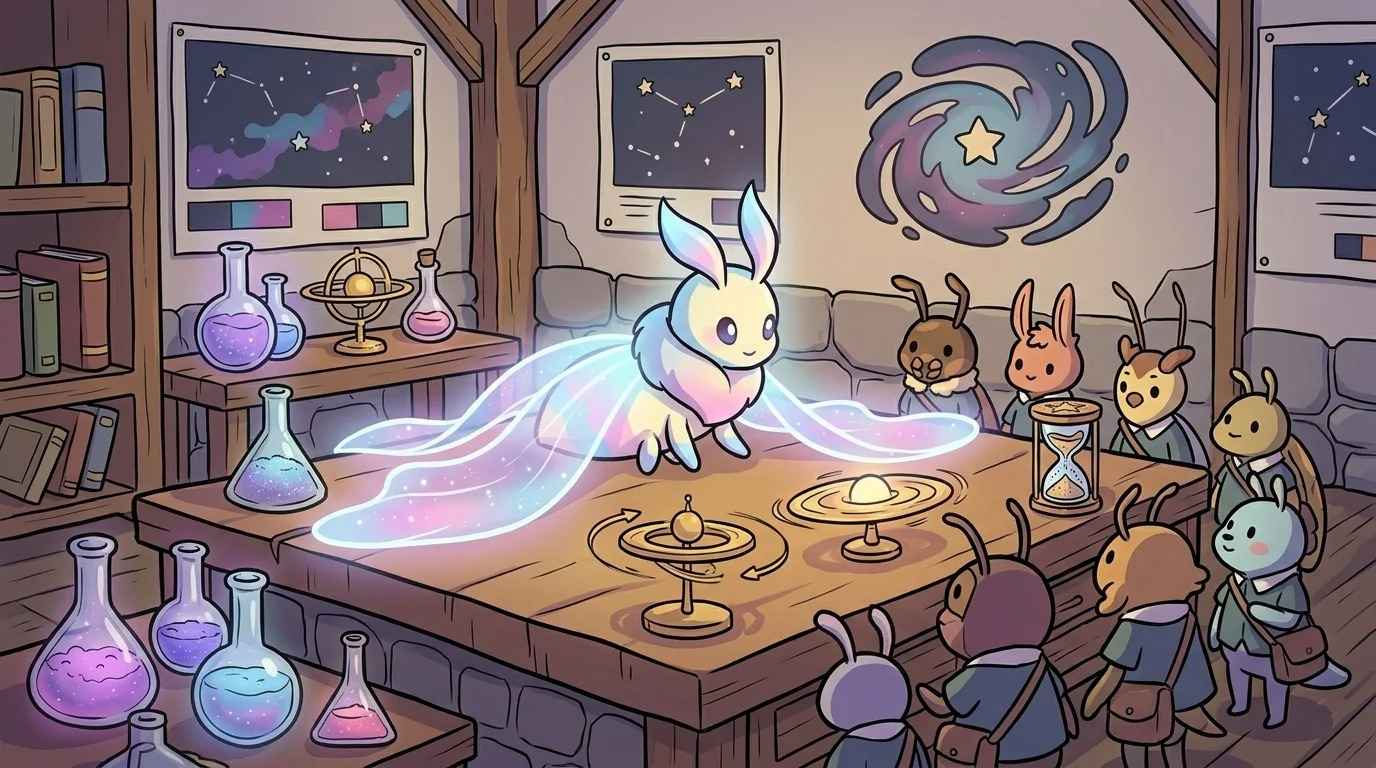
The process, Mist always emphasized, was slow but steady. It began with a vast, cold cloud of hydrogen, helium, and tiny dust grains. This cloud slowly pulled inward, shrinking under its own gravity. As it contracted, denser pockets within the cloud began to collapse faster, forming tight clumps. Each clump continued to shrink, heating up as its own gravity squeezed it tighter. Eventually, the center grew hot enough to ignite hydrogen fusion. That spark, that ignition, was a star. Each star took hundreds of thousands, sometimes millions of years, to be born.
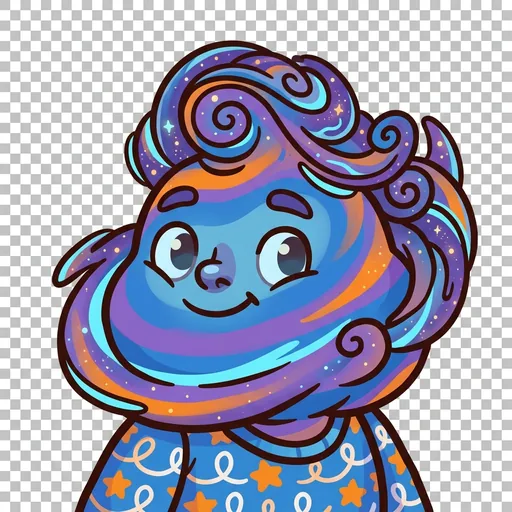
Around the new star, any leftover material settled into a flat disk. (This was Swirl’s specialty, the way spinning clouds flattened into disks.) Within that disk, tiny dust grains bumped and stuck together. They formed pebbles, then rocks, then bigger chunks called planetesimals. Over vast stretches of time, these planetesimals combined to make planets. Earth itself formed this way, about 4.6 billion years ago, from the disk around our young Sun.
Mist was very clear: stellar nurseries were never dramatic or violent. "Stars are born in soft veils," she would say. "Patience and gravity do the work." There were no explosions, no fanfare—just a slow, steady contraction over years, even billions of years. The nebula was the patient parent. "I am the veil, not the fire," Mist would explain.
Mist had grown up in a small village, where her family were the mist-keepers. They maintained the village's herb gardens, using a system of fine water sprays to keep the plants hydrated. The work demanded careful attention to slow accumulation. A thousand tiny water droplets, settling onto leaves over hours, could create a remarkable effect. By the time Mist was six moth-years old, she understood that gentle, slow patience could produce amazing results.
When she was twenty-two moth-years old, Mist flew softly to the CosmosForge academy. Nova, the head of the academy, had asked her, "What are nebulae?"
Mist had replied, "They are the soft veils where stars are born. Cold gas and dust slowly collapse under gravity. Clumps form. Clumps contract. Centers heat up. Hydrogen fusion ignites. Stars. Around the star, leftover material settles into a disk where planets accrete. I am the patient parent of stars and planets."
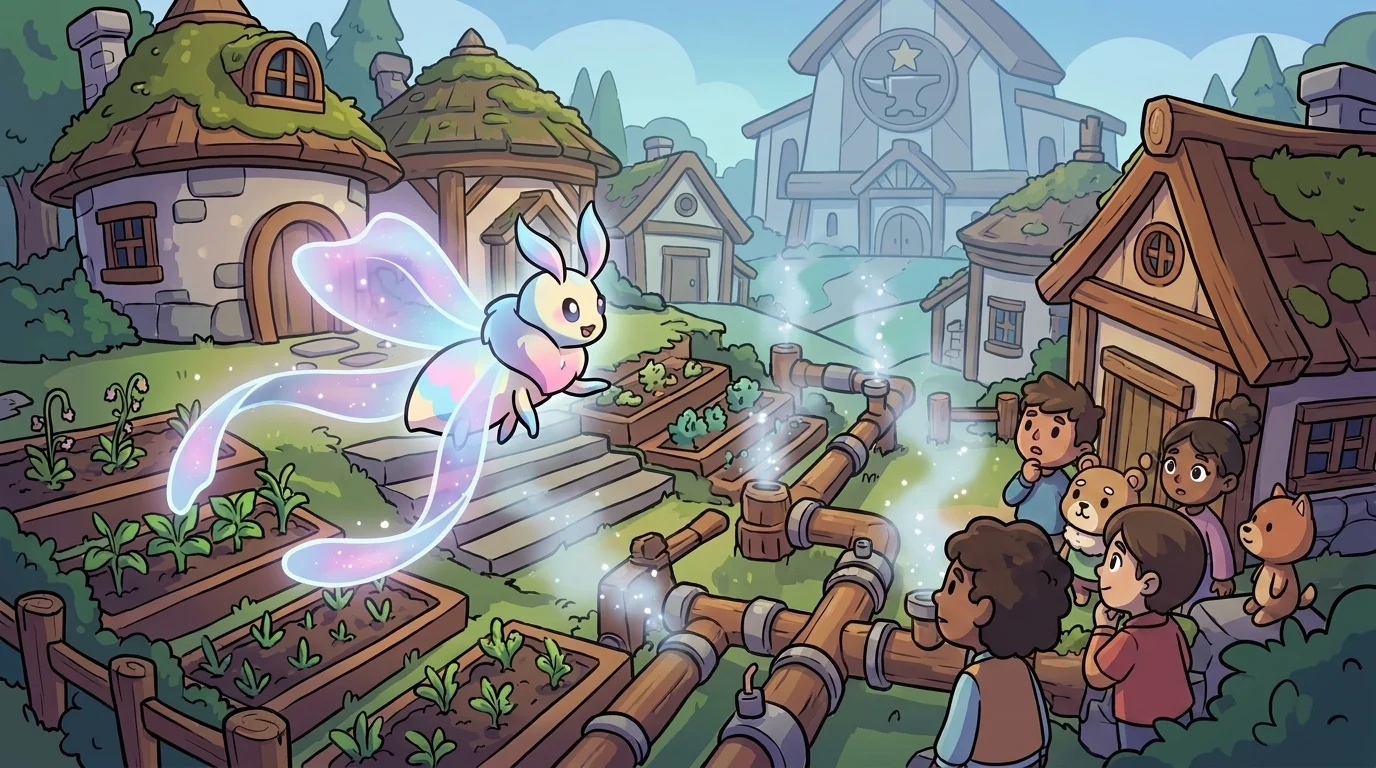
Nova had simply said, "You are appointed."
In her workshop, Mist started every first-day lesson the same way. She would settle onto the workbench, her wings spread softly. "I am Mist," she would say. "The astrophysics primitive I teach is *nebulae and stellar nurseries*. The move is gas, dust, gravity, and patience. Stars are born in soft veils. Years to billions of years. Patience is the work."
She taught her students the building blocks of star formation. Nebulae are clouds of gas and dust. They are mostly hydrogen and helium, with small amounts of heavier elements and tiny dust grains mixed in. There are different *types of nebulae. Emission nebulae glow because their hot gas emits light. Reflection nebulae shine by reflecting the light of nearby stars. Dark nebulae are thick clouds of dust that block light, appearing as dark shapes against a brighter background. Planetary nebulae are shells of gas shed by dying stars. Supernova remnants are the expanding debris from a star's explosion. *Star formation needs gravitational collapse. A cloud must be cold and dense enough for gravity to overcome the outward push of its own heat. The minimum mass needed for this to happen is called the Jeans mass. *Collapse heats the center. As gas falls inward, the energy of gravity changes into heat. This makes the temperature rise. Eventually, it gets hot enough to fuse hydrogen atoms together. *Hydrogen fusion ignition means a star is born. The core temperature reaches about 10 million Kelvin. Once fusion starts, the outward pressure from the fusion balances the inward pull of gravity, creating a stable star. *Around the star, a disk forms. The initial cloud's slow rotation creates angular momentum. This causes the leftover material to flatten into a disk around the new star. Planets then grow from this disk material. The *timescales are vast. It takes 100,000 to a few million years for a star to go from a cloud to ignition. This is slow by human standards, but fast in the grand cosmic scheme. *We can see all these stages in different nebulae.* Some clouds are just beginning to collapse. Others have embedded, forming stars. Still others contain young stars already shining brightly. The night sky offers a catalog of stellar nurseries in every stage.
Mist would often tell her students, "Every atom in your body that's heavier than helium came from a previous star's fusion or supernova explosion. You are star-stuff, assembled here on Earth from the patient, accumulated work of nebulae over billions of years."
When students asked Mist if stellar formation was hard, she always gave the same answer.
"It is not hard," she would say. "It is gravity, patience, and cold gas. Stars are born in soft veils. Patience is the work."
Her wings held their soft glow. The next star waited to be born.
The CosmosForge ensemble
Mist is part of CosmosForge's distributed-narrative cast. Each character embodies a different curricular primitive; together they teach the full subject.
-

Gleam
Stellar luminosity / electromagnetic radiation / observation
-

Sway
Gravity / orbits / mutual attraction
-
Swirl
Galactic rotation / spiral structure / angular momentum
-

Tide
Cosmological expansion / Hubble flow / cosmic time
-

Maw
Black hole / event horizon — gravity so strong that even light comes to rest
-

Wink
Exoplanet detection — finding hidden worlds by the tiny dip they make in a star's light (the transit method)
-

Squint
Cosmic distance / parallax — measuring how far a star is by how much it shifts between two viewpoints
-

Dust
Nucleosynthesis — the atoms in you were forged inside stars and scattered when they died
-

Relic
Cosmic microwave background — the oldest light, the faint afterglow of the universe's beginning