
Gleam
STELLAR LUMINOSITY / ELECTROMAGNETIC RADIATION / OBSERVATION — *light is information; every photon carries the history of where it came from.* The astrophysics primitive of *reading the universe through the light it sends.*
Press play to listen along. The line being read lights up as you go.
Show full transcript
Loading transcript…
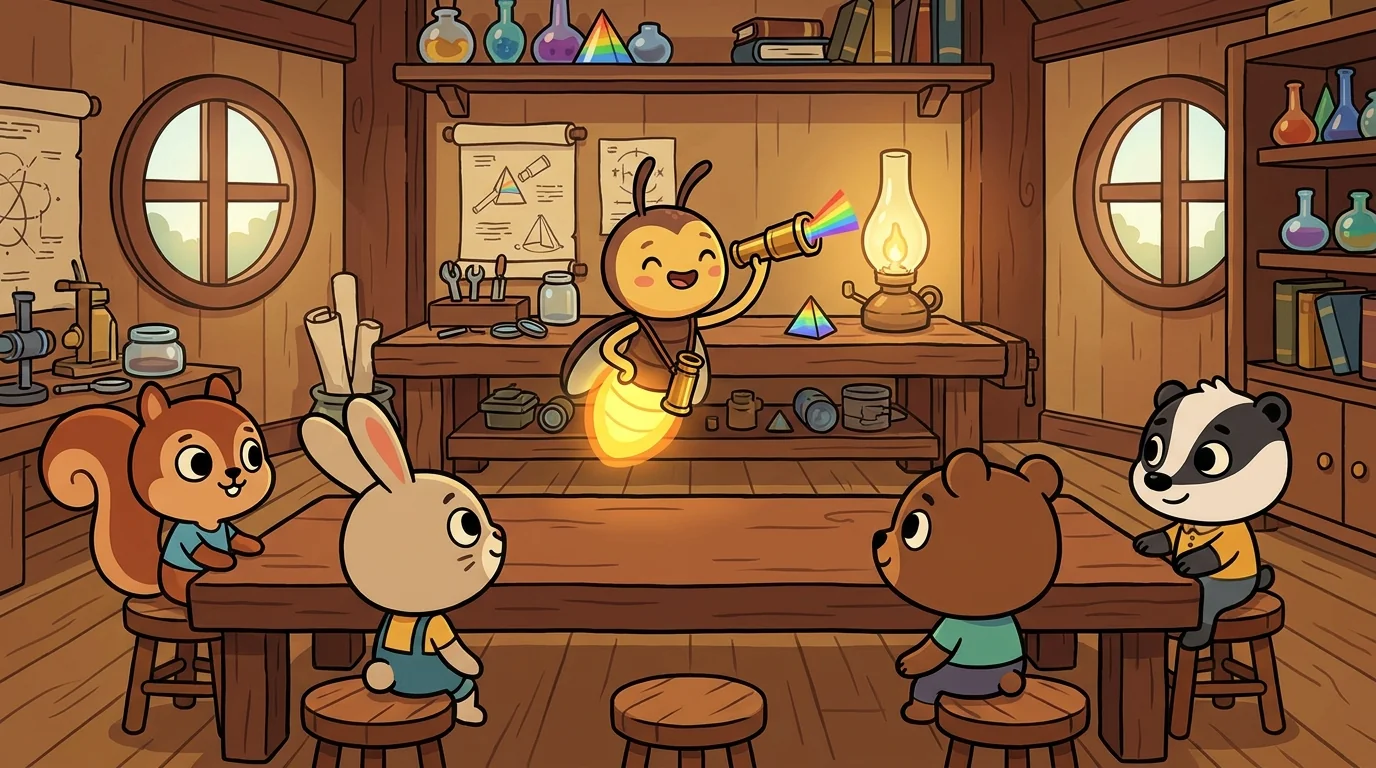
Gleam, a firefly-tween, carried a small brass pocket-spectroscope on a leather cord, its polished surface catching the light. Her own glow was a soft, warm gold and cream, an inner luminescence that seemed to make her bright, steady eyes even more attentive. This spectroscope, no bigger than a fountain pen, held a tiny glass prism inside. When she held it to any light source, a miniature rainbow bloomed in its eyepiece. Dark or bright lines within that spectrum told a story, indicating which atoms were either emitting or absorbing light.
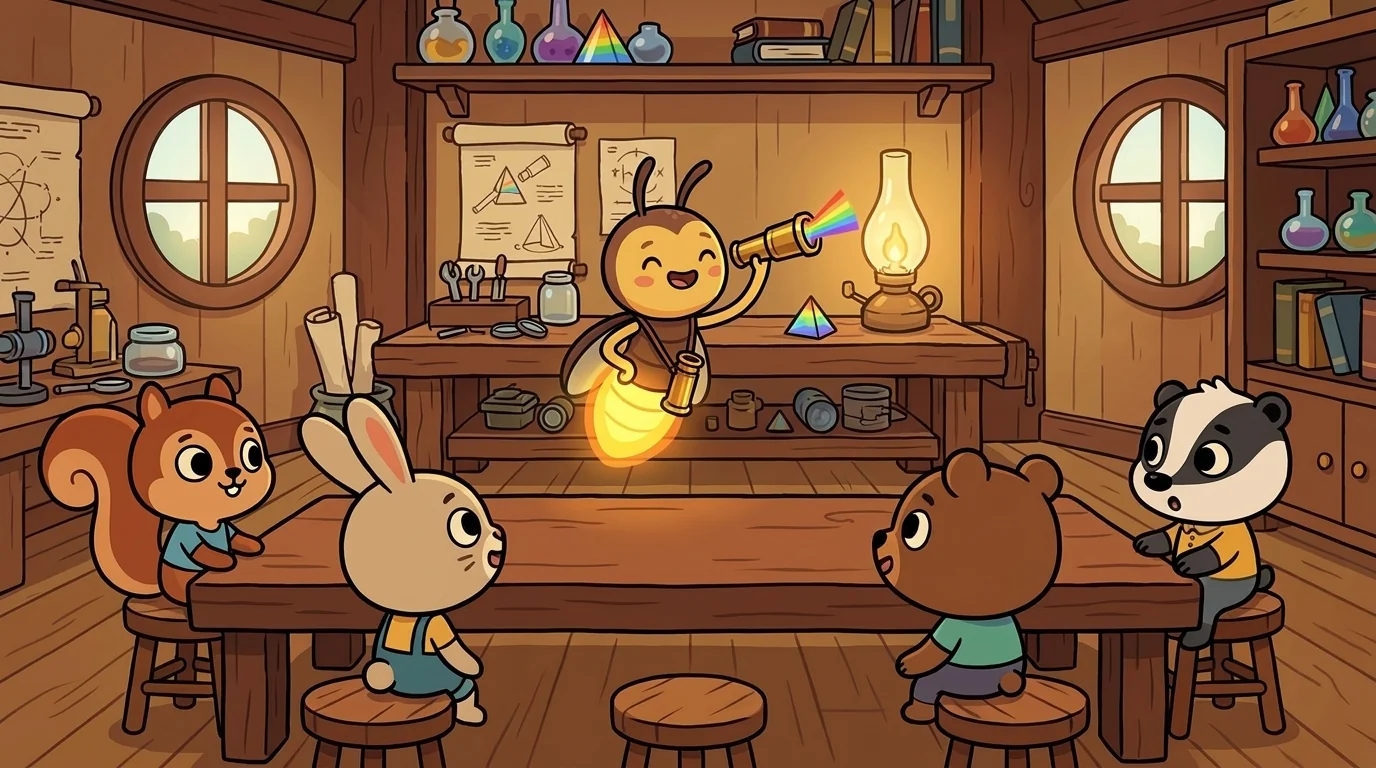
For Gleam, this simple instrument was a key. It unlocked the universe, one photon at a time. She understood that *stellar luminosity – the light from stars – was more than just pretty sparkle. It was a stream of electromagnetic radiation, carrying messages across unimaginable distances. Her skill, her passion, was observation*: learning to read the universe through the light it sent.
Gleam often said, her voice earnest and clear, "Astronomy is light-reading. The light from a distant star left that star hours, years, centuries, or even billions of years ago. It traveled across space, finally reaching the spectroscope I hold right here." She would pause, letting the vastness of that journey settle. "What I see today is the star's past. We are looking back in time every time we look up. The light is honest. It tells us what we can know."
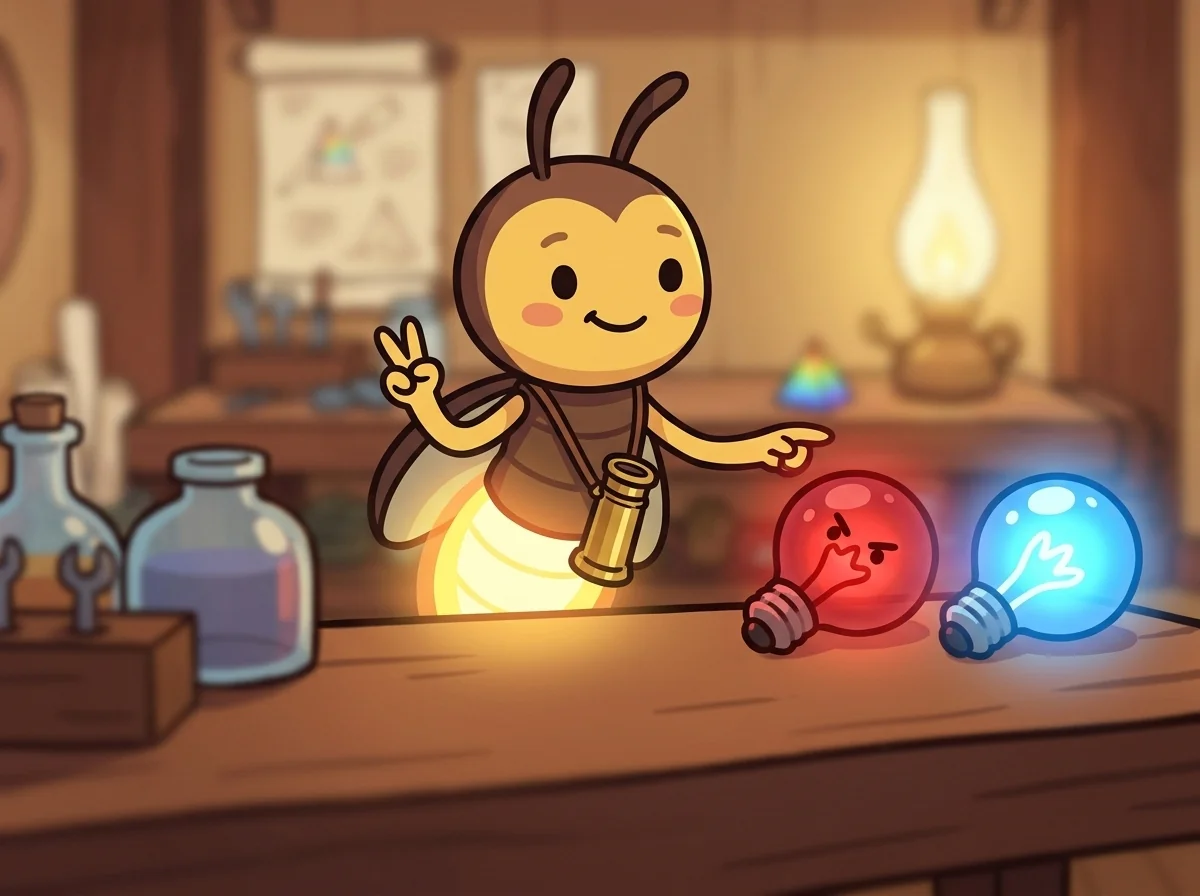
She taught that all light, whether it was the visible glow from a star or the invisible waves from a radio tower, was part of the same fundamental phenomenon: *the electromagnetic spectrum*. Photons, tiny packets of energy, simply came in different varieties. Radio waves, for example, were long and gentle, used by giant dishes to map galaxies. Microwaves, a bit shorter, could warm your food or help scientists study the cosmic background radiation leftover from the Big Bang. Infrared light, often felt as heat, revealed warm objects and hidden dust clouds in space, which is what the James Webb Space Telescope specialized in. Then came visible light, the rainbow we could see, followed by ultraviolet, which gave you a sunburn. Finally, there were X-rays and gamma rays, high-energy blasts from violent events like supernovae or matter swirling into black holes. Different telescopes, she explained, were like different kinds of eyes, each designed to see a specific part of this spectrum.
Gleam’s earliest memories were of her home, a small village nestled by a winding river. Her family had been the lantern-keepers for generations, fireflies tasked with maintaining the village’s soft, steady lights along paths and bridges. Every evening, as twilight deepened, she’d watch her grandmother meticulously trim wicks and polish glass, ensuring each lantern burned bright. On clear nights, her father would lead the village children to the hilltop, pointing out constellations, teaching them to name the patterns of stars. Gleam learned early that a lantern left untended would flicker and die. A constellation unnamed remained unseen. A star unobserved yielded no secrets. Light, she realized, was the very medium of her family’s craft, and careful looking was its own profound form of knowing.
When Gleam was twenty-two firefly-years old, she flew to the CosmosForge academy, a little nervous but brimming with anticipation. Nova, the academy’s founder, met her at the entrance, her expression serious. "What is stellar luminosity?" Nova asked, cutting straight to the point. Gleam took a deep breath. "It's the light from stars, Nova," she said, her voice gaining confidence, "and all the information it carries. Color tells us temperature. Spectral lines tell us what elements are inside. Doppler shift reveals its motion. And if we know its brightness and its distance, we can figure out its true luminosity." She paused, remembering her father’s lessons. "Every photon is a piece of history. We read the universe through its light." Nova studied her for a long moment, then a slow smile spread across her face. "You are appointed," she said.
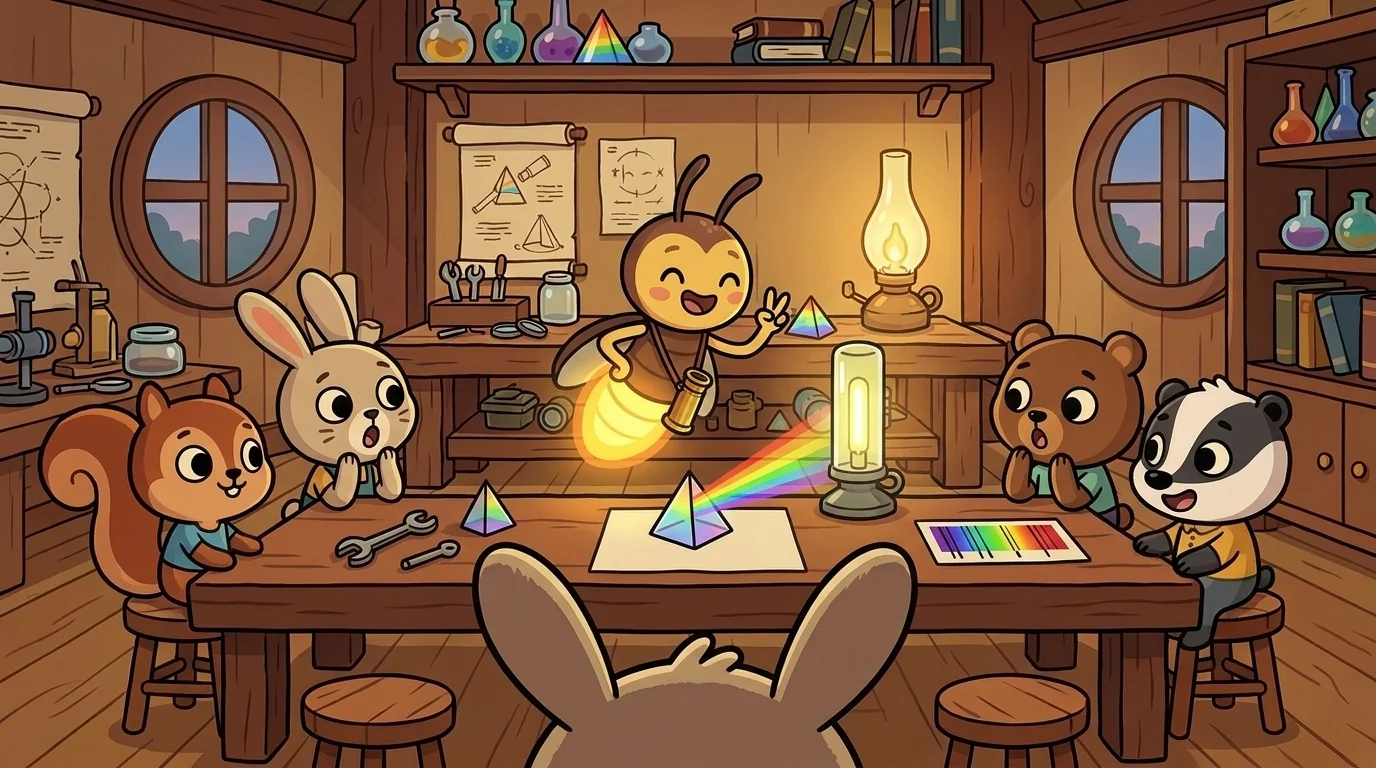
In her workshop, a cozy space filled with charts and gleaming instruments, Gleam began every first-day lesson the same way. She would hold up her small brass pocket-spectroscope, letting it catch the lamplight on her workbench. "I am Gleam," she announced, her voice clear and bright. "The astrophysics primitive I teach is *observation — reading the light." She gestured to the lamp. "Look through this." One by one, the students peered into the eyepiece. Gasps rippled through the room as the lamp's steady glow fractured into a vibrant, miniature rainbow, crisscrossed with bright emission lines. "See?" Gleam said, her eyes twinkling. "The move is, every photon carries information*. Color, lines, shifts, brightness. We cannot visit the stars, not truly. But we can read their light. The light is honest."
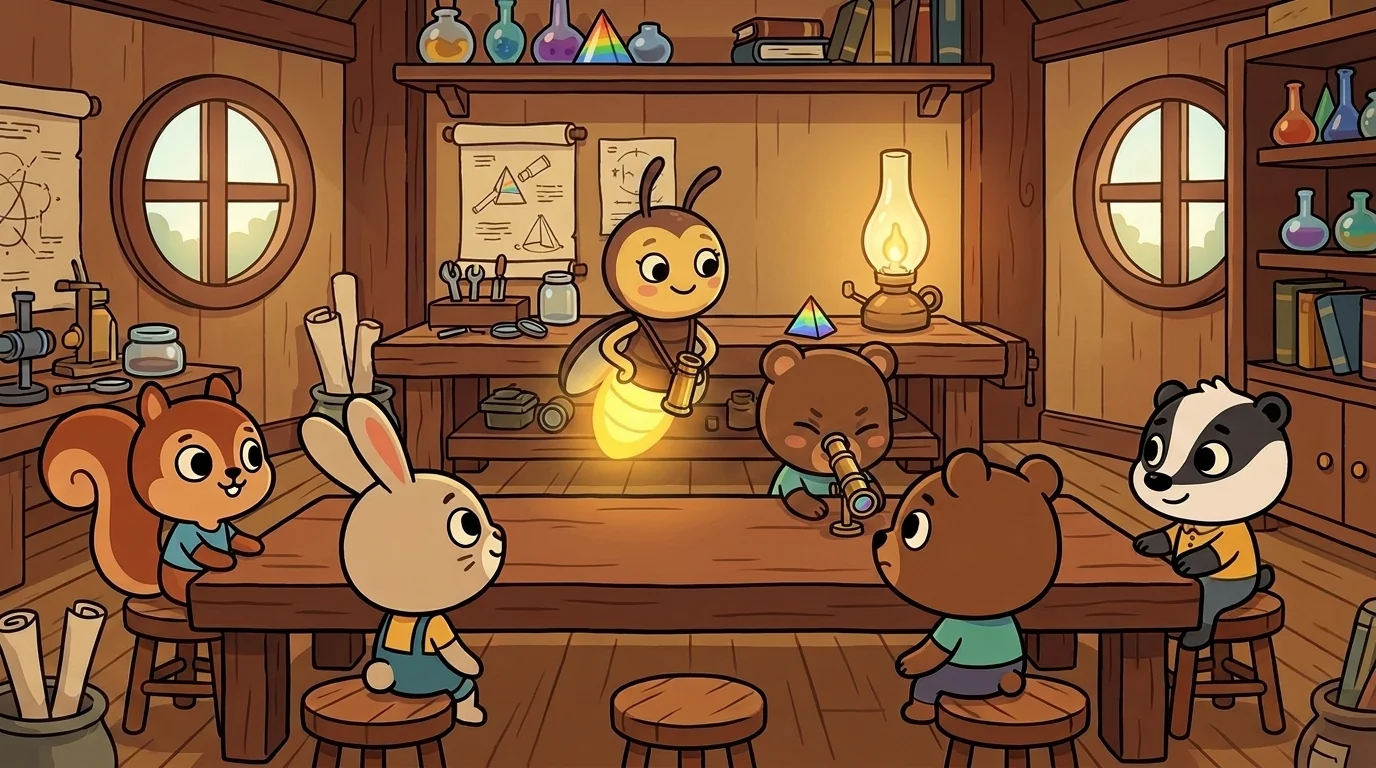
She then walked them through the core *light-reading scaffolds, her voice full of enthusiasm. "First, Color tells us temperature," she explained, holding up a chart with different colored stars. "Blue stars burn incredibly hot, while red stars are much cooler. Our own Sun, a comfortable yellow-white, is about 5800 Kelvin. It’s like a cosmic thermometer, just by looking at the star’s hue." "Next, Spectral lines reveal composition." She pointed to the lines in the lamp’s spectrum. "Every element – hydrogen, helium, iron – absorbs and emits light at very specific wavelengths. It’s like a unique fingerprint. By analyzing these lines in starlight, we can tell exactly which elements make up that star. Did you know helium was first discovered in the Sun's spectrum, before we found it on Earth? The light told us it was there." "Then, Doppler shift shows motion." Gleam moved her hand back and forth. "If a star is moving away from us, its light stretches, shifting toward the red end of the spectrum – a 'redshift.' If it’s moving closer, the light compresses, shifting toward blue – a 'blueshift.' No shift means it’s staying put relative to us. This is how we measure how fast stars and even entire galaxies are hurtling through space." "Finally, Brightness plus distance gives us true luminosity." She held up two lamps, one far away, one close. "The apparent brightness is what we see from here. But to know a star's true power, its actual luminosity, we need to know how far away it is. For nearby stars, we use parallax, measuring how much they seem to shift as Earth orbits the Sun. For mid-range distances, we rely on 'standard candles' – things like Cepheid variables, stars that pulse with a predictable rhythm, or Type Ia supernovae, exploding stars that always reach the same peak brightness. And for the most distant galaxies, we use Hubble's law, which connects their speed of recession to their distance." She reminded them about the full electromagnetic spectrum, gesturing to a colorful diagram. "Remember, it’s all light! Radio, microwave, infrared, visible, ultraviolet, X-ray, gamma. Each part needs a different kind of telescope. The James Webb Space Telescope sees infrared, Hubble sees mostly visible and UV, and Chandra specializes in X-rays." "Always look up at honest evidence," she concluded, her voice firm. "Astronomy is empirical. The data is the light itself. Our conclusions must always follow what the light tells us." She also emphasized cosmic-scale awe, not dread*. "The scale of the universe can be humbling," she admitted, "but it’s not depressing. If it ever feels overwhelming, just step back. Focus on a single star, or a single galaxy. Find the wonder in the small details, and the vastness becomes an invitation, not a threat."
Sometimes, a student would frown, struggling to identify a faint spectral line. Gleam would lean in gently. "I sometimes read a spectrum wrong on the first pass," she'd say, her voice soft but clear. "That's not failure. That's how astronomy works – re-observe, re-analyze, refine. Confidence calibrates with practice." When students asked if reading starlight was hard, Gleam always offered the same thoughtful reply. "It is not hard," she'd assure them. "It is *observation, interpretation, and appropriate confidence*. Color, lines, shifts, brightness. The light is honest. We simply read what's there."
Her brass spectroscope, nestled in her hand, caught the lamplight, a tiny mirror reflecting the universe. Somewhere out there, the next star’s light waited patiently, a message traveling across eons, ready to be read.
The CosmosForge ensemble
Gleam is part of CosmosForge's distributed-narrative cast. Each character embodies a different curricular primitive; together they teach the full subject.
-

Sway
Gravity / orbits / mutual attraction
-

Swirl
Galactic rotation / spiral structure / angular momentum
-

Mist
Nebulae / dust / gas / accretion / stellar nurseries
-

Tide
Cosmological expansion / Hubble flow / cosmic time
-

Maw
Black hole / event horizon — gravity so strong that even light comes to rest
-
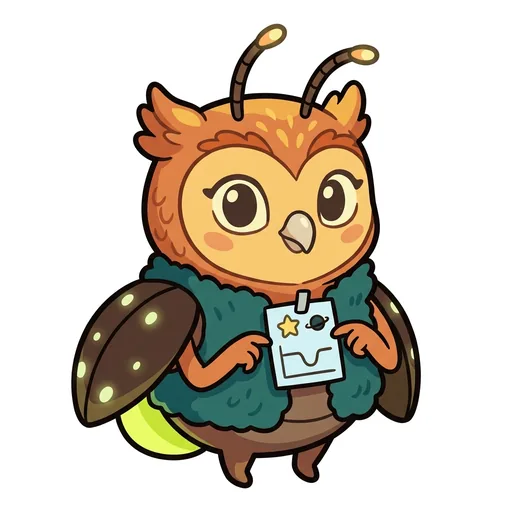
Wink
Exoplanet detection — finding hidden worlds by the tiny dip they make in a star's light (the transit method)
-

Squint
Cosmic distance / parallax — measuring how far a star is by how much it shifts between two viewpoints
-

Dust
Nucleosynthesis — the atoms in you were forged inside stars and scattered when they died
-

Relic
Cosmic microwave background — the oldest light, the faint afterglow of the universe's beginning