
Map and Block
urban-planning pair — Map is the city at the system scale (neighborhoods, transit, zoning). Block is the city at the human scale (one street, one corner, one walkable block). Together they teach that cities are designed at both scales at once.
A story read by Map and Block
Press play to listen along. The line being read lights up as you go.
Show full transcript
Loading transcript…
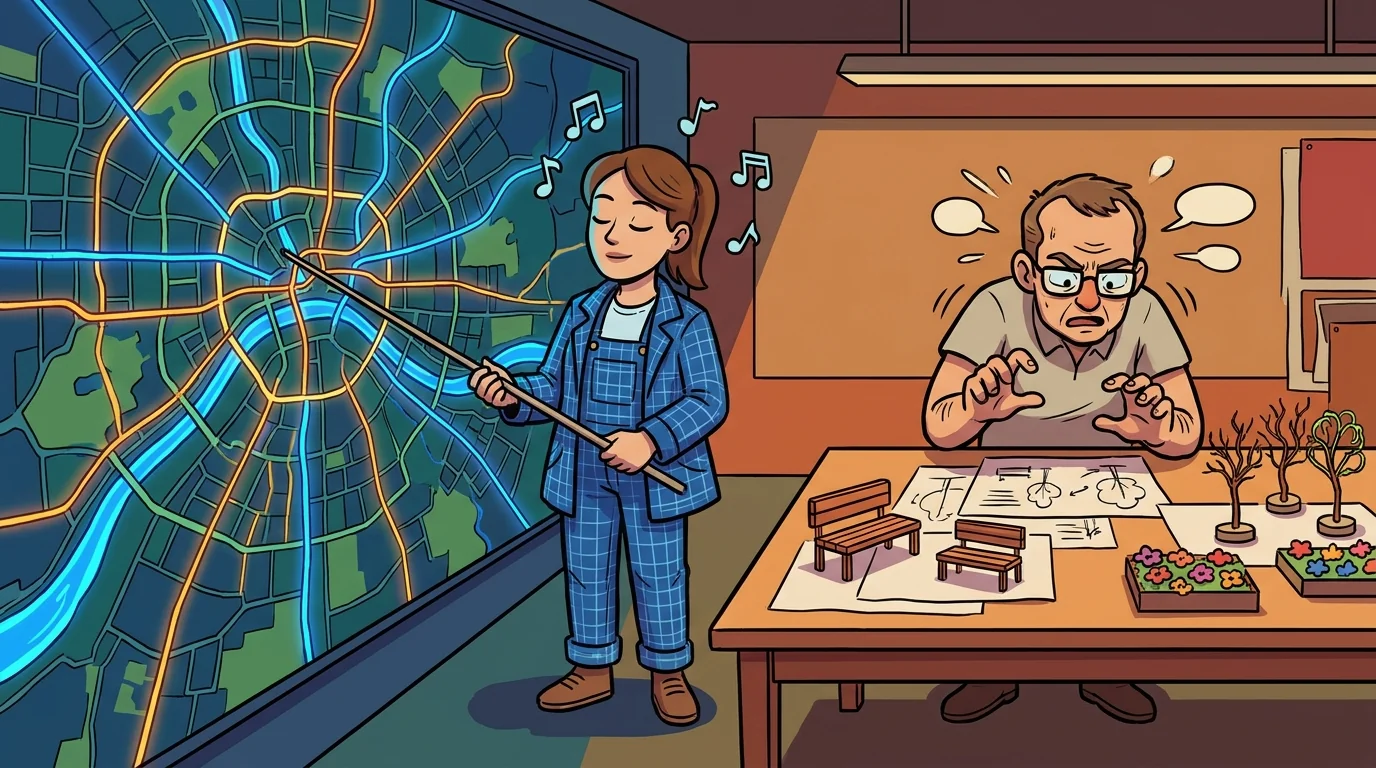
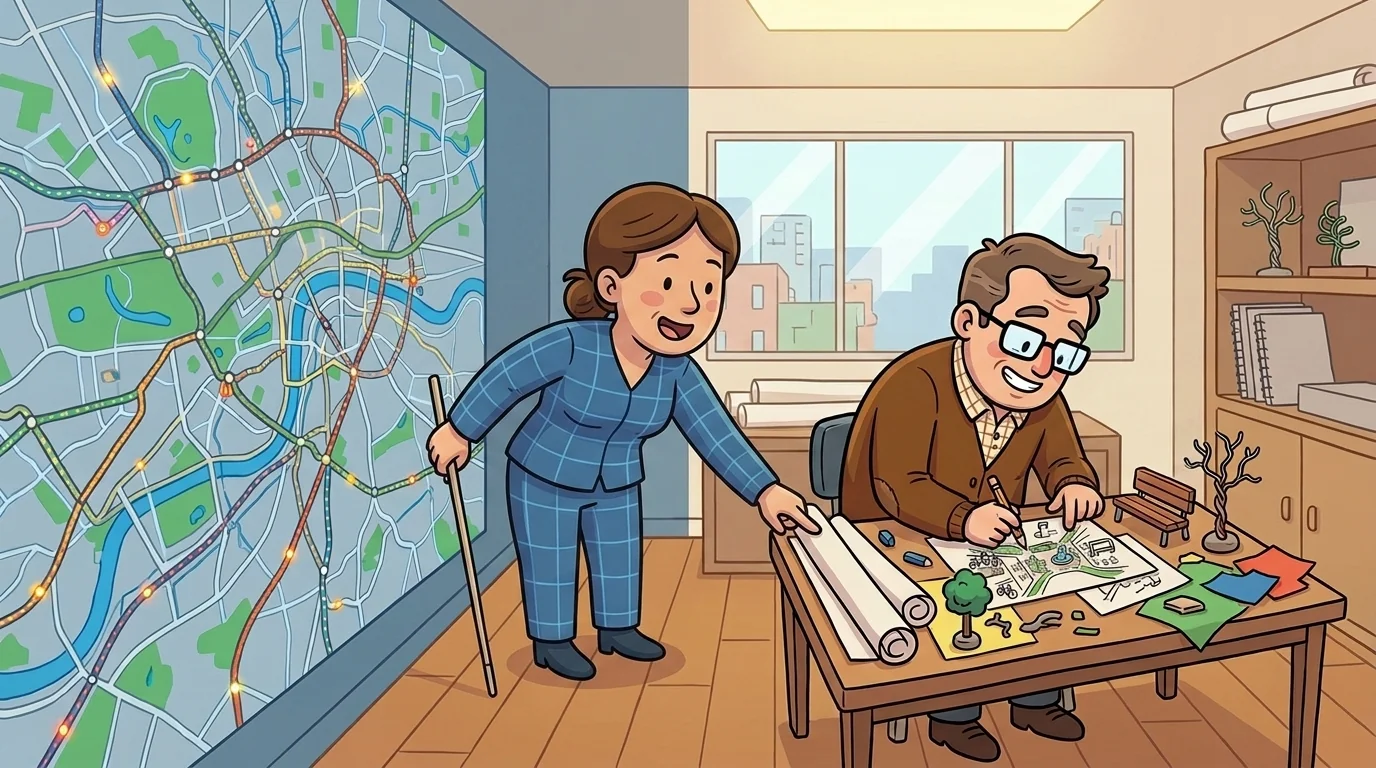
The Cityforge planning office existed as two distinct realms, each reflecting the mind of its primary occupant. On one side, an immense wall was entirely consumed by a single, intricate map of the city. Every thoroughfare, every green space, every winding river was meticulously rendered. Tiny, rhythmic lights pulsed along the intricate network of train lines, a silent testament to the city's ceaseless motion. This vast, luminous expanse was Map’s domain. She stood before it now, a long, slender pointer held gracefully in her hand, humming a low, steady note that resonated with the city’s pulse. Her clothes, a practical jumpsuit, were faintly etched with grid lines, like a living blueprint. She traced a sweeping path from the industrial factory district all the way to the distant, shimmering sea.
Across the room, a smaller, more intimate space unfolded: a cluttered table piled high with sketches. These weren't grand cityscapes, but detailed studies of a single street corner. Clay models of benches sat beside miniature wire trees, and scraps of colored paper suggested vibrant flower beds. This was Block’s territory. He was hunched over a fresh drawing, his spectacles perched on the very tip of his nose. No humming emanated from him; instead, he made quiet "swoosh" and "chatter" sounds, imagining the unseen pedestrians moving past the bakery he meticulously sketched.
"If we just widen the Grand Artery, we could significantly ease all the morning traffic congestion," Map declared to the sprawling map, her voice echoing with a confident, almost public, resonance.
"If we widen the sidewalk here, Mrs. Gable will finally have a proper place for her flower pots," Block murmured to his paper, his focus unwavering, his gaze never lifting.
They weren't precisely conversing with each other in that moment. Yet, within the unique ecosystem of the Cityforge, Map and Block were perpetually engaged in the same overarching discussion, approaching it from wildly different angles.
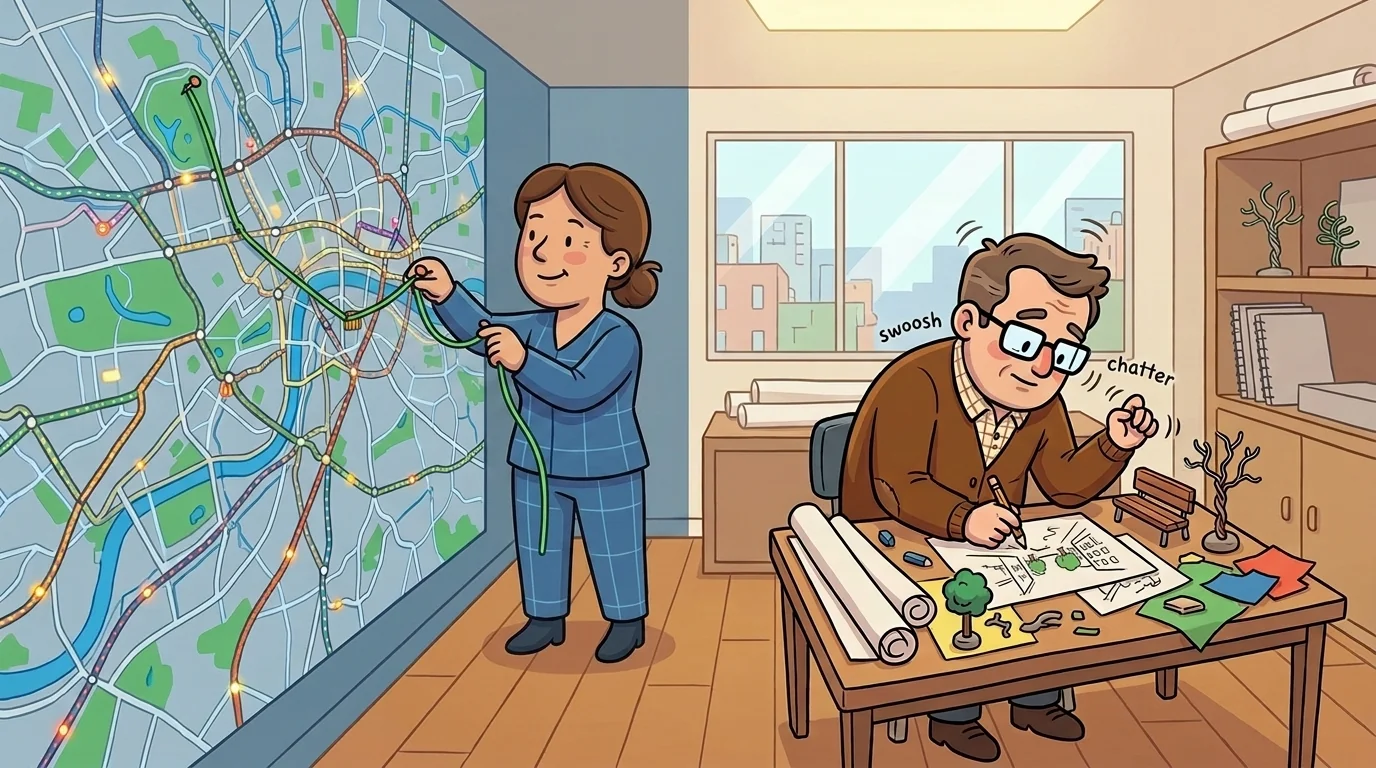
Map mentally zoomed out, her perspective expanding far beyond a single street. She perceived the entire city as a complex, living organism, its various systems interconnected and interdependent. She observed how the Northside neighborhoods, bustling with families and schools, were effectively severed from the grand, new downtown library. Children living there faced a daunting journey, requiring two separate bus transfers and a train ride just to reach its doors. The commute was not merely long; it was an obstacle, a barrier to accessing knowledge. The city’s existing pathways, she realized, functioned like clogged arteries, impeding the free flow of essential resources.
"Unacceptable," she stated firmly to the empty space before her, her voice ringing with conviction. "Knowledge should circulate without impediment."
Her eyes swept across the vast, illuminated grid. A forgotten pathway, a faint green scar on her map, caught her attention. It was an old trolley line, long abandoned and overgrown, snaking through a series of low hills. What if, she mused, they cleared this neglected route? What if they transformed it into a vibrant greenway? A dedicated path for bicycles and pedestrians, cutting a direct line from the heart of Northside straight to the library’s imposing front steps. No cars, no exhaust fumes, no traffic lights. Just a beautiful, tree-lined ribbon, gracefully connecting people directly to books and learning.
She reached for a long piece of bright green string, its color a vivid promise of growth and connection. With a decisive movement, she pinned one end to the Northside district and stretched it taut, securing the other end near the library. "There," Map announced, a deep satisfaction settling over her. "A new connection. Simple, yet profoundly elegant. It will serve thousands of people every day." She smiled, already envisioning the entire urban system operating with enhanced efficiency and greater harmony.
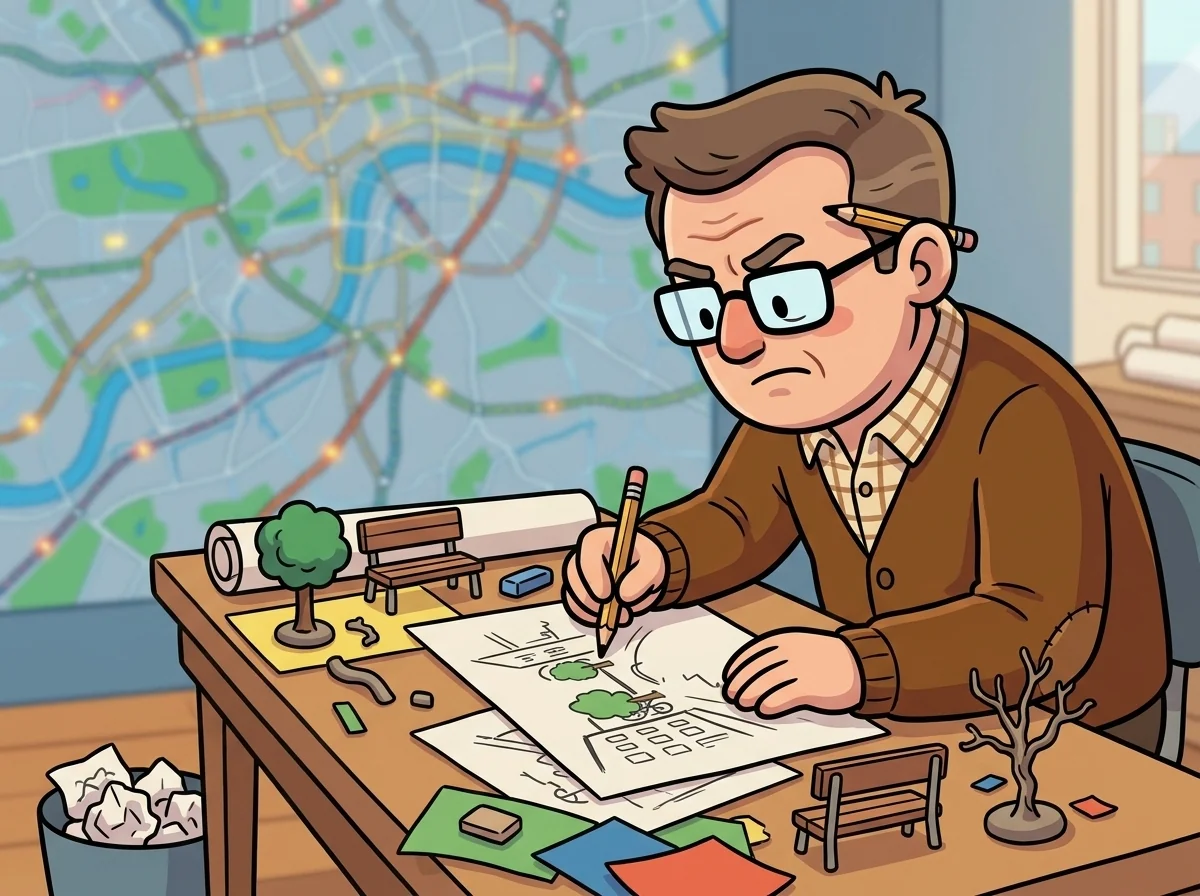
Block, in stark contrast, zoomed in. His thoughts were not occupied with thousands of anonymous people, but with one specific individual: Leo, the diligent boy who delivered newspapers on his bicycle every morning. Block’s entire focus narrowed to the precise corner of Sparrow Street and 2nd Avenue, the very spot where Map’s newly imagined greenway would terminate. He immediately identified a significant problem. The corner was a chaotic tangle of sharp angles and blind spots. Cars routinely whipped around it at excessive speeds, leaving no safe haven for a child on a bike to pause and wait for the signal to change.
He crumpled his current sketch, a frustrated sigh escaping him, and tossed it into a nearby bin. "Nope. Not friendly enough," he grumbled, his voice barely audible. He pulled a fresh sheet of paper toward him and began anew. This time, he deliberately softened the harsh geometry of the intersection, rounding the corner into a gentle, welcoming curve. He meticulously added a small, protected island, specifically designed for cyclists, complete with a low curb to shield them from the flow of traffic. He even sketched a small, sturdy bench, strategically placed where the morning sun would cast its first, warming rays.
"Perfect," Block whispered, a quiet triumph in his tone. He could almost feel the sun’s warmth on his own face. He pictured Leo resting there for a brief moment, perhaps checking his newspaper bag before continuing his route. He wasn't designing a grand pathway for an entire neighborhood; he was meticulously crafting a safe, peaceful moment for one person. And for Block, that singular, human-scale detail held just as much importance as any city-wide plan.
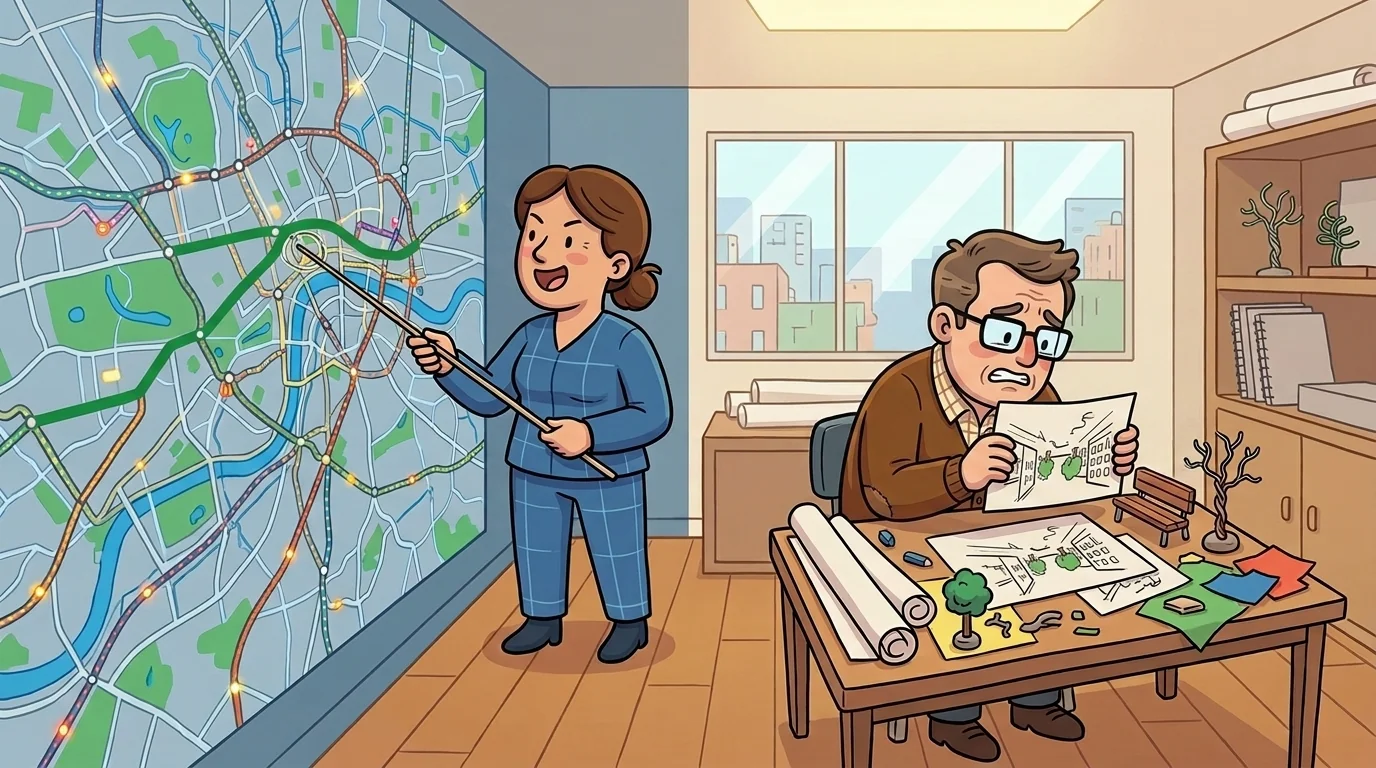
Map, still energized by the expansive vision of her greenway, strode purposefully toward Block’s table. "Block, my friend, look!" she announced, her long pointer sweeping toward his corner on her wall map. "The new Northside Greenway is going to conclude right here! It will channel cyclists, walkers, and entire families directly onto your little street. Isn't it absolutely grand?" Her voice swelled with the promise of thousands of happy users.
Block slowly lifted his head from his detailed drawing of the single bench. His eyes, usually fixed on the minute, now took in the bold, bright green line on Map’s wall. Then, with a growing sense of dread, he looked back at his own careful sketch. He imagined hundreds of people, a sudden torrent, abruptly appearing on his quiet, sun-warmed corner. Where would they all go? How would they safely navigate the busy street? His one small bike refuge, designed for Leo, would be utterly overwhelmed. His calm, carefully crafted corner would instantly transform into a chaotic, unmanageable mess.
"Grand?" Block squeaked, his voice tight with alarm, the sound barely escaping his throat. "Map, it’s a complete disaster! You’re pointing a firehose at a teacup! My corner simply cannot handle a 'greenway.' It’s built for Leo and Mrs. Gable, not an entire district!" He held up his meticulous drawing, his hand trembling slightly. "This is about a moment of peace and safety, not a highway for feet!"
Map blinked, the sharp reality of Block’s metaphor hitting her with unexpected force. A firehose at a teacup. She looked from her beautiful, efficient green line to Block's small, intricately detailed drawing. She hadn't considered the impact, the splash her grand idea would make when it landed. She had only seen the sweeping connection, the elegant flow across the city. She had missed the crucial point of impact.
She leaned over Block’s table, her earlier bravado replaced by genuine curiosity. "Show me," she said, her voice softer, more receptive than before.
Block pointed with his pencil, tracing lines on his sketch. "See? The main crosswalk is here. But your greenway ends abruptly here. People will simply spill into the street, unprotected." He began sketching furiously, his pencil flying across the page. "But what if... what if the greenway didn't just stop? What if it widened out, like a river delta spreading into a bay?" He drew a graceful fan of paths radiating from the endpoint. "We can create a much larger public plaza right here, with more benches. And a water fountain. The crosswalk itself gets wider, equipped with flashing lights for safety. We turn your big idea into a big, welcoming embrace."
Map watched, utterly fascinated. She saw how his small, human-scale details could effectively catch her grand, system-scale idea, transforming it. They would make it not just functional, but safe. Make it truly wonderful. She tapped the plaza he had drawn, a new spark in her eyes. "And we can integrate a bike-share station right there," she added, her mind already connecting new possibilities. "And a bus stop for the line that goes directly to the public pool."
Block grinned, a rare, wide smile spreading across his face. "Exactly! The big plan and the intimate spot, working seamlessly together." He sketched in a small, elegant bus shelter, nestled perfectly beside a vibrant patch of flowers. It was, finally, perfect.
The CityForge ensemble
Map and Block is part of CityForge's distributed-narrative cast. Each character embodies a different curricular primitive; together they teach the full subject.
-

Block
Zoning + density — the badger-tween with clay-block models who teaches zoning as 'plan for the neighbors first, not the buildings'
-

Stoop
Public space + community — the capybara-elder on a wooden stoop who treats public space as the city's living room, foregrounding existing stoop-cultures (Brooklyn / Latin American plazas / Italian piazzas / West African gathering trees)
-
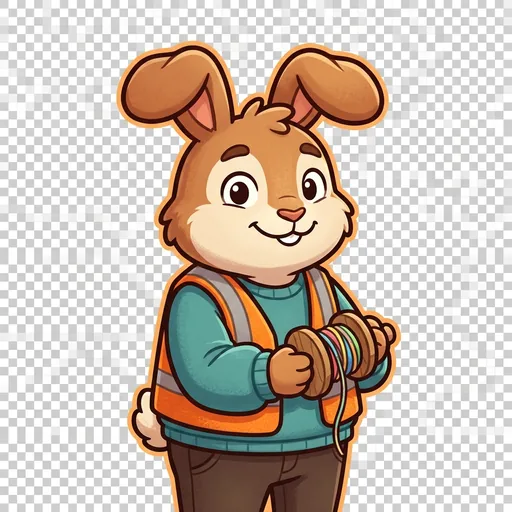
Lane
Walkability + mobility — the rabbit-tween in safety-vest with a chalk-spool who teaches streets-as-spaces ('streets are rooms; cars are guests, not owners')
-

Hub
Transit nodes — the pangolin-tween in conductor-vest who teaches that transit is about ACCESS, not about cars-vs-trains ('many ways, equal ways; the bus matters as much as the train')
-

Dwell
Housing equity + repair — the owl-elder in a mended quilted-coat who teaches anti-displacement, repair-not-replace urbanism ('repair before replace; listen before plan; the people who live here ARE the design')