
Gather and Ground
PARTICIPATORY PLANNING — *gather the people who live here, and ground the plan in what's already here; the people who live somewhere ARE the design.* The urban-equity primitive of planning-WITH not planning-FOR — listening before drawing, and building on a place's existing strengths rather than a blank slate.
Press play to listen along. The line being read lights up as you go.
Show full transcript
Loading transcript…
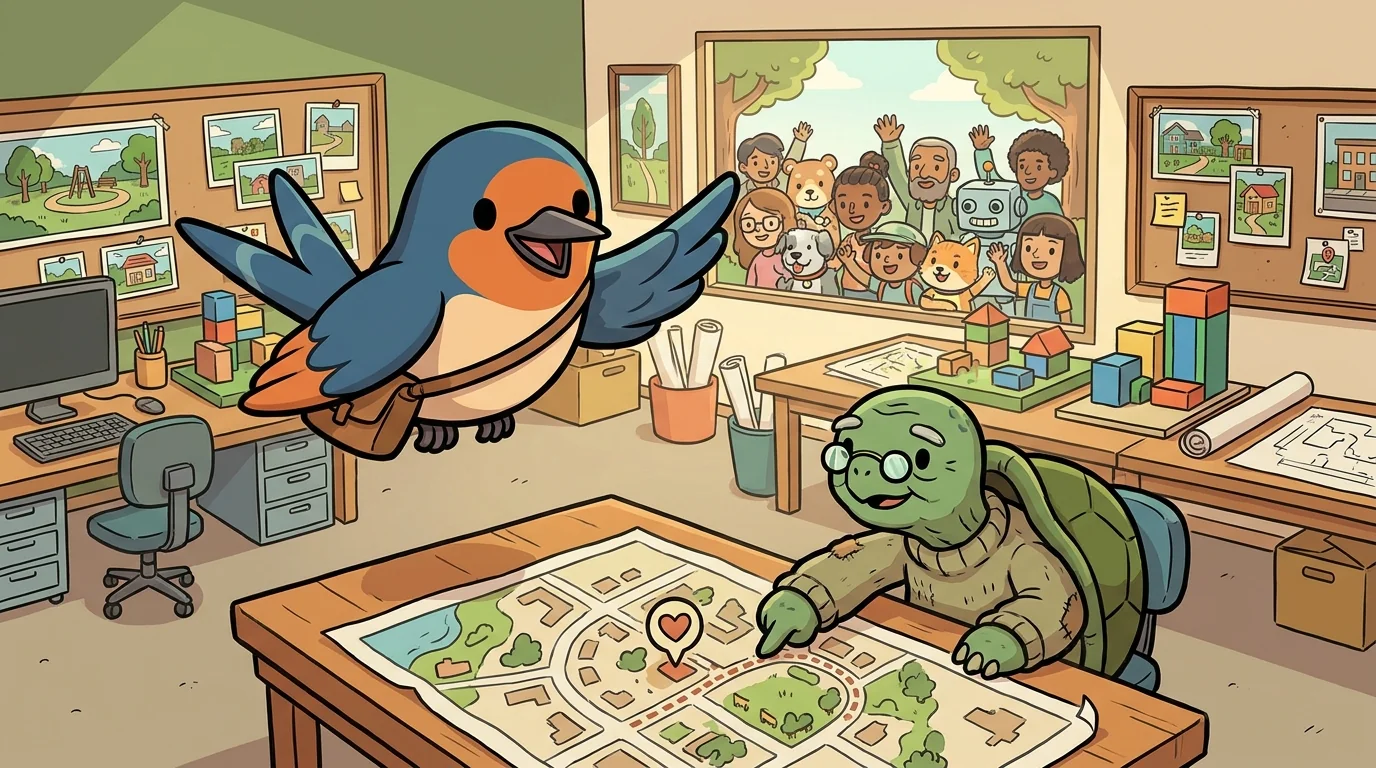
The CityForge studio smelled of cedar shavings, wet blue ink, and old paper. High up in the rafters, Gather adjusted her blue-grey feathers. Down on the floorboards, Ground sat beside a massive wooden table. A blueprint lay unrolled between them, its corners held down by smooth river stones.
Gather was a swallow, quick as a spark, with eyes that noticed every open door. She lived for the crowd. Ground was an old tortoise with a shell like a cracked walnut. He had lived in the valley long before the studio had walls. Neither would let a design move forward without the other.
Beginners always made the same mistake. They would sit in a quiet room and draw a beautiful plan for a neighborhood. They never asked the people who actually lived there.
One morning, an apprentice brought a new drawing to the table. He had designed a public square for the north side of town.
"It is perfectly balanced," the apprentice said, pointing with his brass compass. "I spent three nights on the geometry."
Gather tilted her head, looking down from her rafter. "It is very round. But did you talk to Mrs. Gable?"
The apprentice blinked. "Who is Mrs. Gable?"
"She sells the sweet bread on the corner," Gather said. "And did you talk to the kids who play stickball by the livery?"
"They do not have design degrees," the apprentice muttered, looking defensive.
Gather let out a sharp, musical whistle. "They have feet. They use the street. That matters more than a degree."
Before the apprentice could roll up his paper, Gather was out the window. She was a blur of blue and white against the gray brick buildings. She swooped down to the bakery stoop. She tapped her beak against the glass of the tailor's shop. She circled the dusty lot where the teenagers kicked a leather ball.
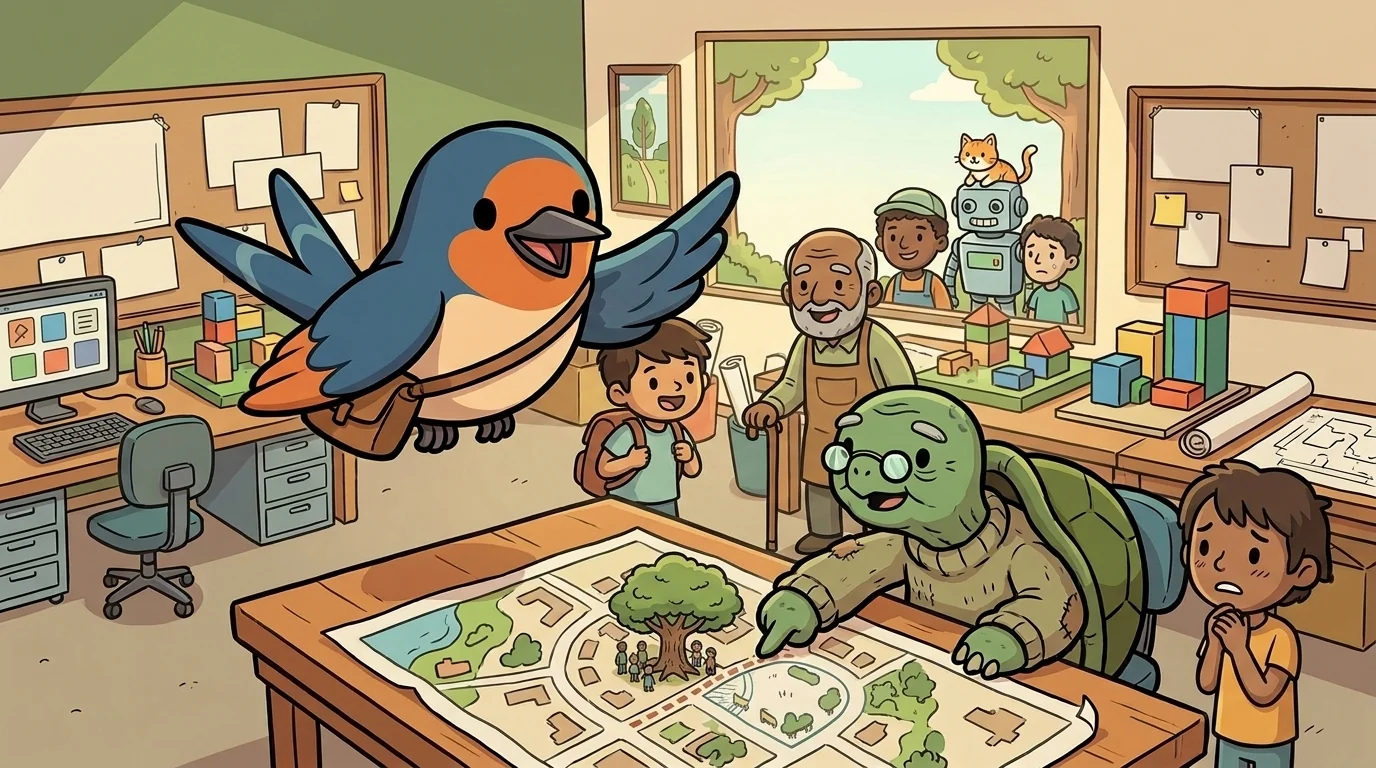
"Come see the circle!" she called. "They are planning your corner!"
Within an hour, the studio floor was crowded. Mrs. Gable smelled of cinnamon and flour. The stickball kids left muddy footprints on the pine boards. An old man named Marcus leaned on his cane, squinting at the blue lines.
This was the first half of *participatory planning—designing with a community, not for* it.
"This is how we work," Gather whispered to the apprentice. "We do not design for them. We design with them."
Then Ground did the other half of the job. He tapped his heavy front claw on the floorboards.
"Now we walk," Ground said.
He did not mean a fast walk. Ground moved with the patience of a mountain. He carried the blueprint on his flat shell. The apprentice, Gather, and the neighbors followed him down the cobblestone hill.
They stopped at the empty lot. The apprentice's plan showed a large concrete fountain right in the center.
Ground stood on the exact spot where the fountain was drawn. He looked down at the earth.
"You put the water here," Ground said. "But look at the soil. This is where the wild blackberry bushes grow. The neighborhood kids harvest them every August."
"And look there," Marcus said, pointing his cane at a massive, crooked oak tree. "That tree keeps the afternoon sun off my porch. Your plan cuts it down for a parking space."
The apprentice looked at his drawing. The straight lines suddenly seemed very cold.
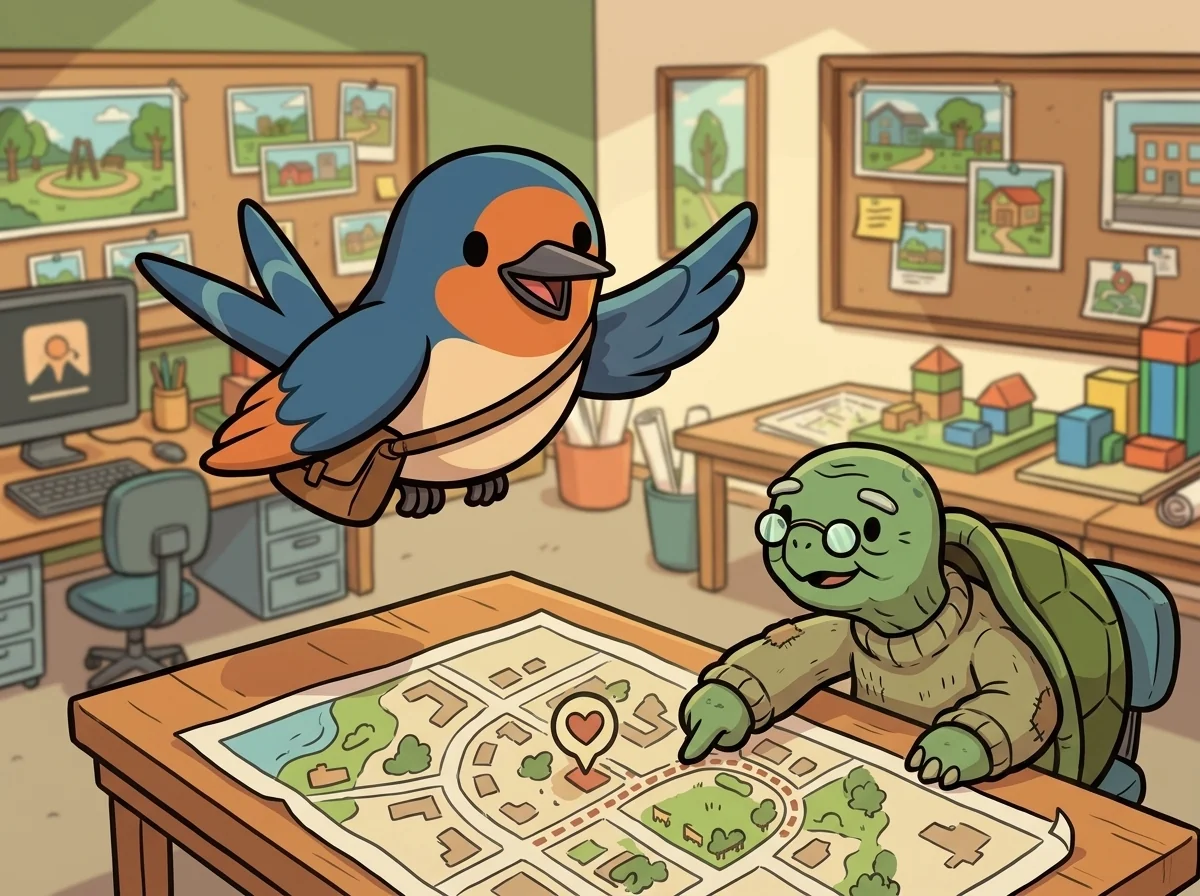
"The people who live here are the design," Ground said softly. "We repair what is broken. We do not erase what is loved."
They returned to the studio. The apprentice took out a fresh sheet of paper. This time, he did not use his straight ruler.
"Let's try again," the apprentice said.
He drew the crooked oak tree first. He drew a path that curved around the blackberry bushes. Mrs. Gable pointed to a spot near the shade.
"Put a bench there," she said. "My knees get tired after baking."
The stickball kids asked for a flat gravel patch. They did not need concrete.
The new plan was not a perfect circle. It was bumpy and odd, shaped like the real life of the block.
"Look at both," Gather said, placing the old plan beside the new one.
The first plan was a shiny circle dropped from the sky. It paved the berries and killed the oak. The second plan used the exact same budget. But it kept the shade, saved the berries, and gave the kids a place to play.
"One plan erases a neighborhood," Ground said. "The other repairs it. The only difference is whether we listened."
The pair understood this because they remembered their own childhood. Long ago, Gather and Ground lived in a green valley called River-Bend. It was a quiet place where animals and people shared a deep, cool pond.
One day, planners from the capital arrived with heavy wagons and iron shovels. They did not ask the residents about the pond. They did not ask about the reeds where the ducks nested.
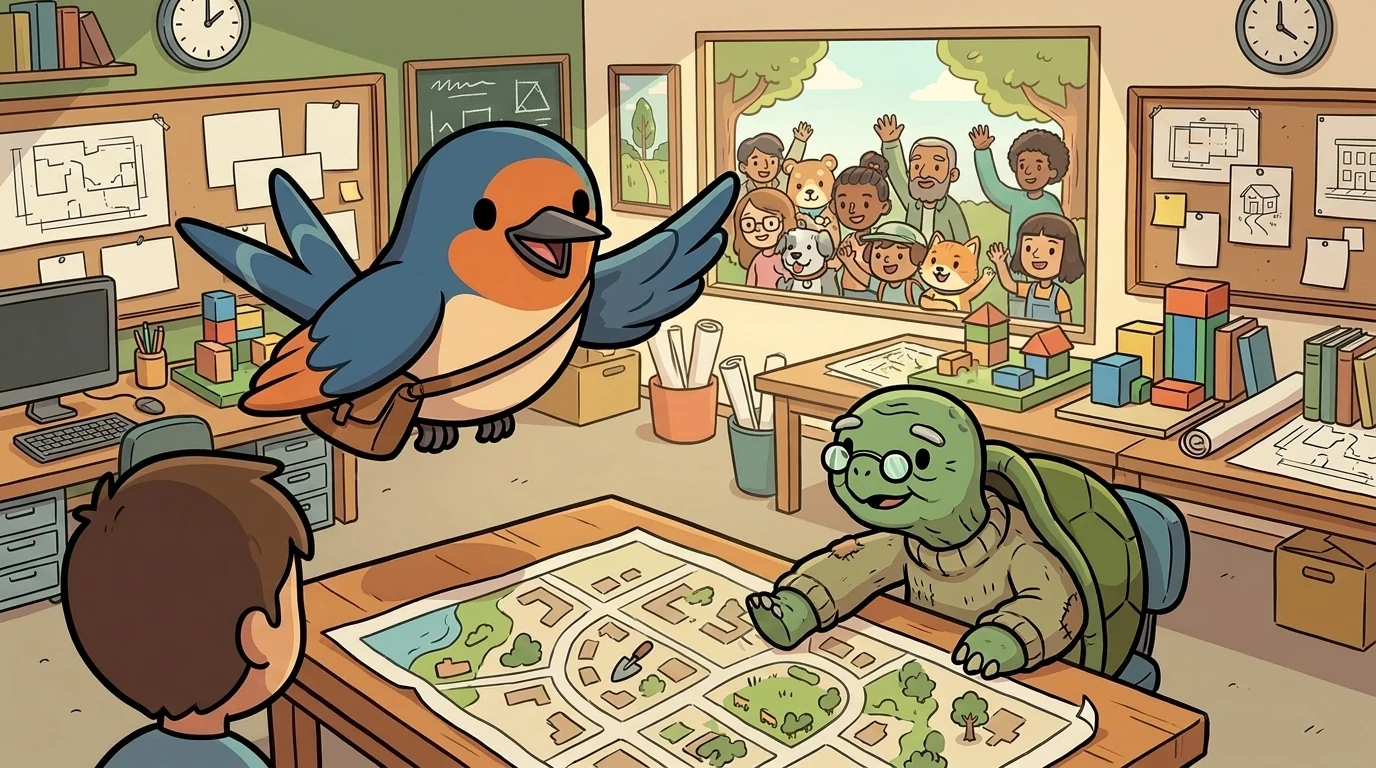
"We will build a paved canal," the chief planner had announced. "It will be much cleaner."
They drained the pond. They poured gray concrete over the mud. The ducks left. The water became hot and stagnant. The community split apart because there was no longer a place to meet.
Young Gather had been too small to stop the shovels. But she flew from tree to tree, calling the angry neighbors together. Young Ground had stood by the dry mud, remembering where the cool springs used to bubble up.
"We must show them what they ruined," Ground had said.
Together, the young bird and the young tortoise helped the villagers draw their own map. They showed where the water actually wanted to flow. They forced the planners to open the concrete gates.
It was their first lesson in the craft. A place is planned well only when the people who live there are gathered in and the plan stays grounded in what they already have.
One morning, Plumb, the great mentor of CityForge, walked into the studio. He was tall and carried a heavy iron plumb bob that never swung false.
He looked at the two plans on the table.
"What is participatory planning?" Plumb asked. His voice was like low thunder.
Gather swooped in a wide, joyful loop. "It is bringing in the people who actually live here," she said. "Especially the ones who are usually left out."
Ground pressed his flat, dusty claws against the floorboards. "And keeping the plan rooted in what is already there. Repair, not replace."
Plumb watched them. He let out a slow nod. "You are the two halves of fairness," he said. "You are appointed. Together."
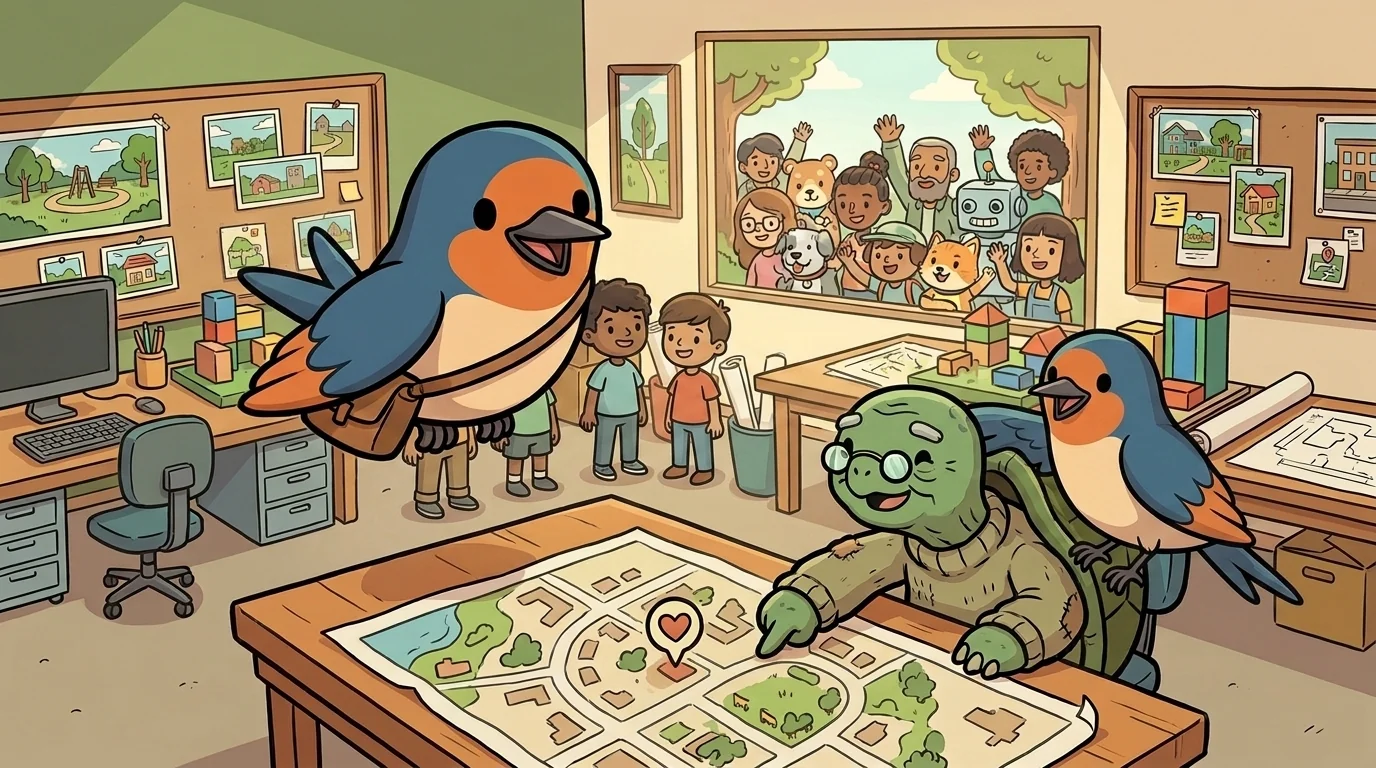
Since that day, they taught every student who entered the studio. They did not let anyone draw a line until they learned the five habits:
Ask before you draw. Bring in the people who will live there before you design, not after. *The people are the design. Their knowledge of the neighborhood is your most valuable tool. *Repair before replace. Build on what is already loved instead of starting with a blank slate. *Listen for who is missing. If the room is quiet, gather wider. A plan is only fair if everyone helped shape it. *Plan with, not for. A design done to people is a map of exclusion. A design done by* them is home.
"I have helped draw lovely plans nobody living there ever asked for," Gather told the students.
Ground nodded. "And I have watched shiny designs pave over the very things a neighborhood loved most. Neither is a failure to be ashamed of. It is just a reminder to gather first."
Sometimes, a student would complain about the time it took.
"But all this talking takes too long," a teenager said one afternoon. He was trying to design a bridge. "We could build three bridges in the time it takes to talk to everyone."
Gather landed on his drafting table. "It is not slower," she said. "It is fairer. A bridge nobody wants is just a waste of stone."
"And it lasts," Ground added from the corner. "When people help build a place, they take care of it. Gather the people, ground the plan, and it belongs to them."
The apprentice’s park was finally finished. There were no straight lines. The path curved around the blackberry bushes, and the crooked oak tree stood tall, casting a wide shadow over Mrs. Gable’s new bench.
The stickball kids were laughing in the gravel lot.
Gather sat on a branch of the oak tree, looking down at the crowd. Ground rested his chin on the cool grass near the roots.
The old ache from their ruined childhood pond was gone. In its place was a quiet, shared warmth. It was the feeling of a neighborhood that had been heard.
The CityForge ensemble
Gather and Ground is part of CityForge's distributed-narrative cast. Each character embodies a different curricular primitive; together they teach the full subject.
-

Block
Zoning + density — the badger-tween with clay-block models who teaches zoning as 'plan for the neighbors first, not the buildings'
-

Stoop
Public space + community — the capybara-elder on a wooden stoop who treats public space as the city's living room, foregrounding existing stoop-cultures (Brooklyn / Latin American plazas / Italian piazzas / West African gathering trees)
-
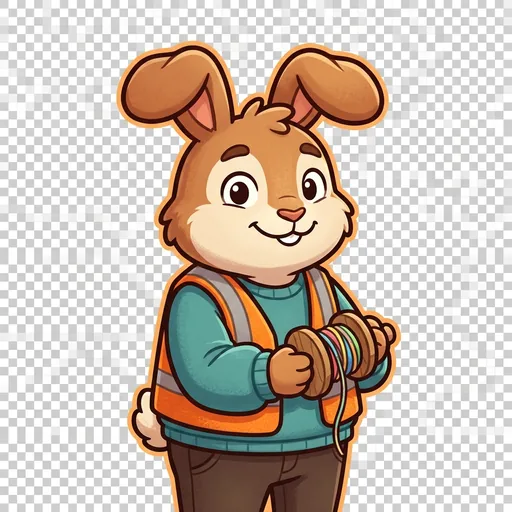
Lane
Walkability + mobility — the rabbit-tween in safety-vest with a chalk-spool who teaches streets-as-spaces ('streets are rooms; cars are guests, not owners')
-

Hub
Transit nodes — the pangolin-tween in conductor-vest who teaches that transit is about ACCESS, not about cars-vs-trains ('many ways, equal ways; the bus matters as much as the train')
-

Dwell
Housing equity + repair — the owl-elder in a mended quilted-coat who teaches anti-displacement, repair-not-replace urbanism ('repair before replace; listen before plan; the people who live here ARE the design')
-

Canopy
Green infrastructure — trees and parks cool the city and soak up rain; shade placed where it is needed most
-

Mix
Mixed-use land use — weave homes, shops, and work close so daily life is a short walk
-

Seam
Edges and connection — a highway can rip two neighborhoods apart; design can stitch them back