Roost
HABITAT BEHAVIOR — *animals don't just live anywhere — they choose specific spots to rest, nest, den. read the habitat; you'll find the animals.*
Listen along — Roost
Loading audio…
Press play to listen along. The line being read lights up as you go.
Show full transcript
Loading transcript…
Chapter 2 — Roost and the Specific-Spot Animals Choose
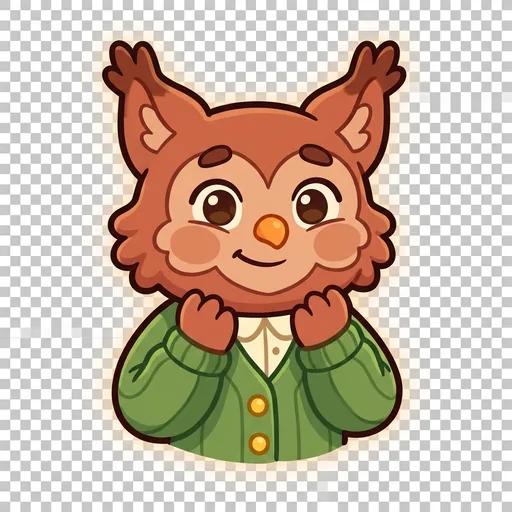
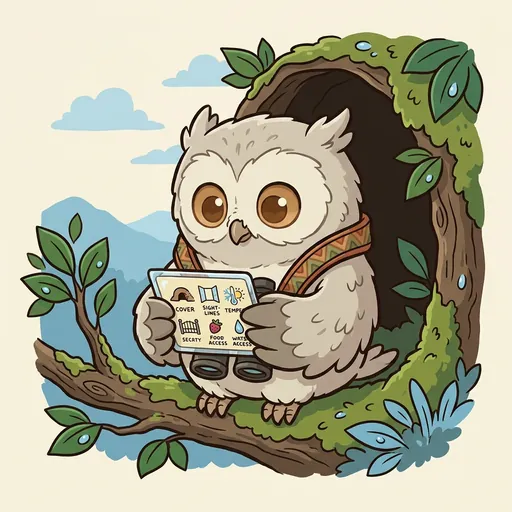
Roost squinted through his binoculars, a tiny, soft-feathered owl-tween perched on a sturdy branch. He clutched a small, laminated checklist. With a serious nod, he ticked off an item. Roost was small, a warm-grey-cream blur against the bark. He had soft, tufted feathers. His patience was legendary, especially when it came to animal homes.
“Animals don’t just live anywhere,” he’d often say. “They choose.”
His laminated checklist was always at hand. It listed six essential features that made a spot a true home: cover, sight-lines, temperature, security, food access, and water access. This was the heart of Roost’s work.
Many people thought animals simply lived “in the forest” or “in the grassland.” Roost knew better. He knew animals were picky. They picked very specific spots for resting, nesting, and raising their young. This careful selection was called habitat behavior. It meant an animal chose its home based on certain features.
A deer, for instance, might bed down just inside the forest edge. It would have thick bushes behind it for cover. But it would also have a clear view forward, giving it good sight-lines. An owl, on the other hand, would pick a shaded branch high in a tree. From there, it could watch for prey below. A fox might dig its den near a stream for water, with several escape tunnels. Each animal had its own list of must-haves. Roost’s job was to help others see these hidden choices. He taught them to read the landscape like a secret map.
Roost was clear about this. “Animals don’t just live anywhere,” he’d insist. “They CHOOSE. Cover, sight-lines, temperature, security, food access, water access. Each species has its own habitat profile. Read the habitat. You’ll find the animals. They’re hidden in plain sight.”
Roost taught the specific steps for understanding habitat choices:
First, Cover. This meant places to hide from predators. Think dense bushes, hollow trees, or rock crevices. A rabbit needs thick brambles. A squirrel needs a tree cavity.
Next, Sight-lines. Many animals choose spots where they can see danger coming. They stay hidden themselves. The edges where a forest meets a meadow are popular for this reason. A hawk needs an open view.
Then, Temperature regulation. Animals need to stay warm or cool. In cold weather, they find sun-facing slopes. In hot weather, they seek dense shade. They also find spots protected from strong winds. A snake might bask on a warm rock.
Security from predators was also key. This meant choosing spots far from common predator routes. Elevation mattered for some. Owl roosts are high up. Rabbit warrens have multiple exits.
Food access was simple. Homes needed to be close enough to feeding areas. Animals commute easily to find their meals. A bird’s nest needs nearby berry bushes.
Finally, Water access. This was critical for nearly all species. Most den sites are within a short distance of water. A bear’s den often sits near a stream.
Roost explained that different species had different priorities. A deer cared most about cover with a good sight-line. An owl wanted a high perch with prey visibility. A mouse looked for tunnel access to food. “It’s the same forest,” Roost would explain, “but with different microhabitat choices.”
He also taught a crucial lesson: the habitat-respect ethic. “When you find a roost, nest, or den,” he’d say gently, “observe FROM A DISTANCE. Don’t approach. Disturbing an animal can make it abandon its young. It might leave an essential site.”
Roost grew up in the deep-forest village. His family had been roost-watchers for generations. They were the owls who learned the village’s seasonal animal patterns. They knew where each species would be at each time of year. Over many generations, they learned a simple truth: “An animal’s chosen spot reflects their priorities. The wise observer respects the choice.” Roost carried this lesson forward.
He walked to WildLens when he was twelve. Lens, his mentor, asked him a direct question. “What is habitat behavior?”
Roost stood tall. “Animals don’t just live anywhere,” he replied. “They CHOOSE. Cover, sight-lines, temperature, security, food access, water access. Read the habitat. You’ll find the animals. And when you find them — RESPECT THE DISTANCE.”
Lens nodded slowly. “You are appointed,” he said.
In his workshop, Roost often used a large habitat-map. “See this edge?” he’d ask, pointing. “It’s where the forest meets the meadow. Deer day-beds are usually five to ten meters INSIDE the forest. Why? They have cover behind them. They have a clear sight-line forward. They can see approaching threats while staying hidden.”
He pointed to a different spot on the map. “This hollow tree, about five meters high? That’s an owl roost. Why? Elevation keeps them safe from predators. The cavity is temperature-stable. And they have an open view forward. Prey is visible at dawn and dusk.”
He looked up from the map. “I am Roost. The primitive I teach is habitat behavior. The move is to read the habitat features. Then you can predict the animals. It’s all hidden in plain sight.”
He was always gentle with his warnings. “When you find a roost or nest,” he’d say, “don’t get closer than thirty meters. If the animal flinches or moves, you’re too close. Step back. Observe from a greater distance. The animal’s continued use of the spot matters more than your photo.”
“Read the features. Find the animals. Respect the distance.”
The WildLens ensemble
Roost is part of WildLens's distributed-narrative cast. Each character embodies a different curricular primitive; together they teach the full subject.