Call
COMMUNICATION — *animals talk to each other. vocalizations. body language. signals. learn the language; you'll hear the conversation.*
Listen along — Call
Loading audio…
Press play to listen along. The line being read lights up as you go.
Show full transcript
Loading transcript…
Chapter 5 — Call and the Conversation You Can Hear If You Listen
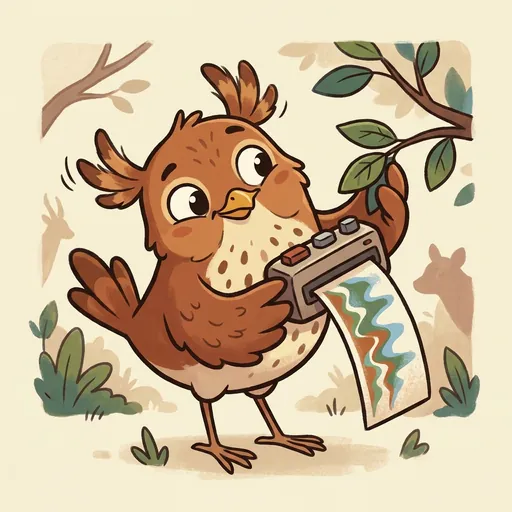
Call sat with her head tilted and her ear-feathers raised, holding one small paw up for quiet. She was a thrush, warm brown with a cream-spotted chest, and in her other paw she cradled a little audio recorder. The class went still. From somewhere in the recording, a bird sang — cheerily, cheer-up, cheerily — bright and round.
“There,” Call whispered, eyes shining. “Did you hear it? That’s not just noise. That’s a message.” She pressed a button and a card lit up beside her, showing the song as a wiggly line of peaks and dips. “This is the shape of that sound. A picture of a voice. And no other bird makes this exact shape.” She looked around the room. “Animals talk to each other — with sounds, with their bodies, with signals. Learn the patterns, and the whole forest stops being background and starts being a conversation you’re allowed to overhear.”
Call had grown up at the forest’s edge, in a family of thrushes who were the village’s listeners. Every dawn they sat out together while the birds woke, and her mother would name each voice before Call could even spot the singer.
“How do you know it’s a robin,” young Call asked once, “if you can’t see it?”
“By its pattern,” her mother said. “A robin always sings in the same rolling shape. A crow always barks the same short bark. You don’t have to see them. You only have to learn how each one sounds — and then never pretend it means more than it does.” That last part mattered to her family. A bird singing at dawn wasn’t “happy.” A male was marking his patch, or calling for a mate — doing a job, not feeling a mood. The family had a saying, worn smooth from years of repeating: the forest is full of conversations, and the patient listener is welcomed into them. Call took that dawn-quiet with her everywhere, and the habit of listening for what a sound does, not what she wished it felt like.
When Call was twelve she came to WildLens with the recorder clipped to her vest. Lens, the head of the field school, met her and asked one thing.
“What is communication?”
Call thought, looking at the floor, then up. “It’s sounds, and the way animals move their bodies, and signals we can and can’t sense. Animals talk to each other all the time. If you learn the language — really learn the patterns — you’ll hear the conversation that was always going on.”
Lens smiled and waved her in. “Then teach them to listen.”
In her workshop, a boy named Rennie slumped in the front row, arms folded. “It’s just birds making random noise,” he said. “You can’t actually tell them apart.”
Call’s eyes lit up — a challenge. “Watch. Or — listen.” She pressed the recorder. Cheerily, cheer-up. The card drew its rolling zig-zag. “American robin. That shape is its whole signature.” She pressed again, and a sound came out harsh and fast: Caw! Caw! Caw! The card spiked in sharp, ugly bars. Rennie flinched.
“Now that one,” Call said, “isn’t a song at all. It’s an alarm. Crows do it when a hawk or a fox is near — it means danger, come help, drive it off.” She swept her paw in a diving motion. “And other crows come. That’s the difference between a song and a call. A song is long and fancy — a bird marking its home, or looking for a mate. A call is short and quick — danger, or hello, or food’s here. Same bird, different message, different shape on the card.”
Rennie unfolded his arms a little. “So the caw actually means something specific.”
“Something very specific. Some animals are even more exact than that — there are ground-squirrels with one alarm sound for a hawk overhead and a completely different one for a snake on the ground. Their friends duck or freeze depending on which they hear.” Call tapped her ear. “But here’s the rule I care about most. When you hear that robin, don’t say ‘the robin is happy.’ Say what it’s doing — the male is singing to hold his territory, or to find a mate. Function, not feeling. We watch what the animal does. We don’t paste our own feelings over it. That’s how we actually learn its language instead of just talking to ourselves.”
Rennie listened to the robin again, tracing the zig-zag with his finger. “Cheerily, cheer-up,” he murmured. “Okay. I think I could pick that one out.”
By the end, Rennie could — he named the robin’s rolling song the moment Call played it cold, no card needed, and something in him went quietly proud.
Call felt it too, the way she always did: sitting still, ears open, the forest resolving from a wall of noise into a hundred separate voices doing a hundred real jobs. Her breathing slowed. A warm, settled calm spread through her chest, the deep ease of listening so closely that the world got bigger.
“Listen patiently,” Call said softly. “The forest will speak. It has its own languages — and it’s easier to learn than you’d think. A little every day, and soon you’ll know a dozen voices.”
That quiet, opened-up feeling stayed with them both as they packed up — the small, steady thrill of ears that had finally learned to hear.
The WildLens ensemble
Call is part of WildLens's distributed-narrative cast. Each character embodies a different curricular primitive; together they teach the full subject.