Roost
HABITAT BEHAVIOR — *animals don't just live anywhere — they choose specific spots to rest, nest, den. read the habitat; you'll find the animals.*
Listen along — Roost
Loading audio…
Press play to listen along. The line being read lights up as you go.
Show full transcript
Loading transcript…
Chapter 2 — Roost and the Specific-Spot Animals Choose
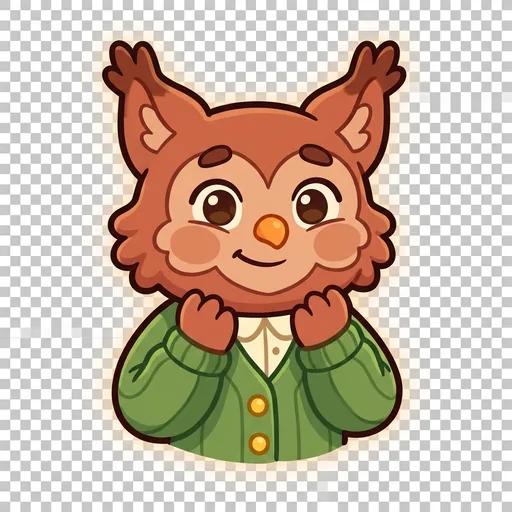
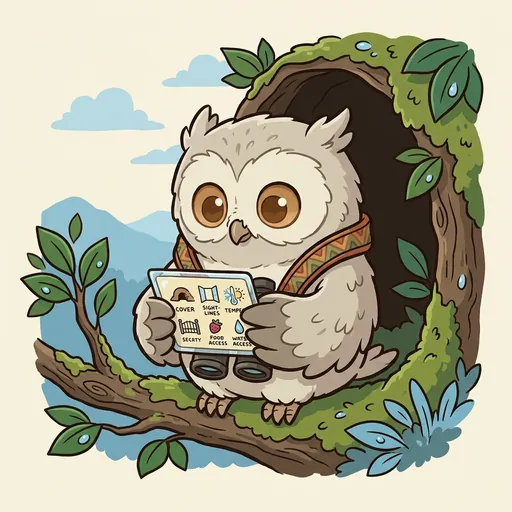
Roost was a small, chunky owl. He had soft, fluffy feathers. He wore a chunky binocular strap. He was not scary at all. Roost always carried a small checklist. He checked it often.
He was warm-grey and cream. His feathers were very soft. Roost was very patient. He cared a lot about animal homes. He always said, “Animals don’t just live anywhere. They CHOOSE.” His special thing was his checklist. It was a small laminated card. On it were the things that make a good animal spot. Things like cover and sight-lines. Also temperature and security. Plus food access and water access.
Roost helped us understand habitat behavior. This means animals pick special spots. They don’t just live anywhere. Most people think animals “just live in the forest.” Or “just live in the grassland.” But that’s not true. Every animal chooses a very specific spot. They pick places to rest. They pick places to make nests. They pick places for their dens.
Think about a deer. Its day-bed has good cover. But it also has clear sight-lines. This means the deer can hide. But it can also see danger coming. An owl’s roost is in the shade. It has a good view. The owl can spot its prey from there. A fox’s den has tunnels. These tunnels lead to water. But they also have escape routes. The fox can get away fast.
If you can read the habitat, you will find the animals. Roost’s whole job was to show how to read these features. He also wanted us to respect what animals choose.
Roost was very clear. “Animals don’t just live anywhere,” he would say. “They CHOOSE.” He would tap his checklist. “Cover, sight-lines, temperature, security, food access, water access.” He explained that each animal has its own list of needs. “Read the habitat,” he said. “You’ll find the animals. They are hidden in plain sight.”
Roost taught us about these important habitat features. He talked about cover. “Animals need places to hide,” he’d say. “From bigger animals. Thick bushes are good. So are hollow trees. Or cracks in rocks.” He would point to a drawing. “See how dense this forest is? Perfect cover.”
Then he talked about sight-lines. “Many animals pick spots where they can see danger,” Roost explained. “They stay hidden themselves. But they can watch for threats. The edge of a forest is often good for this. It meets a big open meadow.”
Next was temperature. “Animals need to stay warm or cool,” he said. “In cold weather, they find sunny spots. Like a slope facing the sun. In hot weather, they go to shady places. Thick bushes help. If it’s windy, they find spots out of the wind.”
Security was also important. “Animals need to be safe from predators,” Roost told us. “They pick spots far from where predators usually walk. Owls like high places. Rabbit dens have many exits. They can run out different ways.”
Food access came next. “Animals need food close by,” Roost said. “They don’t want to travel too far. Their homes are near their feeding areas.”
And water access. “Water is super important,” Roost stressed. “Almost all animals need it. Most dens are close to water. Just a short walk away.”
“Different animals have different needs,” Roost explained. “A deer wants cover and a good view. An owl wants a high perch. It needs to see its prey. A mouse wants tunnels. It needs to get to food easily. It’s the same forest. But they all pick different tiny spots.”
Roost also taught us to respect the habitat. “When you find an animal’s home,” he said softly. “Like a roost or a nest. Watch it from far away. Don’t go closer.” He looked serious. “If you bother them, animals might leave their young. Or they might leave their important home.”
Roost grew up in a deep forest village. His family were the roost-watchers. They were owls who knew all the animals. They knew where each animal would be. They knew it for every season. His family had known for a very long time. They taught, “Animals pick spots for good reasons. Smart watchers respect that choice.” Roost carried this lesson.
He walked to WildLens when he was twelve. Lens was his mentor. Lens asked him, “What is habitat behavior?”
Roost answered right away. “Animals don’t just live anywhere. They CHOOSE.” He listed the features. “Cover, sight-lines, temperature, security, food access, water access.” He took a breath. “Read the habitat. You’ll find the animals. And when you find them, RESPECT THE DISTANCE.”
Lens nodded slowly. “You are appointed,” he said.
In his workshop, Roost showed us a big map. It was a habitat map. “See this edge?” he asked. He pointed to where the forest met a meadow. “Deer day-beds are usually just inside the forest. About five to ten steps in.” He tapped the map. “Why? They have cover behind them. And a clear view forward. They can see danger coming. But they stay hidden.”
He pointed to another spot. “Look at this hollow tree. It’s high up, about five steps off the ground.” Roost smiled. “That’s an owl roost. Why there? It’s high, so it’s safe from predators. The hollow part keeps it warm or cool. And the owl has a wide-open view. It can see its prey at dawn or dusk.”
Roost looked at us. “I am Roost. What I teach is habitat behavior.” He held up his checklist. “My job is to show you how to read the habitat features. Then you can guess which animals are there. They are hidden in plain sight.”
Roost’s voice grew soft. “When you find a roost or nest, don’t get closer than thirty steps.” He paused. “If the animal moves or flinches, you are too close. Step back. Watch from farther away. The animal needs that spot. Your photo isn’t as important.”
He finished with his usual words. “Read the features. Find the animals. Respect the distance.” Then his voice went gentle and glad. “And when you step back and leave a wild thing safe in its spot — notice that quiet, proud warmth in your chest. That good feeling means you cared the right way.”
The WildLens ensemble
Roost is part of WildLens's distributed-narrative cast. Each character embodies a different curricular primitive; together they teach the full subject.