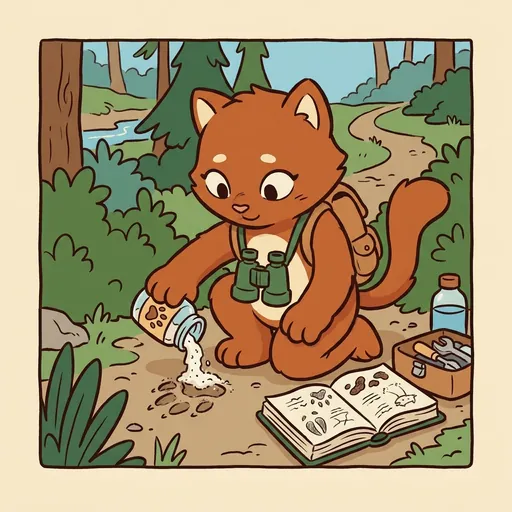
Track
ANIMAL SIGN — the animal was here. read the trail; it tells you who, when, and what they were doing.
Listen along — Track
Loading audio…
Press play to listen along. The line being read lights up as you go.
Show full transcript
Loading transcript…
Chapter 1 — Track and the Story the Trail Tells
Track crouched low over a patch of cold mud and went very quiet, the way she did when a trail was about to talk to her.
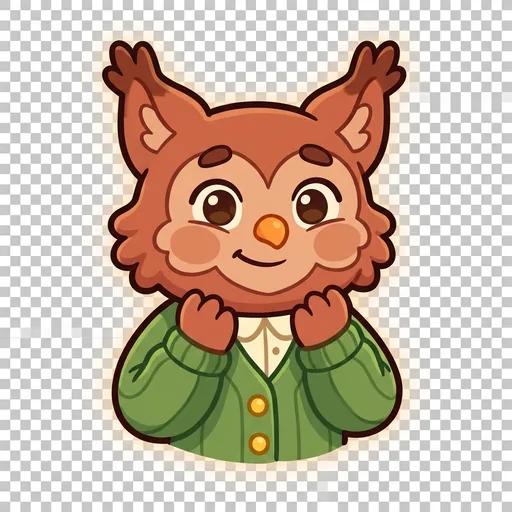
She was a small fisher-cat, deep amber with a cream belly, her binocular strap looped across her shoulder and a battered field notebook tucked under one paw. She had come to the creek at dawn hoping to photograph a fox. There was no fox. There was no anything, really — just wet leaves, grey light, and the hush of a forest that had emptied out before she arrived.
A younger kit had trotted up behind her, camera swinging. “There’s nothing here,” he said, disappointed. “We missed it.”
“We didn’t miss anything,” Track murmured. “Look.” She pointed one paw at the mud, at four small dents pressed into the soft ground. “Somebody came for a drink.”
The kit squinted. “It’s just… dents.”
“It’s a sentence.” Track leaned closer, not touching, reading. “Pointed at the front, two toes spread — a deer. Small print, so a young one. And see how the edges are still crisp, not crumbled? She was here this morning. Maybe an hour ago.” She traced the line of prints without laying a claw on them, following where they climbed the bank and vanished into the ferns. “She drank, then she went up toward the ridge. I never saw her. She told me anyway.”
The kit looked from the mud to Track and back, and something in his face shifted — the disappointment loosening into curiosity.
“You listened with your eyes,” he said slowly, trying the idea on.
“That’s the whole trick,” Track said, and smiled.
Track had not always known how to hear a quiet forest.
The first real trail she ever tried to read, she got completely wrong. She was small then, out with her grandmother, and she’d found a wide muddy print and announced, proudly, that a bear had come through. Her grandmother had looked at it for a long, kind moment. It was a raccoon that had stepped in its own print twice.
Track’s ears had gone flat with embarrassment. She’d wanted to see something big and exciting, and instead she’d seen nothing clearly at all. “I’m no good at this,” she’d said, and the words came out heavier than she meant them to. “The forest doesn’t tell me anything.”
Her grandmother had settled beside her in the leaves and hadn’t laughed. “The forest tells everybody the same things,” she’d said. “You’re just in a hurry. You wanted the bear so badly you stopped seeing the mud.” She’d rested a gentle paw over the print. “Our family has read these trails for the village for a long time — which way the deer move, when to plant, when the season turns. Not one of us was born knowing it. We learned to slow down. That’s all reading a trail really is. Slowing down until the small things get loud.”
Track had sat with that. The hot, stupid feeling in her chest cooled into something steadier. She looked at the print again — really looked — and this time she saw the little hand-shaped toes, the second overlapping step. Raccoon, she thought, and this time she was sure, and being sure felt like a door opening.
She walked to WildLens at twelve, because a place that studied wild things ought to understand the wild things you never actually see.
Lens, the mentor who kept the observation hides, met her at the edge of the wood. Lens didn’t ask her to bring back a photograph of anything rare. Lens asked one question. “What is reading animal sign?”
Track didn’t answer with a speech. She knelt at a stretch of bare earth near the gate, opened her cast kit, and poured plaster into a fresh footprint she’d spotted on the way in. While it set, she talked through it out loud — species from the shape, size from the age, direction from the way the toes pointed — and when the plaster hardened she lifted out a clean white cast of a coyote’s paw.
“I never saw her,” Track said, holding it up. “She passed before I did. But she left a whole sentence behind, and now I get to keep it.” She turned the cast over gently. “Every sign is a word. Footprints. Scat. A bit of hair on a bramble. A scratch on the bark. String them together and the forest reads back to you.”
Lens looked at the cast for a long moment, then out at the empty, breathing wood.
“You belong here,” Lens said.
Track’s workshop was a wall of quiet stories — notebook pages and pale plaster casts, each one an animal she’d never met.
A girl came in one afternoon, shoulders slumped, camera hanging useless at her side. “I sat by the marsh for three whole hours,” she said. “I didn’t see a single thing. I did everything right and the forest gave me nothing.”
Track knew that slump. She’d felt it in the leaves with her grandmother, years ago.
“Show me your boots,” Track said. The girl frowned but held one up. Stuck in the tread was a small tuft of coarse grey hair. “You brought something back after all,” Track said. “You just wore it home.” She teased the hair free and laid it on the bench. “Grey, banded, a little stiff — that’s rabbit. So there were rabbits at your marsh, close enough to leave this on the trail you walked.”
The girl blinked. “But I didn’t see them.”
“You didn’t need to. That’s the part nobody tells you.” Track tapped the notebook. “Animals are shy. Most of them are asleep when we’re awake, or hidden, or gone the second they smell us. If seeing them was the only way to count, we’d almost always come home empty.” She slid a plaster cast across the bench — the coyote paw. “But they leave sign everywhere. Prints. Scat, believe it or not — it’s honestly the most useful thing in the forest. Scratches, scent, a hair on your boot. You don’t chase them and you don’t touch them. You just read what they left, and you let them stay wild.”
The girl turned the tuft of hair over. “So the three hours weren’t wasted.”
“You found a rabbit without a rabbit,” Track said. “That’s not nothing. Knowing they’re there — that’s the discovery.”
Later, when the workshop had emptied, the girl came back with one more question. She was quieter now.
“When you never actually see them,” she said, “how do you know it counts as really finding something?”
Track thought about the cold mud at dawn, and the deer she’d read up the bank, and the raccoon print she’d finally gotten right in the leaves.
“You feel it,” she said. “That’s the honest answer. There’s a moment when the trail comes together — the print, the direction, the little hair — and you know who walked here, and it settles into you warm and certain, like they left you a note.” She looked toward the window, toward the ferns where the deer had gone. “You came for a fox and found a rabbit. You’ll come for one thing and the forest will hand you another, over and over, your whole life. And the day you stop needing to see them to feel them near — that’s the day the whole wood opens up for you.”
The girl nodded slowly, and Track watched the slump lift off her shoulders — the same way, years ago, hers had lifted in the leaves.
She didn’t say the rest out loud, but she thought it, quiet and glad: the forest is never empty. It’s just full of everyone who already went home. And if you slow down enough to feel them there — you’re never really alone in it.
The WildLens ensemble
Track is part of WildLens's distributed-narrative cast. Each character embodies a different curricular primitive; together they teach the full subject.