Brood
SOCIAL STRUCTURE — *some animals live solo. some in pairs. some in family-groups. some in flocks. each pattern is information.*
Listen along — Brood
Loading audio…
Press play to listen along. The line being read lights up as you go.
Show full transcript
Loading transcript…
Chapter 3 — Brood and the Patterns of Many or One
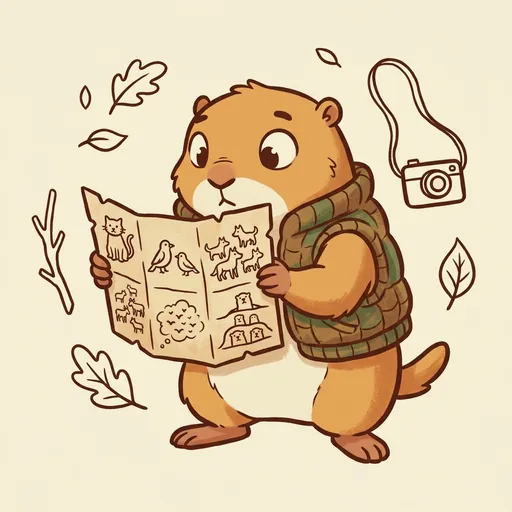
Brood was a blur of warm-tan fur and cream-colored belly, zipping around his workshop. He was a prairie-dog-tween, small but quick, his chunky-cartoon family-burrow-vest a patchwork of embroidered tunnels and tiny, smiling prairie dogs. He loved his vest. It had just enough pockets to hold his most prized possession: a carefully folded chart.
This chart was Brood’s world. It showed how animals lived. Not just where they lived, or what they ate, but who they lived with. He called this social structure: the pattern of how many individuals of a species typically live together. Most people, especially new recruits at WildLens, either forgot about social structure entirely, or they made up stories. They’d see a lone deer and think, Oh, that poor deer looks so lonely. Brood knew better.
He unfolded his chart with a flourish, smoothing the creases. “See?” he murmured, tracing a line with a tiny paw. “Some animals live solo. Some in pairs. Some in family-groups. Some in flocks. Each pattern is information.”
He tapped the first section. “Take the cougar. A big, powerful cat. They hunt alone. A single cougar needs a huge territory to find enough deer or elk. They only meet up briefly to mate. A lone cougar isn’t lonely. That’s just how cougars are supposed to be. It’s their species’ way of life, perfectly suited to hunting big prey that’s spread out.” He made a precise, solo dot on an imaginary whiteboard.
Next, he pointed to the “Pair-bonding” section. “Bald eagles, for example. They form long-term pairs. They build massive nests high in trees, often near water. Why? Because raising eagle chicks is a huge job. It takes two parents to hunt enough fish and protect the nest from predators. One parent hunts, the other guards. Their pair-bond isn’t ‘love’ in the human sense. It’s a survival strategy, an adaptation that helps them raise strong offspring. Each pattern is information.”
Brood shifted his weight, his vest rustling. “Then you have family-groups. Think of a wolf pack. It’s not just a bunch of wolves hanging out. It’s usually an alpha male and female, their pups, and maybe some older offspring. They hunt together, taking down prey like elk that would be impossible for a single wolf. They teach the young how to hunt, how to survive. Elephant herds are another example, led by a wise matriarch. Cooperative care and hunting are key here. This pattern works for them.”
He moved to the larger groups. “Herds, like deer or bison. Imagine one deer trying to spot a hidden cougar. Hard, right? Now imagine fifty deer. Many eyes are better than two. They gain safety in numbers. When one spots danger, they all scatter, confusing the predator. That’s why they group up. It’s a defense strategy, pure and simple.”
“And flocks,” Brood continued, his voice picking up speed. “Like starlings. Have you ever seen a murmuration? Thousands of birds swirling in the sky like a liquid cloud? It’s incredible. It confuses falcons and hawks. The predator can’t pick out a single bird. Flocks also help with efficient migration, sharing information about food sources. It’s not a party; it’s a brilliant way to survive.”
Finally, he pointed to the last section, his own kind. “Colonies. Prairie dogs, like us. Or beavers, ants, honeybees. We build complex tunnels, share defense duties, and warn each other of danger with special calls. My family, for generations, were colony-coordinators for our village. We learned that our colony is our species’ way. A cougar’s solo life is its way. Both are correct for what they do. We evolved this way because it makes us stronger, safer. We share the work, we share the watch. It’s how we thrive.”
Brood had carried this lesson forward since he was a pup. He remembered walking to WildLens when he was twelve, feeling a mix of nerves and excitement. Lens, the head mentor, had looked him over with sharp eyes. “What is social structure, Brood?” Lens had asked.
Brood hadn’t hesitated. “It’s how many individuals of a species typically live together. Some solo, some paired, some grouped, some flocked, some colonized. Each pattern is information about ecology. Each is correct for its species.”
Lens had simply nodded. “You are appointed.”
Now, back in his workshop, Brood tapped his chart again. “When you observe wildlife, always note the GROUP SIZE. One animal alone is information. Three animals together is different information. Twenty in formation is different still. Each tells you about the species you’re observing.” He looked directly at an imaginary student. “I am Brood. The primitive I teach is social structure. The move is count and categorize. Solo, pair, family, herd, flock, colony. Each pattern is information.”
He leaned in, his voice gentle but firm. “Don’t be tempted to anthropomorphize. The lone deer isn’t ‘sad’ or ‘lonely.’ Deer go solo sometimes – between giving birth, between herd movements, or during early morning foraging. Lone-doesn’t-mean-lonely. The accurate observation respects the species. Projecting human emotion onto non-human patterns just misses the point. The wolf pack isn’t ‘friends.’ They’re a highly organized unit, working together to survive.”
Brood carefully folded his chart, tucking it back into a pocket in his vest. “Patterns of many or one. Each is information; each is correct.”
The WildLens ensemble
Brood is part of WildLens's distributed-narrative cast. Each character embodies a different curricular primitive; together they teach the full subject.