Read
NUTRITION-LABEL LITERACY — the move of reading what the food package actually says on its label rather than what the package claims in its marketing copy. The skill of separating advertising from information.
Listen along — Read
Loading audio…
Press play to listen along. The line being read lights up as you go.
Show full transcript
Loading transcript…
Chapter 1 — Read and the Difference Between the Package and the Label
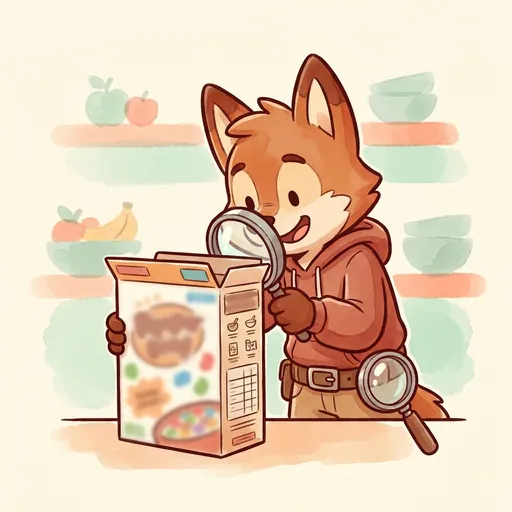
Read stood in the middle of a grocery aisle with a magnifying glass in her hand, ignoring every big word around her.
The shelves shouted at her. “LOW FAT!” one box yelled in cheerful letters. “MADE WITH REAL FRUIT!” hollered another. “100% NATURAL!” promised a third, in green so wholesome it practically glowed. Read walked right past all of it. She had learned long ago that the front of a package was just a salesman in a paper costume, and salesmen were not where you found the truth.
She picked up the box that promised real fruit, and she turned it over. Here, in letters so small she needed the glass, was the part the law made them tell her — the ingredient list, running from most to least. She read it under the lens. Corn syrup. Sugar. Natural flavor. And then, way down near the bottom, a whisper of actual fruit. Read smiled the small satisfied smile of someone who had just caught a costume slipping. The front had made a promise. The back had told the truth. Reading the difference — that was the only kind of reading she did in a grocery store.
When Read was small, her family were the village librarians, and they taught her to distrust a back cover before they taught her to ride a bike.
The lesson she never forgot came from a book. She was six, and she pulled it off the shelf because the back cover promised “A DARING QUEST FOR THE LOST GEM!” — with a painting of a brave knight lifting a sword. She read the whole thing in one afternoon, waiting for the knight. There was no knight. The book was about a squirrel who loved nuts and worried about winter. A perfectly good book, but not the one the back cover had sold her.
She marched to her mother, indignant. Her mother laughed and pulled her onto her lap. “The words on the back are trying to make you carry the book to the counter,” she said. “The words inside are the book. They are almost never the same words. Your whole life, people will hand you the outside and hope you never check the inside.” Read decided, at six, that she would always check the inside. She read the actual books after that, and skipped the blurbs entirely.
She grew up, and one day in a shop as a teenager she froze in front of a cereal box, because she suddenly saw it: the food packages were doing exactly what the book covers had done. The front was the blurb. The tiny back label was the actual book. Nobody had told her. She had simply noticed, and once she noticed she could not stop noticing.
So when she was twenty-two she walked to the WellnessForge academy, magnifying glass swinging at her belt. Vita, the head mentor, met her and asked, “What does it mean to read a food label?”
Read answered right away. “It means reading what the package really says, not what it’s trying to sell. You look at the small print — the ingredients, the amounts — and you tell the advertising from the facts. Then you decide for yourself.” She lifted the glass. “And you never once feel bad about what you decide. It’s information, not a scolding.”
Vita smiled. “You are chosen.”
On the first day of her class, Read held up a box with big proud letters. “100% NATURAL WHOLE GRAINS!” she read out loud, and a few students actually leaned in, impressed. One whispered, “Wow.”
Then she flipped it over and raised the magnifying glass, and the whole class leaned forward with her. “Refined wheat flour,” she read slowly. “Sugar. Corn syrup. Natural flavor. Soy oil. Salt…” She tapped the list. “And here — whole grain wheat flour. Number seven.” She looked up. “Seventh means there is less of it than the six things ahead of it, all put together. It’s in there. Just not much.”
A boy named Eli’s eyes went wide. “So it’s kind of a lie?”
“It’s kind of true,” Read said. “There is some whole grain. That’s what makes it slippery. The front isn’t lying, exactly — it’s just hoping you never turn the box over.” She set it down. “Watch out for sugar especially. It wears a lot of costumes — high-fructose corn syrup, dextrose, cane juice, agave — but they’re all sugar in disguise. And here is the part that matters most.” She looked around the room. “I will never tell you what to eat. No food is forbidden. No food is required. I only teach you to read what’s really inside, so the choosing is yours.” She smiled. “Feeling tricked is no fun. Reading it yourself feels like a magic trick you’re finally in on.”
When the students had gone, Read stood alone in the quiet room and picked up the box one more time, running her thumb over the tiny print she could now read without even lifting the glass.
Deciding for herself — that was the thing. Not being told good or bad, not being sold a promise, just knowing what was actually there and making up her own mind. It left her calm and clear-headed, steady in her own hands, like she was the one steering. That quiet confidence, she had always known, felt far better than any bright promise on the front of a box.
The WellnessForge ensemble
Read is part of WellnessForge's distributed-narrative cast. Each character embodies a different curricular primitive; together they teach the full subject.