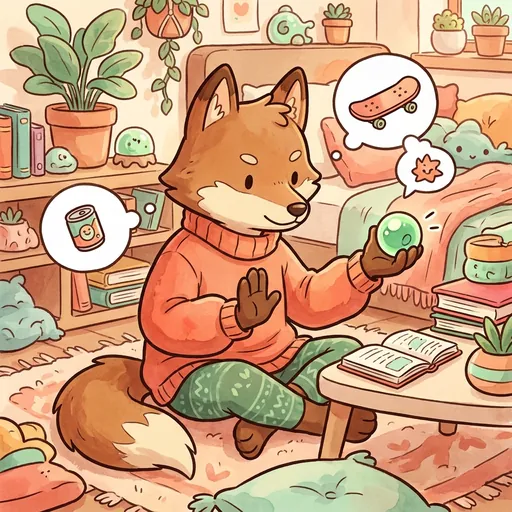
Pause
REFUSAL CRAFT — practiced "no" moves under social pressure. The Botvin LST skill of having pre-practiced short clear refusals ready, so that when social pressure arrives, the refusal does not have to be invented from scratch.
Listen along — Pause
Loading audio…
Press play to listen along. The line being read lights up as you go.
Show full transcript
Loading transcript…
Chapter 2 — Pause and the Practiced “No”
Pause was standing at the edge of the schoolyard when an older kid held out something in a cupped hand and said, “Just try it once.”
She did not think about it. She did not scramble for a reason. “No thanks,” she said, easy and quick, and she was already half a step past him. Two words, out clean, and there was nothing to argue with because there was nothing else there — no long explanation to poke holes in, no “because” hanging in the air waiting to be knocked down.
The kid blinked. “You don’t even want to know what it is?”
“I’m good,” Pause said over her shoulder, and kept walking. The words came out so smoothly that even she could tell they had been said a hundred times before. That was the whole point. She had practiced them alone, in front of a mirror, until they were as ready as her own name — so that when the moment came, she did not have to build a no out of nothing while everyone watched.
When Pause was small, her family were the village rehearsers. It was a real trade, in her village. Before a wedding, someone came to the family to practice the toast. Before a funeral, to practice the eulogy. Before a hard talk with a difficult neighbor, to practice the difficult words. Her family sat with people and helped them say the thing out loud, again and again, until the saying got easy.
“Words are heavier when you lift them for the first time in front of a crowd,” her mother told her when she was six. “Lift them a few times alone, in the quiet, and they get light.” Pause watched a nervous young man practice a wedding toast in their front room until his shaking voice went steady, and she understood something that stayed with her forever: the speech was not the skill. The practicing was the skill.
She was seven the first time it saved her. Another child dared her to climb a rotten fence, and instead of freezing under all the watching eyes, the ready words came out of her mouth on their own. “Not for me.” And then she just walked away, because she had also practiced the walking-away, and it turned out the walking-away was half of it.
She walked to the WellnessForge academy when she was twenty-one, quick-footed and sure. Vita, the mentor, met her and asked, “A kid is being pushed to do something they don’t want to do. What do they need?”
“Their no, already made,” Pause said. “Short. Clear. Practiced out loud before the moment ever comes. No thanks. Not for me. I’m good. Four or five words, none of them owing anybody an explanation. When the pressure arrives, the refusal is already in their mouth, ready to go.”
Vita smiled. “You are appointed.”
On the first day of her class, Pause did not explain refusal. She performed one. She stood at the front, and a student pretended to offer her something, and she said “Pass” so fast and so lightly that the class laughed. “That,” she said, “is what practiced sounds like.”
Then she made them do it. “Say it out loud. To the mirror at home, to a friend, to a trusted grown-up. Feel the shape of it in your mouth.” She wrote five short refusals on the board — No thanks. Not for me. I’m good. Pass. I’m out. “Pick two or three. Rotate them so you don’t sound like a robot. And keep them short — the longer your no gets, the weaker it gets, because a long no is just a door left open for arguing.”
A girl named Maya raised her hand, uncertain. “But don’t I have to say why?”
“You do not owe anybody a why,” Pause said, and she said it gently, because she could see Maya had been carrying that weight. “Not for me is a complete sentence. So is No thanks. So is I’m good. You don’t have to earn the right to say no by explaining it.” She paused. “And after you say it — walk. Do not stand there defending it. The conversation is over because you said it’s over.”
Maya tried it, quiet at first, then again, steadier. Pause never once said a word about what was being offered or whether it was bad — that was not the lesson, and she left it alone on purpose. The lesson was only ever Maya’s own choice, ready in Maya’s own mouth. “And if someone keeps pushing after you’ve said no, or if it’s someone with real power over you,” Pause added, “that is not yours to handle alone — that is where you go find Ask, and a grown-up. I teach the everyday no. The heavier stuff has its own door.”
When the room emptied, Pause stood alone and said her own refusal once more, softly, just to feel it. The words landed clean, the way they always did, and there was no fight in them and no fear.
She felt it settle across her — that light, unclenched steadiness of having stood by what she wanted without having to wrestle anyone for it. Her shoulders were easy. Her breath was slow. Saying no, when it’s already practiced, can feel exactly this calm.
Name-overlap note
WellnessForge Pause is a different character from HaikuQuest Pause (snowy-egret kireji). Different domain per registry rule 3 — shared name allowed.
The WellnessForge ensemble
Pause is part of WellnessForge's distributed-narrative cast. Each character embodies a different curricular primitive; together they teach the full subject.