Mend
FIRST-AID RESPONSE — assess / call / care framing for emergencies. The skill of knowing what to do in the first 60 seconds of an unexpected health-or-safety event.
Listen along — Mend
Loading audio…
Press play to listen along. The line being read lights up as you go.
Show full transcript
Loading transcript…
Chapter 4 — Mend and the First Sixty Seconds
Mend was crossing the academy courtyard when a boy went down on the stone steps and did not get up right away.
She reached him in four strides, but she did not grab at him. She crouched, and she looked. Was he breathing? Yes — his chest was moving. Was he awake? His eyes fluttered open, confused. Was he bleeding? A scraped knee, nothing more. Was the ground around them safe? No sharp edges, no crowd pressing in. It took her maybe six seconds, and in those six seconds her hands stayed still.
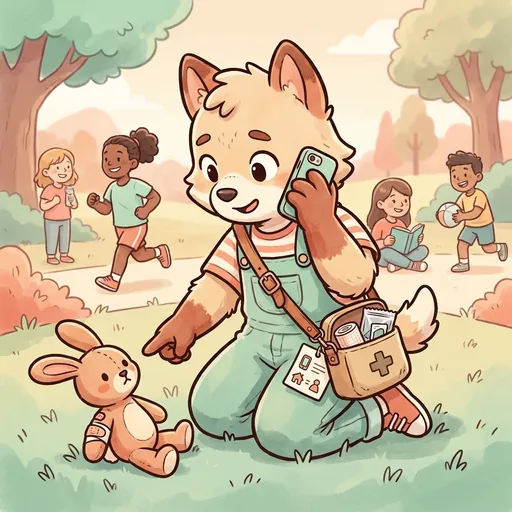
“Hey,” she said. “You took a spill. Stay put a moment.” She turned her head toward the doorway. “Someone get the nurse — tell her a fall on the steps, awake, small cut.” Only then did she open the little pouch on her leather strap, take out a clean bandage, and press it gently to his knee. Look first. Call for the right person. Then do the small thing you can actually do. In that order, every time.
When Mend was small, her family were the ones the village called first. Not doctors — nobody in the family was a doctor — but the neighbors who kept a kit by the door and knew how to stay calm until the doctor came. Her grandmother was the steadiest of them all.
Her grandmother sat her down when she was eight, on the day Mend had panicked over a friend’s bloody nose and made it worse by tipping the boy’s head back. “Sweetie,” her grandmother said, cleaning Mend’s shaking hands. “The first sixty seconds matter more than anything after. But you were doing it backwards.” She held up one finger at a time. “First you look — just look, and let yourself understand what is really happening. Then you call the right person. Then you do what you actually can, and only that.” She paused. “You are not the doctor. You are the kid who shows up and does not freeze. Do you know how much that is worth?”
Mend shook her head.
“Everything,” her grandmother said. “It is worth everything.”
So Mend practiced. Not stitches, not anything a real doctor did — just the looking, and the calling, and the small sure things. By her teens she had become the one who stayed steady while everyone else went loud, because she had a sequence to hold onto and the sequence held her.
She walked to the WellnessForge academy when she was twenty-three, the pouch on her strap and the emergency card tucked inside it. Vita met her and asked, “A kid is standing over someone who just got hurt. What is the very first thing that kid should do?”
“Look,” Mend said. “Not touch — look. Is the person breathing, awake, bleeding, safe? Five to ten seconds of understanding before anything else. Then call for help if it is bigger than a scrape. Then care, but only within what they know how to do.” She rested a hand on the pouch. “Most of the time, the bravest and best move is just calling the right person and staying while you wait.”
Vita nodded slowly. “You are appointed.”
On the first day of her class, Mend set the pouch on the table and opened it so everyone could see: a few bandages, antiseptic wipes, gauze, a thin foil blanket, and a small card with numbers on it. Nothing fancy. “This is what a kid can carry and a kid can use,” she said. “Not a hospital. Just enough.”
Then she walked them through it. “Assess first,” she said, and had them practice on each other, pretending — is your partner breathing, awake, hurt, safe? — counting to ten out loud. A boy named Tomas raised his hand. “What if it’s really bad and I don’t know what to do?”
“That is exactly when you call,” Mend said. “Nine-one-one for a real emergency. A trusted grown-up for the smaller stuff. Calling is not the thing you do when you fail. Calling is the response — it is the smartest move on the whole list.” She let that land. “And for care — a small cut, you clean and cover. A nosebleed, you pinch and lean forward. A fall, you check before you move anybody. But if someone is hurt badly, you do not move them and you do not try to fix it. You keep them warm, you stay close, and you wait for the people who can.”
Tomas frowned. “So sometimes the answer is to not do a lot.”
“Sometimes the answer is to do the one small right thing and wait,” Mend said. “Knowing what to leave alone is part of the skill. You are the responder. You are not expected to be the doctor. The responder is enough.”
When the class had gone, Mend closed the pouch and buckled the strap across her chest. The numbers were on the card. The sequence was in her hands. She thought of her grandmother’s finger going up, one at a time — look, call, care — and of the boy on the steps who was already back on his feet.
Holding the pouch, feeling the whole thing ready in her breath and her steady hands, she felt a calm, sturdy warmth spread through her chest — the particular quiet that comes from being the one someone else can lean on, and knowing you will not fall down when they do.
Name-overlap note
WellnessForge Mend is a different character from RuptureRepair Mend (mentor needle-and-thread). Different domain per registry rule 3 — shared name allowed.
The WellnessForge ensemble
Mend is part of WellnessForge's distributed-narrative cast. Each character embodies a different curricular primitive; together they teach the full subject.