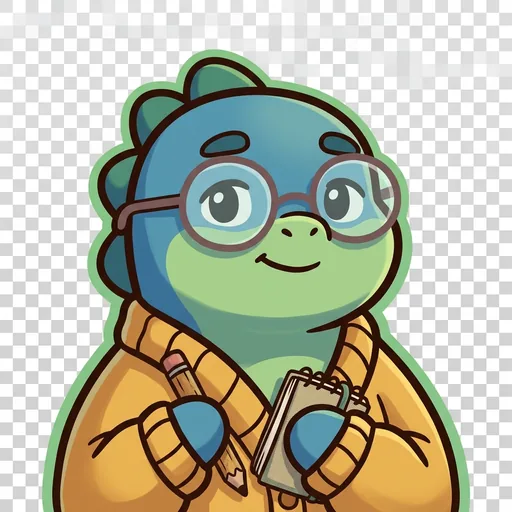
Ask
HELP-SEEKING — trusted-adult identification + crisis-resource awareness. The Botvin LST skill of knowing who to ask and how when something is too big to handle alone.
Listen along — Ask
Loading audio…
Press play to listen along. The line being read lights up as you go.
Show full transcript
Loading transcript…
Chapter 5 — Ask and the Small Card in Her Pocket
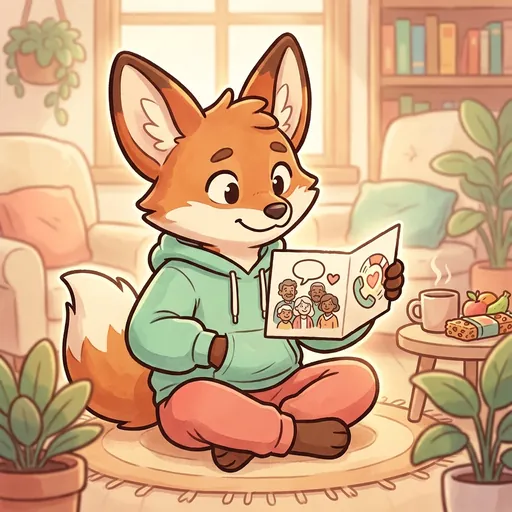
Ask stood on the corner where two streets crossed, and she had a card in her hand. It was small enough to hide inside a fist, and she was showing it to a boy named Dev who had been standing there for a while, not going anywhere.
“Here,” she said. She held it up so he could see both sides. On one side, in careful handwriting, was a short list of names — his aunt, his soccer coach, the counselor at his school, his older cousin who lived across town. On the other side, a row of numbers. “The names are people you can walk up to and talk to. The numbers are for the nights when the thing is bigger than any of them.”
Dev looked at the card without taking it. “What if I don’t know which one to pick?”
“Then you pick any of them,” Ask said. “You are not choosing wrong. You are just choosing a starting place.” She folded the card and pressed it into his palm, and she watched his shoulders come down half an inch, the way they always did once a kid had the card in hand instead of just the worry in his chest.
When Ask was small, her family were the town criers. In her village, when something happened that people needed to know, it was a crier who carried the message from door to door. Her grandfather had done it, and her mother did it, and Ask learned the work the way other children learned to tie their shoes.
The trick, her mother taught her, was never the message. The trick was knowing where the message went. A spilled cart went to the neighbor with the strong back. A flooding field went to the council. A fire went to everyone, all at once, as loud as she could shout. “Anybody can run down a street yelling,” her mother said, kneeling to Ask’s level. “The skill is knowing which door to knock on. That is a whole thing to know all by itself, separate from fixing what went wrong.”
Ask was six the first time she got it right. A woman had fainted in the market, and the grown-ups around her froze. Ask did not freeze. She ran — not to the woman, because she was six and could not lift her — but three doors down, to the house of the healer, and she pounded until the door opened. Later her mother said, “You did the most important part. You went and got the person who could help.” Ask had carried that sentence her whole life: getting help was helping.
She walked to the WellnessForge academy when she was twenty-two, the card already worn soft in her pocket. Vita, the head of the academy, met her at the gate and asked her one question. “When something is too big for a kid to carry alone — what do they do?”
Ask did not hesitate. “They reach for someone. Trusted grown-ups first — a parent, a teacher, a coach, a counselor. And for the nights that are heavier than that, real numbers they can call or text.” She turned her card so Vita could read it. “The card is not the answer to the hard thing. The card is proof they are not alone with it.”
Vita read both sides slowly. Then she looked up. “You are appointed.”
On the first day of her class, Ask did not start with a lecture. She started with scissors and paper. She handed every student a blank card and sat down among them.
“Write three to five names,” she said. “People you actually trust. People you can actually reach — not people you are supposed to trust because a poster says so.” She waited while pencils moved. A girl named Priya raised her hand. “What if I only have two?”
“Two is enough to start,” Ask said. “You can always add more. And here — flip it over.” On the board she had already written the numbers, and she read them out loud, plain and unhurried: nine-eight-eight, the line you call or text when the dark feels too big; text the word HOME to seven-four-one-seven-four-one; Childhelp, at one-eight-hundred-four-two-two-four-four-five-three, for when a grown-up is hurting you; RAINN, one-eight-hundred-six-five-six-four-six-seven-three; and nine-one-one, for the emergencies that cannot wait.
“Copy them exactly,” she said. “Not because tonight is scary. Because someday might be, and you deserve to already know the way.” Priya copied them, and then she asked the question Ask had been waiting for. “Isn’t asking for help kind of like giving up?”
Ask shook her head. “The hard thing being big is not you being small. When something is too heavy for one person, reaching for another set of hands is not failing. It is doing the exact right move.” She smiled. “And if the first person you reach isn’t there — you try the next name on your card. You never have to stop at one no.”
At the end of the day, when the room had emptied, Ask picked up a card a student had left behind and set it on her desk to return. Her own card was still in her pocket, folded along its soft crease.
She thought about Dev on the corner, and Priya with her two names, and all the kids who would carry a small square of paper without ever needing to use the numbers on the back — and all the ones who someday would. And something in her chest settled, quiet and steady, that certain warmth of knowing you are never quite as alone as a hard moment tries to make you believe. The names were there. The numbers were there. And somewhere, always, was someone who wanted to help.
Name-overlap note
WellnessForge Ask is a different character from InclusionForge Ask (ally-move ask-amplify). Different domain per registry rule 3 — shared name allowed.
The WellnessForge ensemble
Ask is part of WellnessForge's distributed-narrative cast. Each character embodies a different curricular primitive; together they teach the full subject.