Hook, Wager and Tempo
WHY WE KEEP READING — a page-turner is engineered from three things: Hook makes the opening a promise the reader can't refuse, Wager puts something precious at stake so the reader has a reason to care, and Tempo paces the story — speeding up and slowing down — so the tension keeps pulling us forward
A story read by Hook, Wager and Tempo
Loading audio…
Press play to listen along. The line being read lights up as you go.
Show full transcript
Loading transcript…
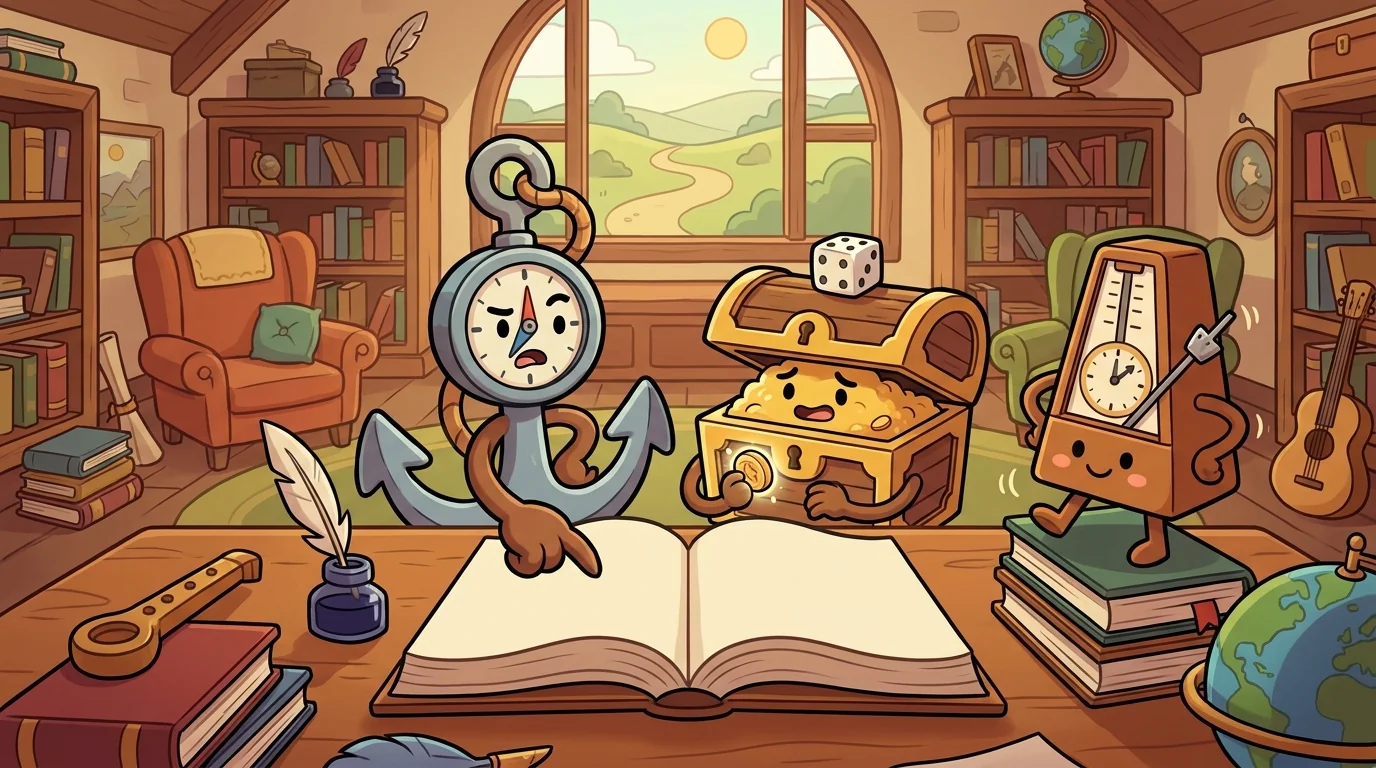
A young writer had a story that was, technically, fine. Good sentences. Nothing wrong with it. And nobody could get past page two. Three friends came to help, because they knew that "nothing wrong with it" is not the same as "impossible to put down" — and that a page-turner is built, on purpose, from three particular things.
Hook studied the opening line, looking for the promise it made.
Wager searched the story for what was truly at stake.
And Tempo felt the rhythm — where it rushed, where it dragged.
"Your first line," said Hook, "is: 'It was an ordinary Tuesday morning.' And that's exactly why nobody reads on. An opening makes a promise — and yours promises nothing. Let's fix that first."
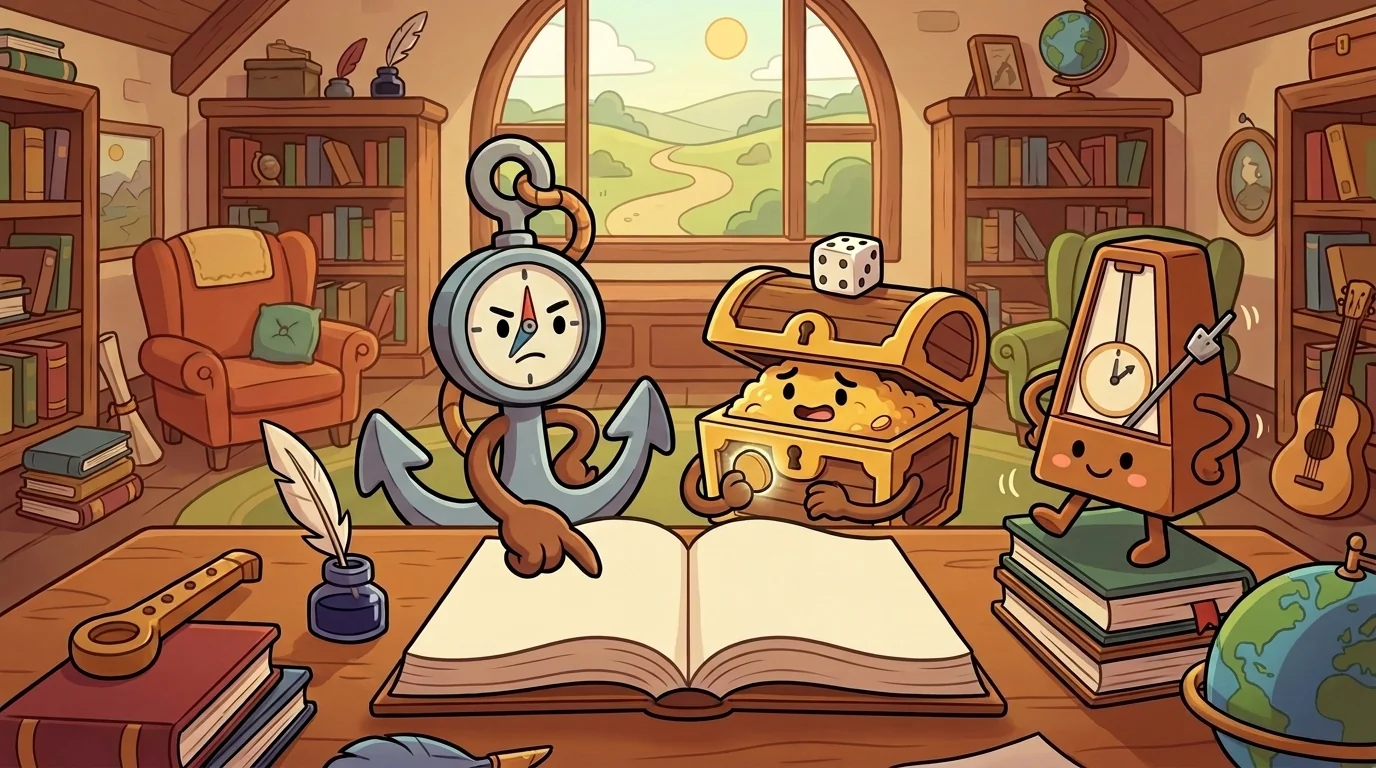
Hook went first, because the opening line is a promise to the reader — and a promise they can't refuse is what makes them turn the page.
"An ordinary Tuesday morning," Hook repeated. "That promises the reader: nothing interesting is about to happen. Why would anyone read on?" Hook leaned in. "The first line — the first page — is a contract. It says to the reader: here is the kind of story you're in, and here is a question you now need answered. And a great hook plants a question so sharp the reader cannot walk away without the answer." Hook tried a new opening. "What if it's: 'It was an ordinary Tuesday morning, right up until the moment the school bus lifted three feet off the ground.' Now the reader has to know — how? why? what happens?! That's a hook: a promise that something is happening, and a question that itches until it's answered." Hook set it. "You don't have to blow up the world in line one. You just have to make one promise the reader can't refuse — plant one question they need answered — so that not turning the page becomes impossible."
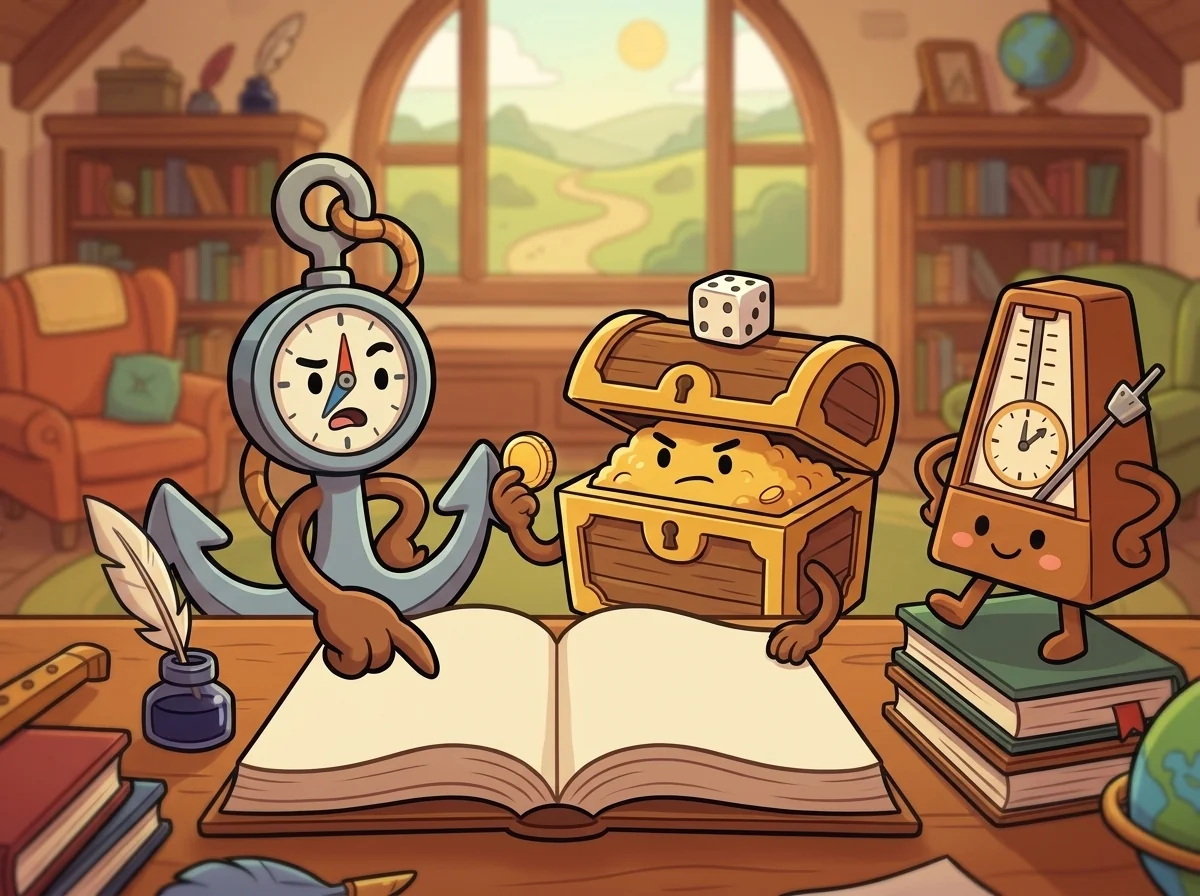
Then Wager searched the story for what was at stake — because a reader only keeps turning pages if they care, and caring means something precious could be lost.
"Okay, they're hooked," said Wager. "But to keep them, they have to care — and caring comes from stakes. Something precious has to be on the line, something the reader is afraid of losing." Wager dug into the story. "Right now, if your hero fails... nothing much happens. No stakes. So the reader relaxes — and a relaxed reader puts the book down." Wager raised the stakes. "But what if the floating bus has your hero's little brother on it, drifting higher, and she's the only one who knows how to get him down — and she's terrified of heights? Now something precious is at risk. Now the reader is afraid for her, for the brother." Wager held up the stakes. "That's the wager: put something on the line the reader doesn't want to lose. The bigger and more precious the stake — a life, a friendship, a dream, a home — the harder the reader grips the page. No stakes, no worry. No worry, no page-turning. Make us afraid to lose something, and we cannot look away."
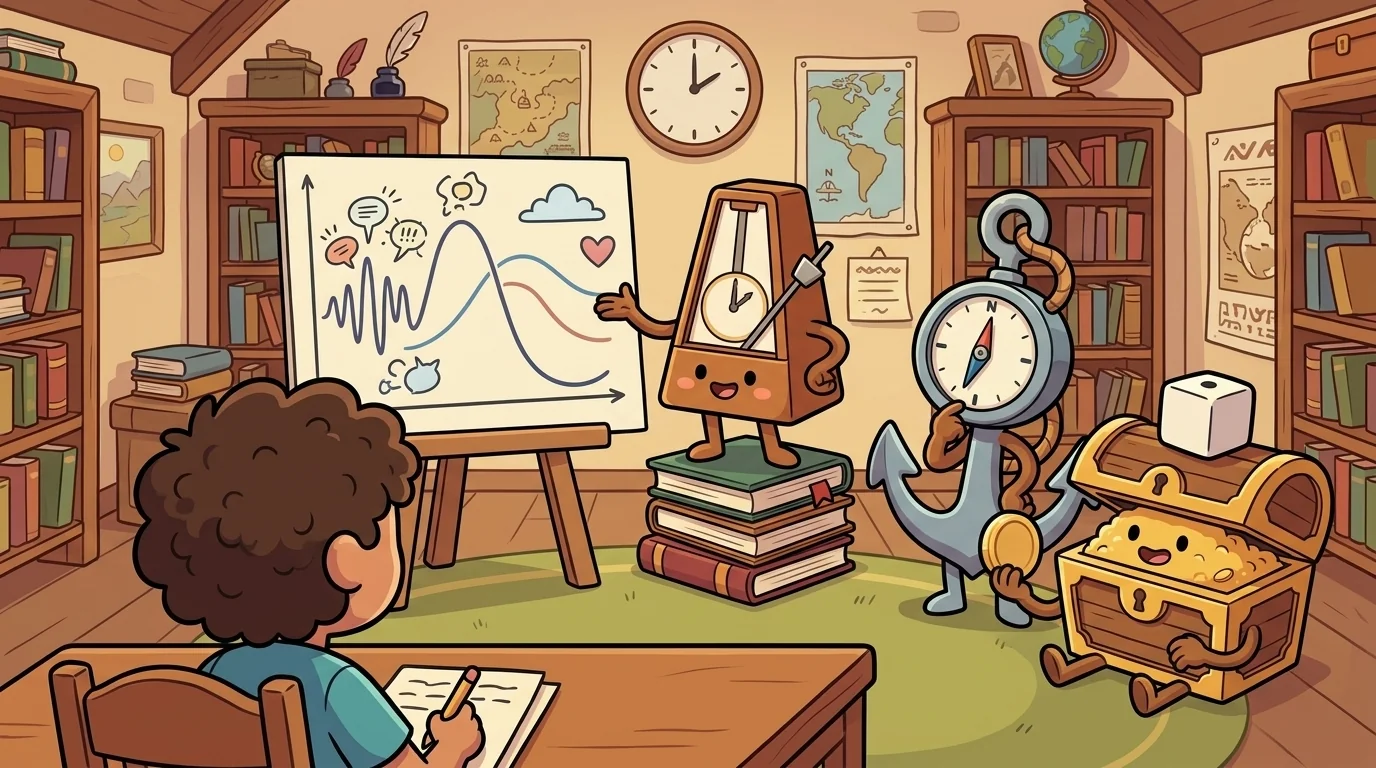
And Tempo did the last thing — controlling the speed, because tension has to rise and fall in a rhythm or it goes numb.
"Hooked and caring — now I control the pace," said Tempo. "And the secret is: you can't run flat-out the whole time, and you can't crawl the whole time either. Tension needs rhythm." Tempo showed the shape. "In the scary, urgent parts — the bus rising, the brother slipping — I write short. Sentences. Fast. Little paragraphs. Quick cuts. The reading speeds up, heart pounding, matching the danger." Then Tempo slowed. "And then, right after, I let it breathe — a slower moment, longer sentences, the hero catching her breath, so the reader catches theirs too. Because if everything is loud and fast, the reader goes numb and stops feeling it." Tempo built the wave. "Fast, then slow, then faster — tightening and releasing, over and over, each peak a little higher. That rising-and-falling rhythm is what pulls a reader through a whole book without ever letting them settle enough to put it down. Speed is storytelling. I decide when the reader can breathe — and when they can't."
And the young writer rebuilt the opening with all three — a hook that promised a flying bus, a wager that put her little brother at risk, a tempo that raced and breathed and raced again — and suddenly the story that nobody could get past page two of was one nobody could stop reading.
"Good promise," said Wager.
"Good stakes," said Tempo.
"Good pace," said Hook.
There is a particular, delicious feeling every reader knows — staying up far too late, one-more-chapter after one-more-chapter, physically unable to put a book down. And the wonderful secret is that it isn't an accident. It's built — with a hook that makes a promise, a wager that puts something precious at risk, and a tempo that races and breathes and races again. Learning to build it yourself is like being handed the keys to that feeling: the power to reach into a reader, plant a question they can't ignore, make them care, and pull them helplessly forward. To give someone that can't-stop-reading feeling — the one you've loved from the other side so many times — is one of a writer's very best joys.
The TaleForge ensemble
Hook, Wager and Tempo is part of TaleForge's distributed-narrative cast. Each character embodies a different curricular primitive; together they teach the full subject.
-

Hook
Story elements — opening as contract with the reader; the first line is a promise; 'Make me lean in. Then keep me leaning.'
-

Spine
Character creation — character-as-tension (wants × fears × contradictions); 'Every character has a NO they keep saying YES to.'
-

Bough
World-building — coherence-rules-as-promises-the-world-keeps; what the world ALWAYS does + NEVER does (SOFT collision with LinguaQuest Bough — different role/domain/visual)
-

Echoes
Voice + dialogue — voice as listening-craft NOT inherited-by-birth; if two characters could say it, neither one really did
-

Glimmer
Revision + reflection — first draft as DATA not failure; the second look that makes the first attempt useful
-

Wager
Stakes — moss-soft creature (they/them) who carries one glowing marble holding everything they'd hate to lose; a story matters when something precious is at risk
-

Keystone
World-consistency — kind-eyed stone (they/them) at the center of an arch; an invented world feels real when it keeps its own rules all the way through
-

Swerve
The twist — sideways-shimmering creature (they/them) who loves a road that turns; a twist must be surprising AND fair (the clues there all along)
-

Tempo
Pace / rising tension — lithe creature (they/them) with a self-beating heartbeat-drum; a story breathes, fast and slow on purpose, climbing to its biggest moment
-

Heart
Theme — soft glowing creature (they/them) who listens for the true thing beating under a story; show the meaning, never announce it like a lesson