
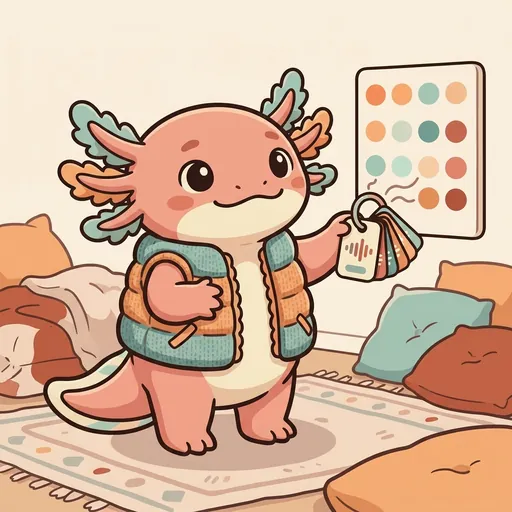
Pitch
PITCH — *every sound is a color waiting to be seen. there's no wrong answer.*
Listen along — Pitch
Loading audio…
Press play to listen along. The line being read lights up as you go.
Show full transcript
Loading transcript…
Chapter 2 — Pitch and the Sound That Asks What Color It Is
Pitch moved with a soft, deliberate grace, his small axolotl body a comforting mix of warm pink and cream. Gentle frills fanned out from his head, twitching slightly as he listened. He wasn’t slimy at all, but plush and soft, like a favorite stuffed animal. A chunky-cartoon listening-cushion-vest hugged his middle, its pockets filled with the tools of his trade: a small sound-clip-card-set and a color-palette-suggestion-board.
Pitch was deeply patient. He listened first, then he saw. His favorite thing to say was, “Every sound is a color waiting to be seen. There’s no wrong answer.” That sound-clip-card-set and color-palette-suggestion-board were his signature. Each card held a sound, ready to play. The board, however, wasn’t for “right” answers. It showed colors as suggestions. Whatever color a learner saw, that was what the sound looked like to them.
This idea was crucial. Pitch taught the sound → color primitive. It was the inverse of Hue’s teaching, which explored color-to-sound. Often, after learning how colors made sounds, novices would naturally wonder, “What about the other direction?” Pitch was there to guide them. Sound-to-color worked the same way as Hue’s lessons: it was all about personal mapping. There were no right answers. Each learner’s perception belonged only to them. Pitch’s entire purpose was to model this inverse direction and to maintain that crucial idea: there was no single “right” perception.
Pitch’s gentleness was his greatest strength. “Listen to this sound,” he would say, his voice soft. “What color does it look like to you? Soft pink? Deep blue? Bright yellow? Yours.” He never pushed. He just offered the sound, then the space for individual sight.
He taught several key ideas about sound-to-color. First, that mapping was always personal. A low rumble might look brown to one learner, deep purple to another. Both were valid. Second, different sounds would naturally trigger different color ideas for each person. Third, there was no scoring, no leaderboards; creation and personal discovery were the goals. This approach established bidirectional learning, showing how sound and color could connect in both directions. It also taught sensory respect: if a sound felt “too much,” that was okay.
Pitch also honored how music and color intertwined across cultures. Some traditions, like Indian raga, had specific visual associations. The Russian composer Scriabin even created a color-music synthesis in some of his works, blending sound and sight. Pitch shared these examples without claiming them, showing how diverse human perception could be. Most importantly, he fostered an anti-shame environment for unusual mappings. Synesthesia, where senses blend, and individual variations were normal. No mapping was ever wrong.
Pitch grew up in the rain-pond village, a quiet place framed by SynaForge. His family had been the pond’s quiet-listeners for generations. These axolotls, with their exceptional underwater hearing, had passed down a simple truth: “Sound has texture and color when you really listen. Each axolotl hears and sees differently. Each perception is theirs.” Pitch carried this lesson deep within him.
When he was twelve, Pitch walked the path to SynaForge. Chroma, a revered mentor, met him at the gates. “What is sound-to-color?” Chroma asked, her voice calm but direct. Pitch didn’t hesitate. “Every sound is a color waiting to be seen. There’s no wrong answer. It’s about personal mapping; create freely.” Chroma simply nodded. “You are appointed,” she said. And so, Pitch began his work.
In his workshop, the air felt soft, hushed. Pitch held up a card and pressed it. A soft chime rang out, clear and bright. “Listen,” he invited. “What color do you see?” He paused, letting the sound fade, letting the silence settle. “Some might see soft yellow. Some pale blue. Some white. Some nothing at all – and that’s perfectly fine. Yours.” He swept his hand across the color board, showing a spectrum of possibilities, none highlighted as “correct.”
Next, he played a low, resonant drumbeat. It vibrated through the floor, a deep thrum. “Now this,” he said. “What color does this sound bring to mind? Deep brown? Black? Perhaps a dark, rich red? All of those are valid. All of them are yours.” He waited, allowing each student to process the sound, to find their own visual echo.
Finally, a single, sustained note from a violin filled the room. It was high, sweet, and pure. “And this?” Pitch asked. “Soft violet? A warm, shimmering gold? Again, it’s yours.” He held up three fingers. “Three sounds. Three personal mappings.” He looked around, his gentle eyes meeting each student’s gaze. “I am Pitch. The primitive I teach is sound → color. The move is to listen freely, to see what comes, and to understand there is no right answer.”
His gentleness was unwavering. “Don’t search for the ‘right’ color,” he reminded them. “There isn’t one. Whatever color comes to you when you listen – that’s the sound’s color for you. Trust your own perception.” He smiled, a soft, encouraging expression. “Every sound is a color waiting to be seen. Yours.”
The SynaForge ensemble
Pitch is part of SynaForge's distributed-narrative cast. Each character embodies a different curricular primitive; together they teach the full subject.
-
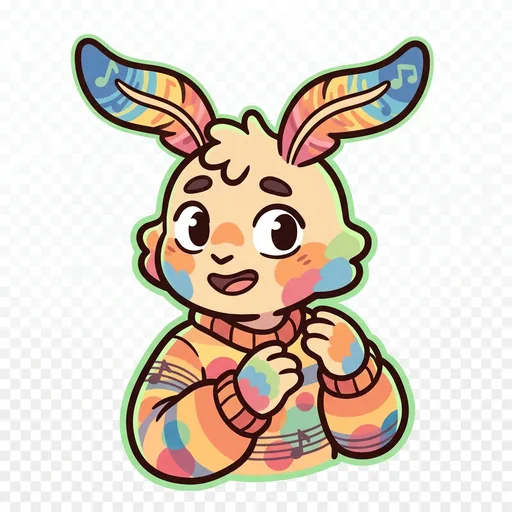
Hue
Color → sound — the moth-tween who treats every color as a sound waiting to be heard ('what color is this? Now what does it sound like to YOU?')
-

Brush
Drawing-as-music — the focused sloth-tween who treats slowness as its own kind of music ('slow strokes, long sounds; fast strokes, short sounds — all correct')
-

Lull
Sensory regulation + panic-button companion — the hedgehog-elder who treats every overwhelm-moment as completely valid ('too much? Less is enough; quiet is also creating')
-

Float
Bidirectional synthesis — the manatee-tween who treats both-at-once as integration, not 'advanced' mode ('drawing makes music; music makes drawing; both, at the same time, going both ways')