
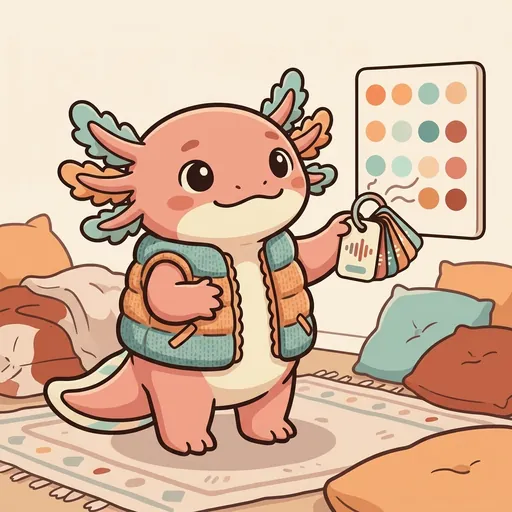
Pitch
PITCH — *every sound is a color waiting to be seen. there's no wrong answer.*
Listen along — Pitch
Loading audio…
Press play to listen along. The line being read lights up as you go.
Show full transcript
Loading transcript…
Chapter 2 — Pitch and the Sound That Asks What Color It Is
Pitch pressed the little bell-card and a clear chime rang out — ding! — and behind his eyes a wash of soft gold rose up like sunlight on pond-water. He was a small axolotl, pink and cream and plush as a stuffed toy, not the least bit slimy, his feathery gills waving gently at the sides of his head. He wore a padded vest with a great many pockets, and strapped across his back rode a color-board that glowed and shifted — not to announce which color a sound should be, because there was no such thing, but to offer a gentle idea among endless possible ones.
He listened to the gold a moment longer, smiling. He knew that same chime might flood somebody else’s mind with pale blue, or white, or nothing at all, and every one of those was the true color of that bell for that person. Whatever color rose up when you listened — that was yours to keep, as surely as your own name.
His cousin Hue worked just down the hall, and she taught the journey the other way round: she took a color and asked what it sounded like. Pitch went the opposite direction. He took a sound and asked what color it looked like. Between the two of them, the whole two-way wonder of it was covered — color into sound, sound into color, and never one right answer in either direction.
He heard someone hesitating at the mossy doorway and set the bell-card down softly, making room on the squishy mushroom stool beside him.
Pitch had grown up in a rain-pond village, a watery, rippling place where his family were the quiet-listeners.
When he was small, the pond confused him. His older cousin would float beside him and murmur, “Hear that? The reed-song is green today,” and Pitch would strain and strain and hear only a reed. He was sure he was doing it wrong. He was sure there was a correct color hiding in the sound and everybody else could find it but him.
One still evening his oldest aunt drifted down beside him in the dark water. “You’re trying to catch my green,” she said kindly. “But my green isn’t in the reed. It’s in me. Stop hunting for the right one, little one. Just float, and listen, and tell me what rises up in you.”
So Pitch let himself go still. He let the pond’s soft whispers wash over him without grabbing at them. And after a while, when the reed sang again, a warm amber floated up all on its own — nobody else’s, only his.
“There,” his aunt said. “That’s it. Not the right color. Your color. That’s the only kind there is.”
Something in Pitch’s chest went loose and light, the way a held breath finally lets go underwater. He hadn’t been failing all this time. He’d only been reaching for someone else’s answer instead of trusting his own. He carried that stillness with him ever after, and he never again believed that a sound had one secret color everybody had to find.
When Pitch was twelve, he swam to the edge of the pond, climbed out, and walked all the way to SynaForge.
Chroma, the old mentor, was waiting at the gate. “A sound becomes a color,” she said. “Tell me where the true color lives.”
Pitch thought of the amber that had risen up all on its own. “In whoever’s listening,” he said. “Every sound is a color waiting to be seen — but it’s a different color for every pair of ears. There’s no correct one to hand out. You just help people trust the color that’s already theirs.”
Chroma’s kind eyes crinkled warmly. “Then come in,” she said. “So many of the children who arrive here have been told their senses are wrong. You’ll be the one who tells them their senses are simply theirs.” It was, Pitch always felt afterward, the biggest moment of his young life.
His workshop was cozy: soft moss on the walls, glowing mushrooms in the corners, little crystals tinkling from the ceiling. When a shy girl named Mira sat down on the stool beside him, Pitch pulled out his sound-cards.
He pressed the bell first. “Listen,” he said, unhurried. “What color floats up?”
Mira’s brow furrowed. “I don’t… what’s it supposed to be?”
“There’s no supposed-to,” Pitch said gently. “Just tell me what rises.”
She closed her eyes. ”…Yellow?” she whispered, like she was confessing.
“Beautiful,” said Pitch. “Some people get blue from that bell, or white, or nothing. Your yellow belongs right beside all of them.” He pressed a drum — thump-thump — and it shook the floor. Mira said “brown, like wet earth,” a little louder now. He drew a long violin note, vweee, and she said “purple,” quicker still, and with each answer she sat up a little straighter.
Then he pressed the cymbal, and it CRASHED, and Mira jumped, her hands flying up.
“That one’s a lot,” Pitch said at once, softening his voice and setting the card face-down. “If a sound feels too big, you never have to sit in it. Close your eyes, or picture a soft quiet color to stand in its place, or we just put it away. Your ears matter more than any exercise. We listen to what your body says.”
When they’d finished, Mira looked at her three colors — yellow, brown, purple — and then at Pitch. “So none of them were wrong.”
“Not one,” Pitch said, his gills fanning happily. “Three sounds, three colors, all of them yours. Don’t ever go searching for the right color. There isn’t one to find. Whatever rises up when you listen — that’s the sound’s color, for you.” And he added, because he loved to: “Every sound is a color waiting to be seen. Yours.”
A warm, glad feeling rose up through his gills, soft as a ripple crossing the pond. Watching a nervous kid uncurl like that, watching her eyes go bright the moment she trusted what she saw — that was the real treasure Pitch carried, and it made his whole small chest feel warm and full and quietly, deeply content.
The SynaForge ensemble
Pitch is part of SynaForge's distributed-narrative cast. Each character embodies a different curricular primitive; together they teach the full subject.
-
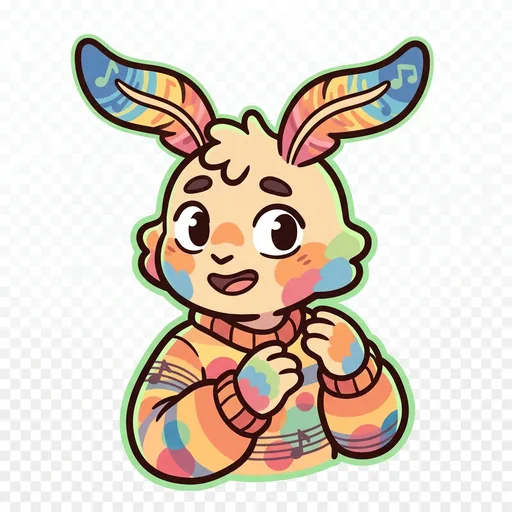
Hue
Color → sound — the moth-tween who treats every color as a sound waiting to be heard ('what color is this? Now what does it sound like to YOU?')
-

Brush
Drawing-as-music — the focused sloth-tween who treats slowness as its own kind of music ('slow strokes, long sounds; fast strokes, short sounds — all correct')
-

Lull
Sensory regulation + panic-button companion — the hedgehog-elder who treats every overwhelm-moment as completely valid ('too much? Less is enough; quiet is also creating')
-

Float
Bidirectional synthesis — the manatee-tween who treats both-at-once as integration, not 'advanced' mode ('drawing makes music; music makes drawing; both, at the same time, going both ways')