
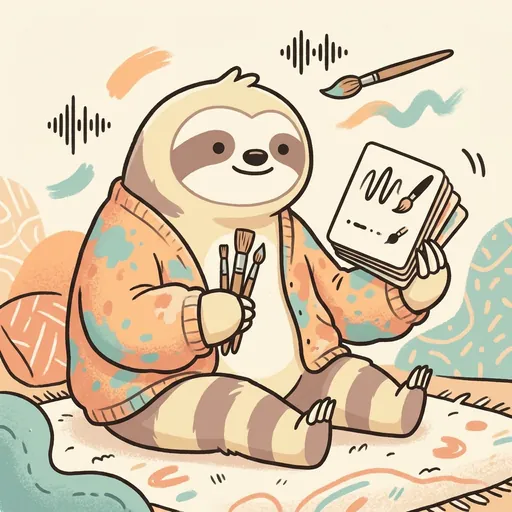
Brush
BRUSH — slow strokes, long sounds; fast strokes, short sounds — all correct.
Listen along — Brush
Loading audio…
Press play to listen along. The line being read lights up as you go.
Show full transcript
Loading transcript…
Chapter 3 — Brush and the Slowness That Is Music
In a quiet corner of the SynaForge studio, a sloth named Brush drew a single line across a wide sheet of paper, and the room filled with a low, warm note that went on and on.
She was not hurrying. Her paw moved the brush the way water moves down a leaf — steady, unbothered, taking its time. As the brush slid, the note stretched with it, deep and soft, like a cello holding one long breath. A cluster of kids had crowded in to watch, and one of them, a fidgety fox-boy near the front, kept bouncing on his heels.
“Is it done yet?” he blurted. “That’s so slow.”
Brush didn’t stop. The line kept growing. The note kept sounding. When at last the brush lifted off the far edge of the paper, the sound faded into the quiet like the last light of evening.
“There,” she said. She turned her big, calm eyes to him. “Slow strokes make long sounds. Fast strokes make short sounds. Both are music.”
The fox-boy grabbed a brush and slashed three quick marks — tak, tak, tak — and three bright little chirps popped out. He grinned.
“See?” said Brush. “Yours is a fast song. Mine is a slow one.” She swayed her head gently. “Nobody’s wrong. The music just came from how you moved.”
Brush had grown up high in the rainforest, where her whole family moved slowly. Very, very slowly.
When she was small, she had worried about it. Once she watched a troop of monkeys race through the branches, screeching and swinging, and she thought her own careful crawl looked broken by comparison. That night she felt small and heavy, and a tightness sat behind her ribs. Everyone else is quick, she thought, and I’m the slow one. I’m doing it wrong.
Her mother found her curled in the crook of a branch. She didn’t tell Brush to hurry. She just settled beside her and went still, and after a while she began to hum — a sound so low and unhurried it seemed to come from the tree itself.
“Listen,” her mother said. “The fast-mover misses the slow-music. They go by too quick to hear it.” She nodded at the forest, where rain was starting, one drop at a time. “You can hear every single note. That is not being broken, little one. That is a gift.”
Brush listened. She heard the tick of one drop, then a long pause, then another. Slow. Patient. Beautiful. The tightness behind her ribs loosened, just a little. For the first time, her slowness didn’t feel like a mistake. It felt like a way of hearing the world that the quick ones never got to have.
When she was twelve, Brush walked to SynaForge. It was a long walk, and she made no effort to shorten it.
She stopped for every leaf and every dewdrop. It took many days. When she finally reached the gate, Chroma — the studio’s wise mentor, with bright, curious eyes — was waiting.
“What is drawing-as-music?” Chroma asked, her voice soft as a breeze.
Brush didn’t answer with words. She took a slow breath, picked up a brush, and drew. First a long, sweeping arc — and a long, held note poured out. Then, without pausing, four sharp little dabs — and four quick sounds skipped after. She pressed hard for a booming stroke, then feather-light for a whisper of a sound. On one sheet, she had made a whole song out of nothing but how her body moved.
Chroma watched the paper the way you’d watch someone sing.
“You made music,” Chroma said, “and you never touched an instrument.”
“I only moved,” said Brush. “The moving was the music.” She set the brush down gently. “Slow or fast, hard or soft — it all counts.”
Chroma smiled. “Then you’re home.”
Brush’s studio became a place where kids drew their songs.
One afternoon a girl came in who kept her arms tucked close, moving carefully. “I can’t go fast,” she said quietly. “My hands get tired. Everybody else makes these big loud drawings and I just… can’t.”
Brush knew that quiet. She’d felt it in a rainforest tree a long time ago.
“Draw me something small,” Brush said. “As small as you like.”
The girl made one tiny, slow line with just the tip of her finger. A single soft note rose — thin and clear, hanging in the air.
“Now listen to it finish,” said Brush. They both went still. The note faded slowly, the way a bell fades. “Did you hear all of it? The whole thing, start to end?”
”…Yeah,” the girl said. “It lasted a long time.”
“That’s the slow-music. Fast drawings are loud and busy — they’re wonderful too — but they rush past so quick you miss the middle of every note.” Brush leaned in. “Yours, you can hear every part of. That’s not less. That’s more.”
The girl drew another small line, then another, each one unhurried. The notes stacked up into something gentle and whole — a quiet melody that filled the studio without ever raising its voice. She was smiling now, her shoulders down and easy.
“If your body needs to rest,” Brush added, “you can even draw the strokes in your head and hear the music there. Moving is one way in. It’s not the only door.”
Later, when the studio had emptied, the girl lingered at the door with one more question.
“When it’s so slow and quiet like that,” she asked, “how do you know it still counts as a real song?”
Brush thought about the rainforest, and the rain falling one drop at a time, and the tightness that had once sat behind her own ribs.
“You feel it finish,” she said. “A fast note is gone before you can hold it. But a slow one — you get to stay with it the whole way down, until the very last of it goes quiet. That waiting, that letting a sound take all the time it needs — that feeling is the music, too.”
The girl nodded, slow this time, unhurried.
And as she walked out into the evening, Brush stayed still and listened to the studio settle — the soft creak of the floor, the hush of the paper, the long, warm quiet after a note lets go — and felt, all the way through her, calm and unrushed and exactly the right speed.
The SynaForge ensemble
Brush is part of SynaForge's distributed-narrative cast. Each character embodies a different curricular primitive; together they teach the full subject.
-
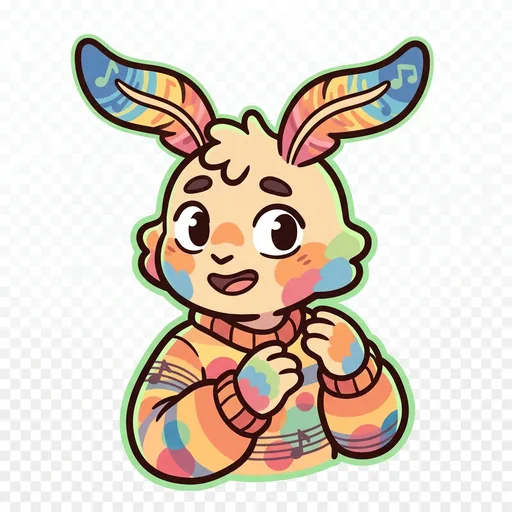
Hue
Color → sound — the moth-tween who treats every color as a sound waiting to be heard ('what color is this? Now what does it sound like to YOU?')
-

Pitch
Sound → color — the patient axolotl-tween who treats every sound as a color waiting to be seen ('there's no wrong answer')
-

Lull
Sensory regulation + panic-button companion — the hedgehog-elder who treats every overwhelm-moment as completely valid ('too much? Less is enough; quiet is also creating')
-

Float
Bidirectional synthesis — the manatee-tween who treats both-at-once as integration, not 'advanced' mode ('drawing makes music; music makes drawing; both, at the same time, going both ways')