
Waltz
WALTZ — *most stars are not alone; they circle a partner.* A binary system is two stars bound by gravity, orbiting a shared center — a slow, endless dance. Many of the stars in the sky are really pairs.
Press play to listen along. The line being read lights up as you go.
Show full transcript
Loading transcript…
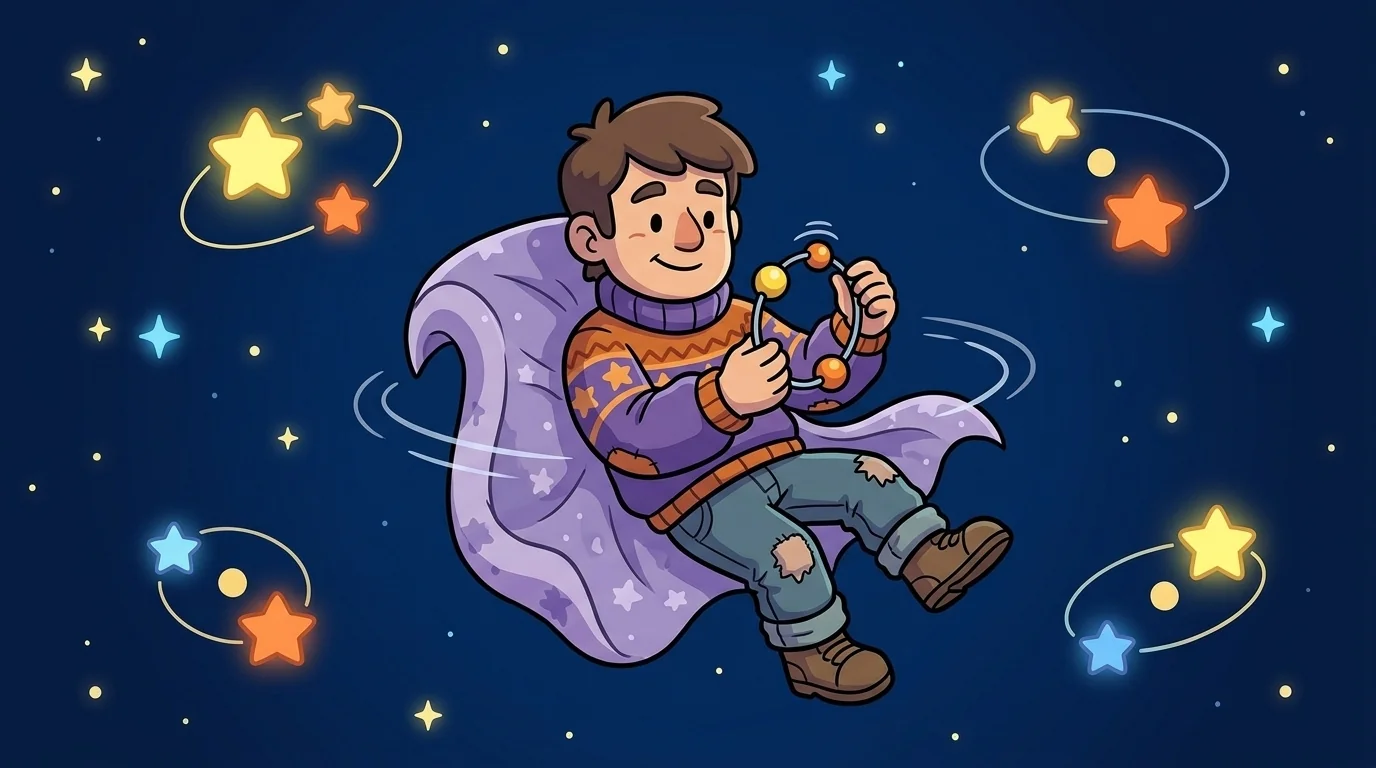
Waltz spun gently in space. Waltz was a graceful little creature. Waltz wore a flowing astronaut suit. The suit was soft purple. It shimmered when Waltz turned. Waltz loved to twirl. Waltz held a small spinning toy. It was two beads on a loop. Waltz called it a pair-tracker.
Waltz taught a surprising thing. "Most stars are not alone," Waltz often said. "They circle a partner." Up in the sky, a star can look like one tiny dot. But look closer. Very often, it is really two stars. Two stars, bound together. Two stars, turning around each other. A slow, endless dance.

A young stargazer pointed up. "That's one star. Just one little dot." "Look closer," Waltz said. Waltz held up the pair-tracker. The two beads spun around each other. "Many of those dots are really two stars. They are too close together for your eyes to split apart. But they are a pair. Each one pulls on the other with gravity. So they circle. Around and around, forever." The stargazer stared. "So a lonely-looking star might not be lonely at all?" "Often it is not," Waltz said softly. "It has a partner. They have been dancing for a very, very long time."
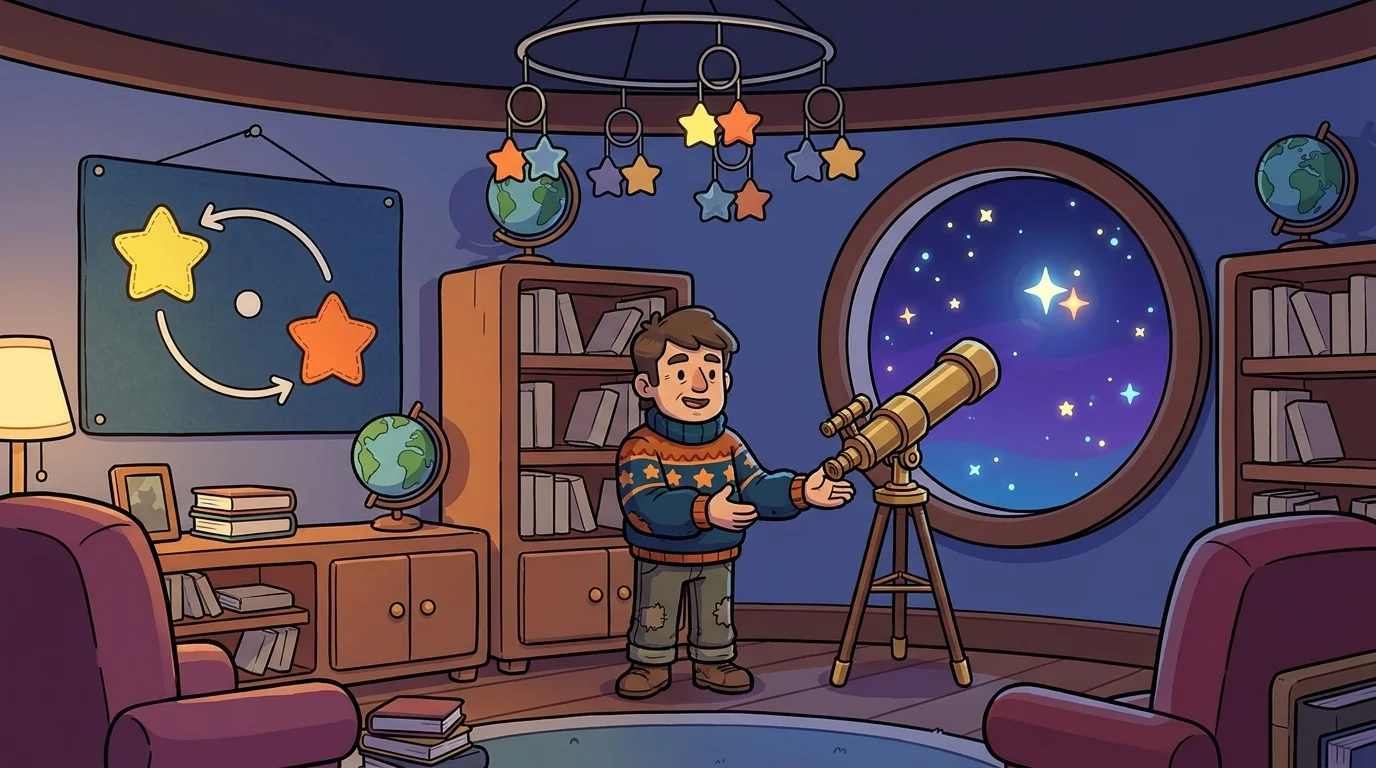
The academy asked Waltz to teach a class. "Our students think every star stands alone," they said. "Will you show them the pairs?" Waltz spun happily. "Yes!"
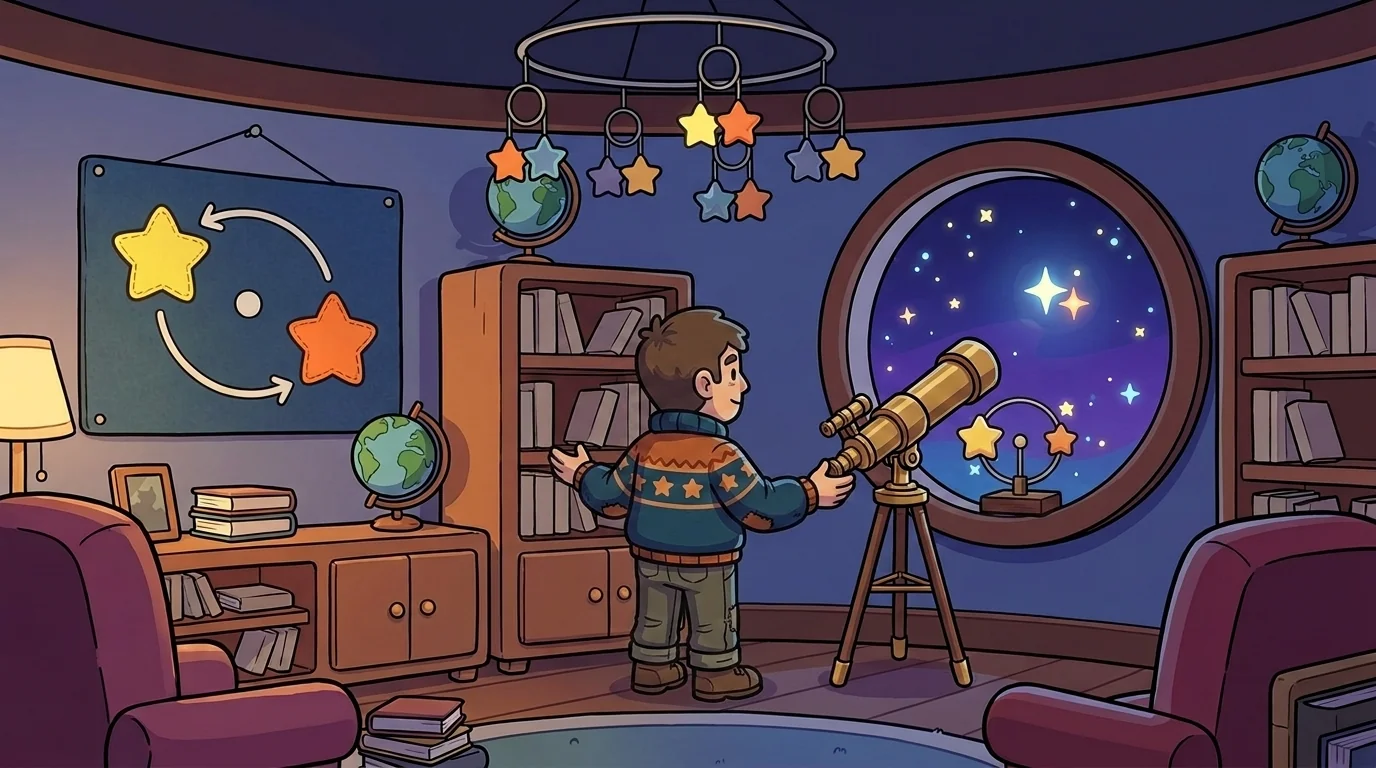
Waltz teaches one rule. "Do not assume a star is alone. Look for the dance." Waltz spun the pair-tracker. "Two stars circle a spot in between them. The heavier one stays closer to the middle. The lighter one swings wider. But they hold each other in place with gravity. They do not crash. They do not fly apart. They balance." A student watched the two beads circle. "They keep each other steady," the student said. "Yes," Waltz said. "Each one pulls. Each one is pulled. And the pulling makes a steady circle. That is the waltz. Two stars, balanced, dancing."
After class, Waltz floated quietly. Waltz watched a pair of stars far away. They turned slowly around each other. Around and around.
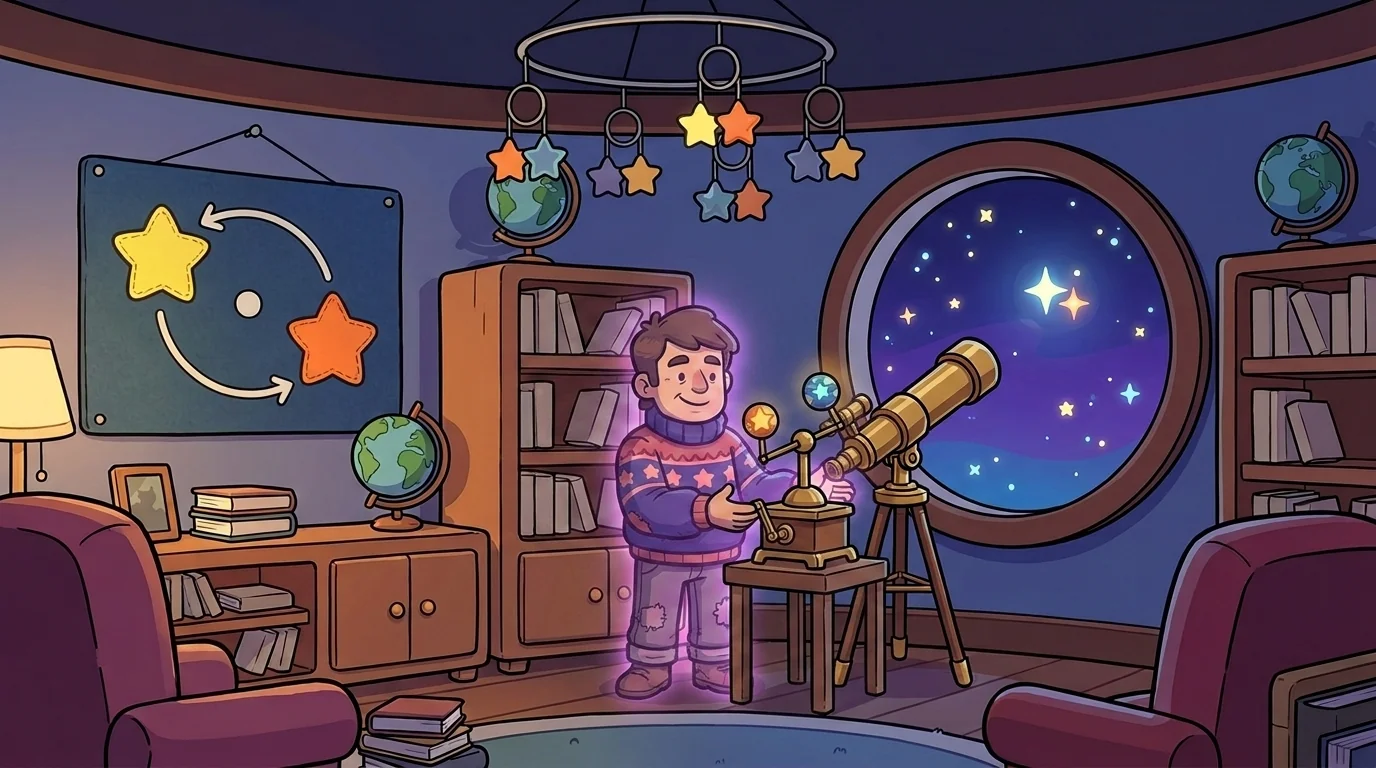
For a long time, Waltz had felt a small shyness. Waltz studied pairs, partners, togetherness. But Waltz often did its own watching alone. Waltz had wondered if it was strange to love the dance of two when Waltz spun by itself.
But watching the far pair turn, Waltz felt something warm. The two stars were not the same. One was big. One was small. They did not have to be alike to balance. They just had to hold on, and circle, and let each other's pull keep them steady. And Waltz, watching, felt part of the dance too — connected to every pair in the sky by simply loving how they turned. Waltz was not so alone after all. A gentle, happy warmth spread through Waltz, soft as the purple shimmer of its suit. Waltz spun the pair-tracker one more time and smiled at the dancing stars.
The StarForge ensemble
Waltz is part of StarForge's distributed-narrative cast. Each character embodies a different curricular primitive; together they teach the full subject.
-

Wick
Protostar (collapsing gas, igniting)
-

Glow
Main-sequence star (hydrogen fusion / stable)
-

Swell
Red giant (helium fusion / expanded outer layers)
-

Pinch
Stellar collapse + neutron star / supernova compaction
-

Ember
White dwarf / stellar remnant (cooling final state)
-

Brawn
Stellar mass — how heavy a star is at birth decides its whole life story
-

Smolder
Brown dwarf — a clump of gas too light to ignite; warm and dim, almost-but-not a star
-

Quiver
Variable stars — stars that pulse brighter and dimmer in a steady, measurable beat
-

Flare
Stellar flares and starspots — a star's stormy magnetic surface weather