
Flare
FLARE — *a star's surface is stormy, with dark spots and sudden bursts of light.* Stars have magnetic weather: cooler dark patches called starspots, and sudden flares — bright bursts of energy that leap off the surface.
Press play to listen along. The line being read lights up as you go.
Show full transcript
Loading transcript…
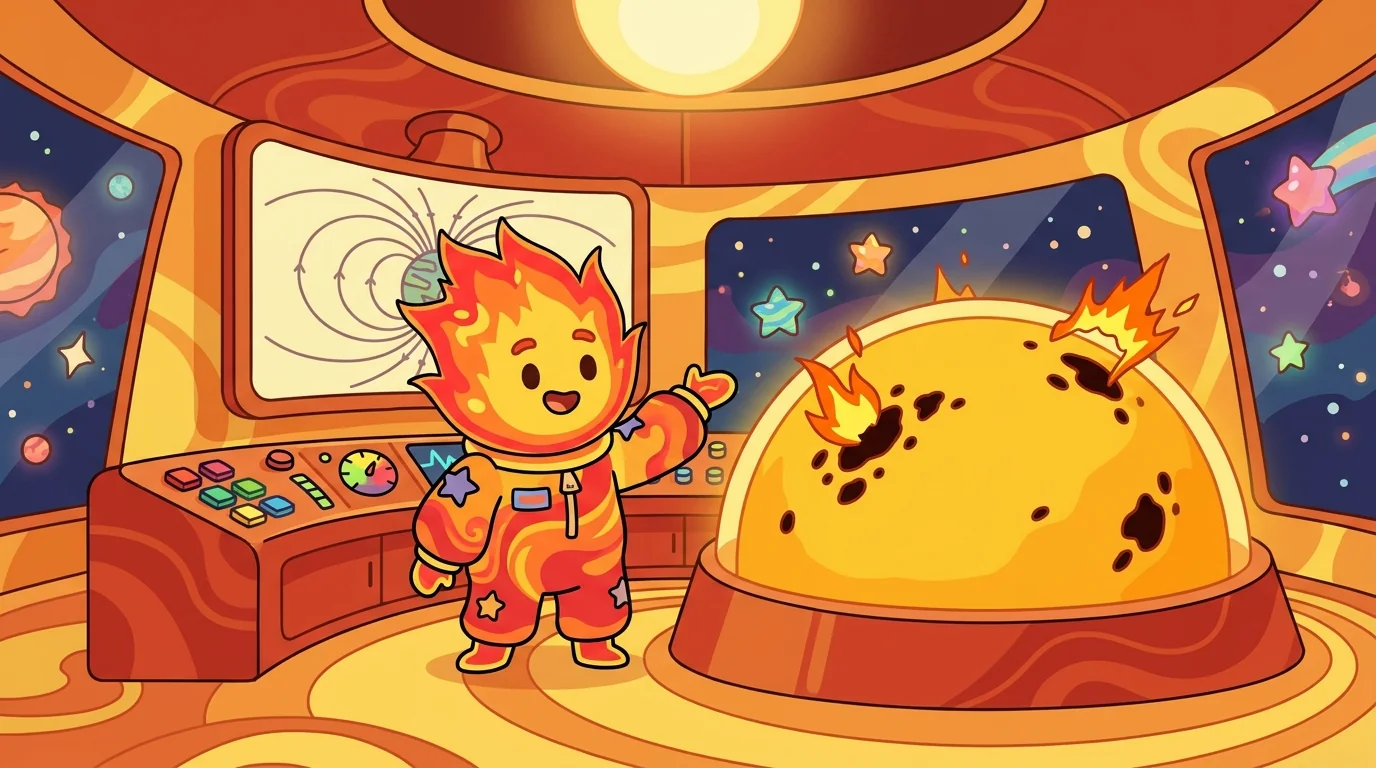
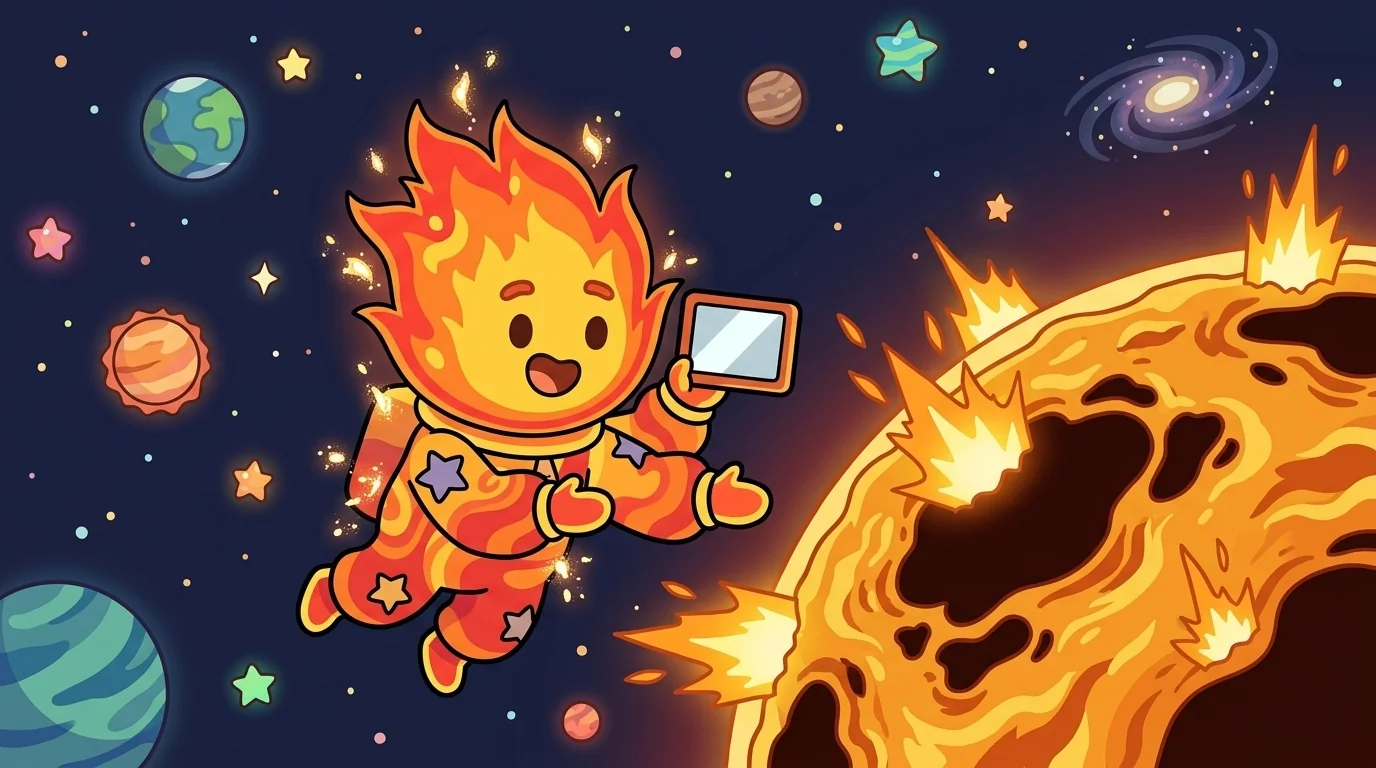
Flare zipped around in space. Flare was a lively little creature. Flare wore a crackly astronaut suit. The suit was bright yellow with orange streaks. Tiny sparks popped off Flare now and then. Flare was full of energy. Flare carried a small viewer. Flare called it a spot-watcher.
Flare taught about a star's stormy face. "A star's surface is not calm," Flare said. "It is stormy." From far away, a star looks smooth and steady. But up close, its surface churns. There are dark, cooler patches called starspots. And there are sudden bursts of light called flares. "Stars have weather," Flare said. "Magnetic weather. And it can get wild."
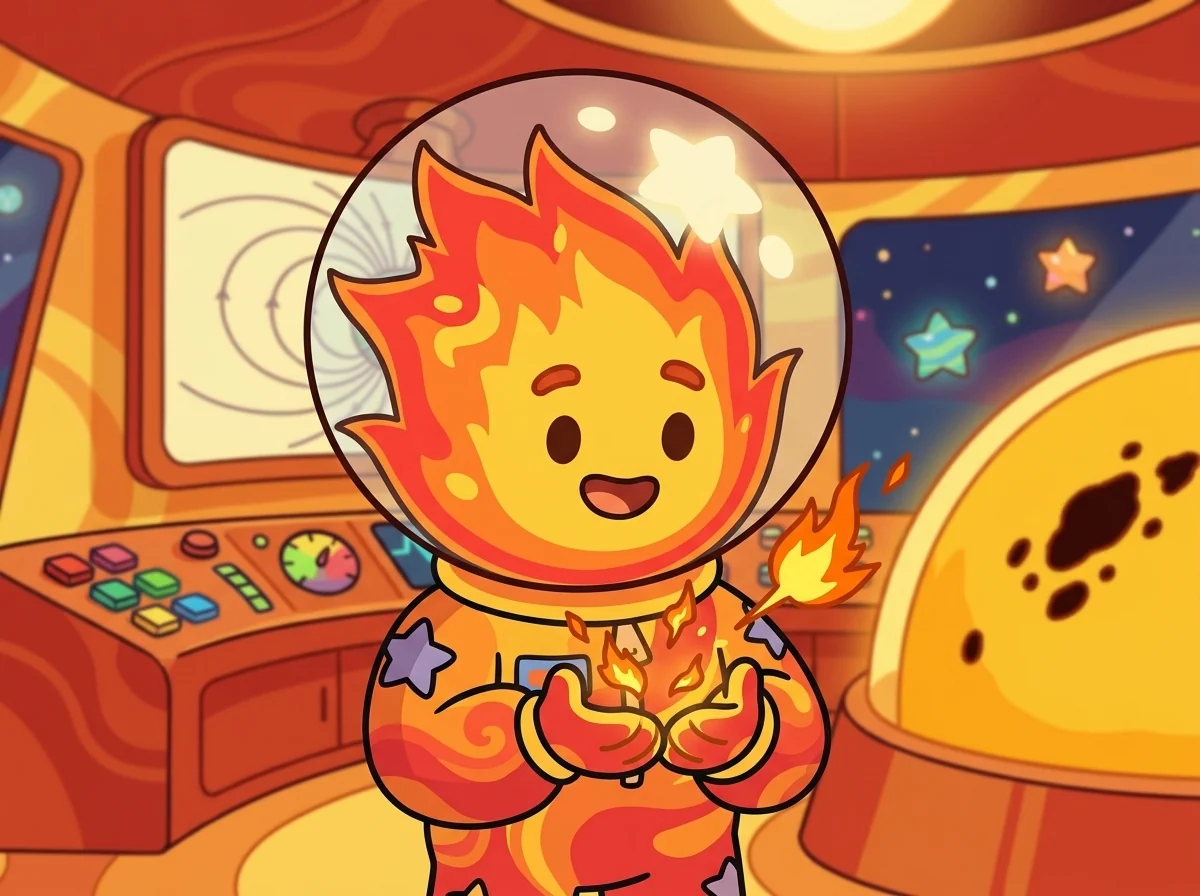
A young stargazer looked through the spot-watcher. "The star has... dark spots on it?" "Starspots," Flare said. "They are patches that are a little cooler than the rest. So they look darker. They come and go." Then — snap! — a bright burst leaped off the star's edge. "And that," Flare said, "is a flare. A sudden burst of energy. The star's magnetic field gets twisted up, then snaps loose, and whoosh — out flies a blast of light and energy." The stargazer jumped. "It just... burst out!" "It does that," Flare said, sparks popping. "Even calm-looking stars do. The storms are always there, under the steady shine."
The academy asked Flare to teach a class. "Our students think stars just shine quietly," they said. "Will you show them the storms?" Flare crackled with excitement. "Oh, yes!"
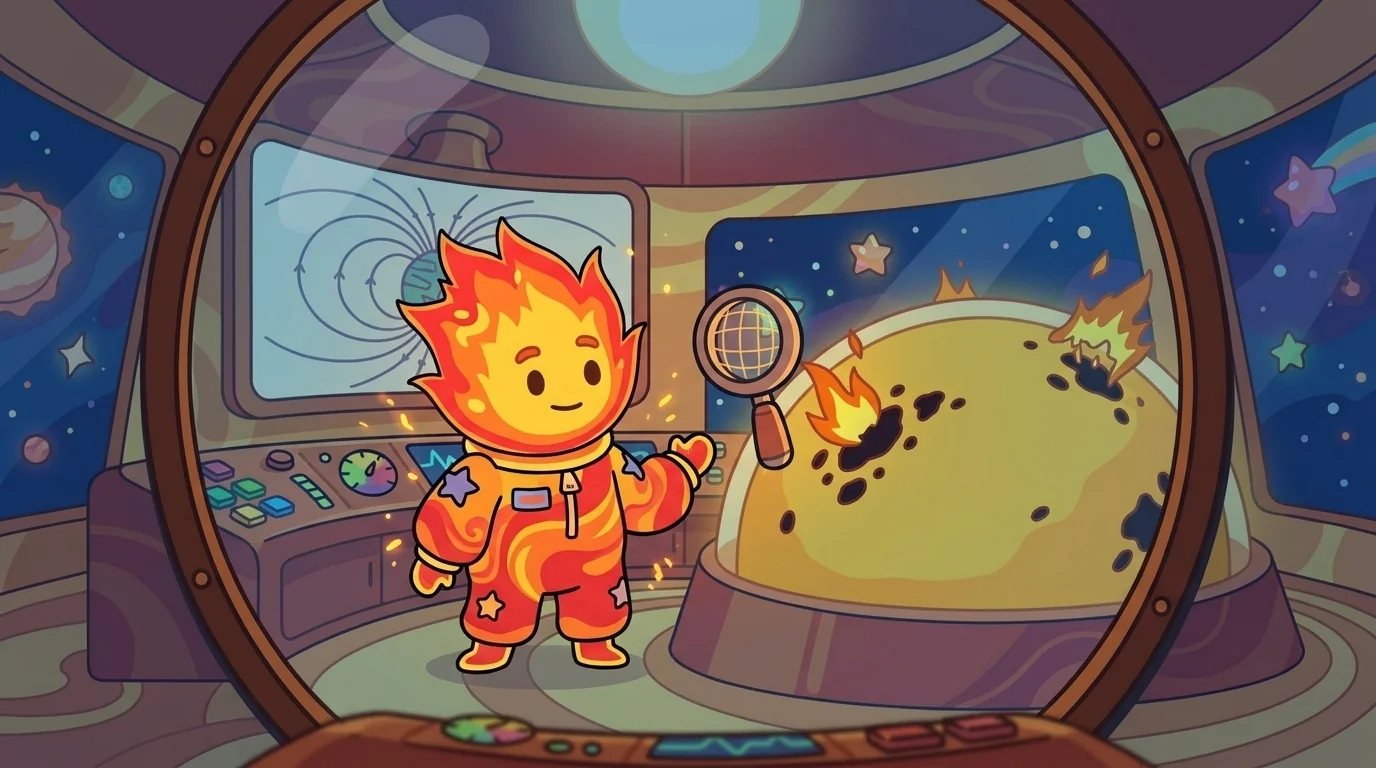
Flare teaches one rule. "A steady shine can still hide a storm." Flare held up the spot-watcher. "Watch for the dark spots. They tell you the star's magnetic field is active. Watch for the sudden bursts. Those are flares, and a big one sends energy out across space — even all the way to nearby planets. That is why we watch them. On our own Sun, a big flare can light up the sky with beautiful glowing colors, and we like to know when one is coming." A student watched a flare leap and settle. "So the bursts aren't bad. We just need to know they're coming." "Exactly," Flare said. "Just energy. Watch it, understand it, and you are ready for it."
After class, Flare floated, sparks settling slowly. Flare watched a far star's surface churn and pop.
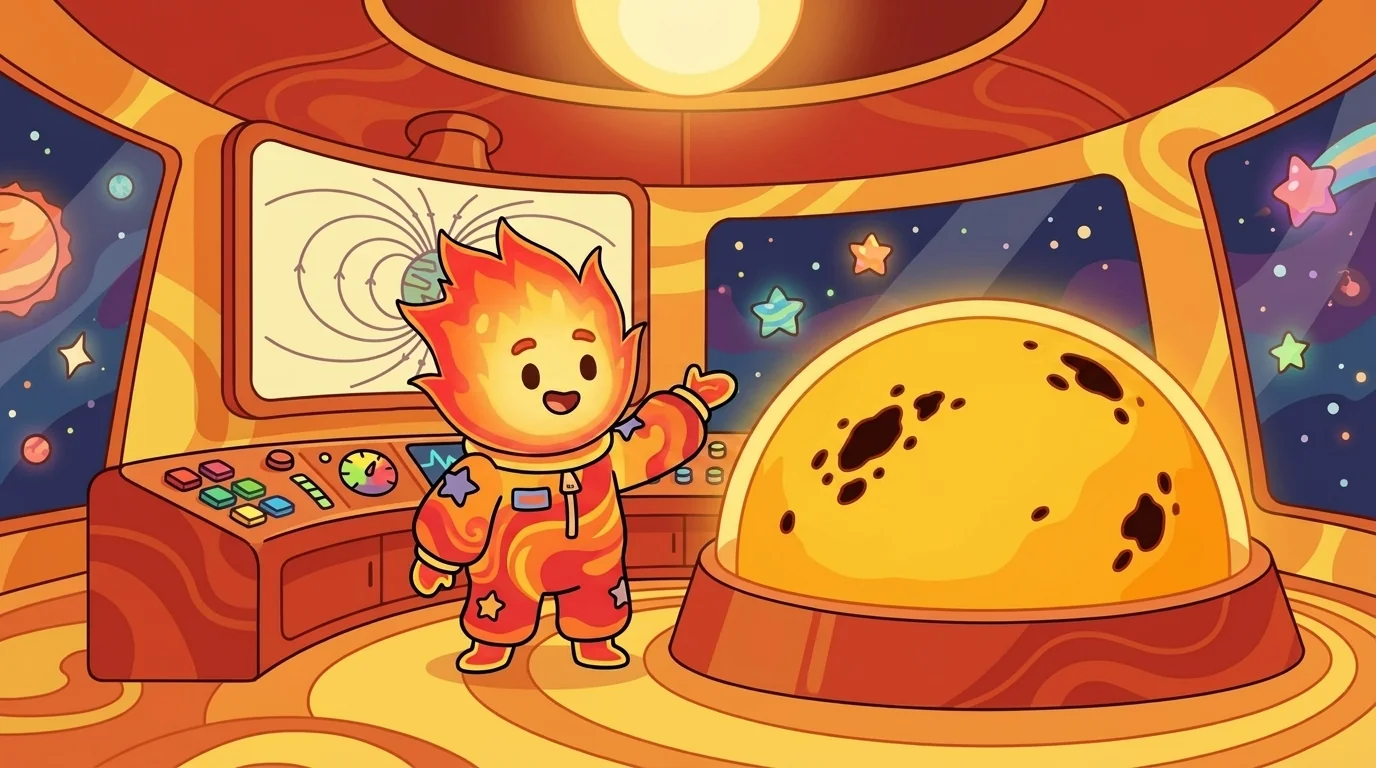
For a long time, Flare had felt a little embarrassed. The other stars seemed so calm. So smooth. So steady. Flare was all sparks and bursts and sudden energy — never quite still. Flare had worried that its storms made it seem out of control. Too much. Like it could not just shine quietly like everyone else.
But watching the far star burst and settle, Flare understood something. The storms were not bad behavior. They were just energy — the star's magnetic field, alive and moving. And the bursts were not dangerous if you understood them and knew when they were coming. Even the calmest-looking stars had storms underneath; Flare just showed its weather more openly. There was nothing wrong with that. Knowing your storms, instead of hiding them, was how you stayed ready. A warm, settled calm spread through Flare, and the sparks slowed to a gentle glow. Flare smiled, no longer embarrassed by its lively, stormy, perfectly normal star-weather.
The StarForge ensemble
Flare is part of StarForge's distributed-narrative cast. Each character embodies a different curricular primitive; together they teach the full subject.
-

Wick
Protostar (collapsing gas, igniting)
-

Glow
Main-sequence star (hydrogen fusion / stable)
-

Swell
Red giant (helium fusion / expanded outer layers)
-
Pinch
Stellar collapse + neutron star / supernova compaction
-

Ember
White dwarf / stellar remnant (cooling final state)
-

Brawn
Stellar mass — how heavy a star is at birth decides its whole life story
-

Waltz
Binary stars — most stars are not alone; they circle a partner in a slow gravitational dance
-

Smolder
Brown dwarf — a clump of gas too light to ignite; warm and dim, almost-but-not a star
-

Quiver
Variable stars — stars that pulse brighter and dimmer in a steady, measurable beat