
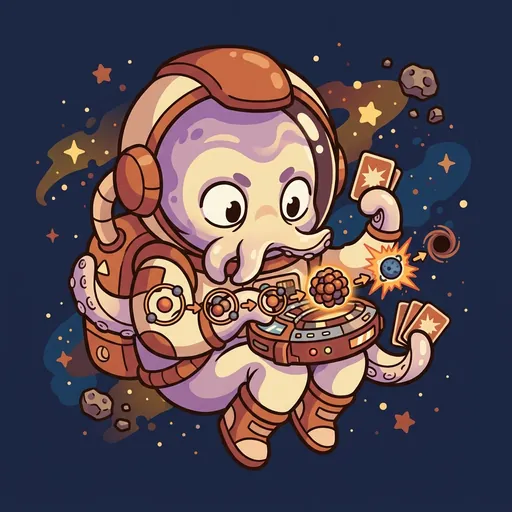
Pinch
PINCH — *collapse. high-mass star + supernova → neutron star or black hole.*
Listen along — Pinch
Loading audio…
Press play to listen along. The line being read lights up as you go.
Show full transcript
Loading transcript…
Chapter 4 — Pinch and the Star’s Final Roar
Pinch hunched over the holographic display, a small figure utterly absorbed. Her round face, the color of warm cream with faint lavender undertones, was pressed close to the swirling projections. She wore a practical, slightly oversized tunic that looked like it belonged on a shuttle pilot, and her dark hair was pulled back in a no-nonsense bun. Around her, the air hummed with the quiet whir of the collapse-tracker, a device no bigger than a lunchbox, projecting a miniature, glowing star.
“See?” Pinch pointed a stubby finger at the star, which pulsed with an unnerving, slow rhythm. “It’s a high-mass star. Not like our sun, which is pretty average. We’re talking eight times bigger, at least. A real giant.”
She shuffled a deck of oversized, glossy supernova-cards, each one depicting a different stage of a star’s life. She laid them out in a neat sequence on the table beside the tracker. “First, it burns hydrogen into helium. Then helium into carbon. Carbon into oxygen. Oxygen into silicon.” Her voice was precise, almost a chant. “It’s like a cosmic furnace, always building heavier stuff.”
A classmate, Maya, leaned closer, her brow furrowed. “So, like, it’s making elements?”
“Exactly!” Pinch’s eyes gleamed. “That’s fusion. It’s how stars make energy, by mashing lighter elements together to create heavier ones. It’s also how all the elements in the universe, everything from the oxygen you breathe to the iron in your blood, got made.”
She tapped the last card in her sequence, which showed a dense, fiery sphere. “But then, it hits iron. And iron is different. Fusing iron actually uses energy instead of releasing it. It’s a dead end for the star.” Pinch paused for dramatic effect, her gaze sweeping over her small audience. “The furnace stops.”
The holographic star on the tracker flickered, its vibrant colors dimming. A small, red warning light began to flash.
“And when the furnace stops,” Pinch continued, her voice dropping to a near whisper, “gravity wins. There’s nothing to push back against it. The core collapses. Catastrophically.”
The word “catastrophically” hung in the air, a heavy, dark sound. On the tracker, the star imploded in a blink, shrinking to a tiny, brilliant point of light before exploding outward in a silent, dazzling burst of energy. This was stellar collapse, the violent end of a massive star.
“That’s a supernova,” Pinch declared, her voice now ringing with awe. “It’s the biggest explosion in the universe. For a few days, it can outshine an entire galaxy. Imagine that. Brighter than billions of stars, all at once.”
She picked up two new cards. One showed a tiny, incredibly dense sphere. The other, a swirling vortex of darkness. “What’s left depends on how massive the star was to begin with. If it’s big, but not too big, you get a neutron star.” Pinch held up the first card. “It’s so dense that a single teaspoon of its material would weigh billions of tons. Seriously. Imagine squeezing a mountain into a sugar cube.”
Maya’s eyes went wide. “No way.”
“Way,” Pinch confirmed, a small, dry smile touching her lips. “But if the star was really, truly enormous, then the collapse is even more extreme. It keeps going, crushing itself down until nothing, not even light, can escape its gravity. That’s a black hole.” She presented the second card, a stark image of cosmic emptiness.
Pinch gathered her cards, her movements precise and economical. She reset the collapse-tracker, ready to demonstrate again. Her focus was absolute, a tiny compass needle always pointing to the grand, violent ballet of the cosmos.
“So, yeah,” she said, looking up, her intense gaze softening slightly. “Collapse. High-mass star + supernova → neutron star or black hole. And that’s how we get all the heavy elements, too. Pretty cool, right?”
The vastness of it, the idea that the very stuff of their bodies had been forged in such distant, fiery deaths, settled over the group. Pinch didn’t need to explain the wonder; she just showed them the mechanics, and the wonder was undeniable.
The StarForge ensemble
Pinch is part of StarForge's distributed-narrative cast. Each character embodies a different curricular primitive; together they teach the full subject.
-

Wick
Protostar (collapsing gas, igniting)
-

Glow
Main-sequence star (hydrogen fusion / stable)
-

Swell
Red giant (helium fusion / expanded outer layers)
-

Ember
White dwarf / stellar remnant (cooling final state)
-

Brawn
Stellar mass — how heavy a star is at birth decides its whole life story
-

Waltz
Binary stars — most stars are not alone; they circle a partner in a slow gravitational dance
-

Smolder
Brown dwarf — a clump of gas too light to ignite; warm and dim, almost-but-not a star
-

Quiver
Variable stars — stars that pulse brighter and dimmer in a steady, measurable beat
-

Flare
Stellar flares and starspots — a star's stormy magnetic surface weather