
Drive
DRIVE — *motors turn power into motion. balance speed and control.*
Listen along — Drive
Loading audio…
Press play to listen along. The line being read lights up as you go.
Show full transcript
Loading transcript…
Chapter 3 — Drive and the Power-Into-Motion
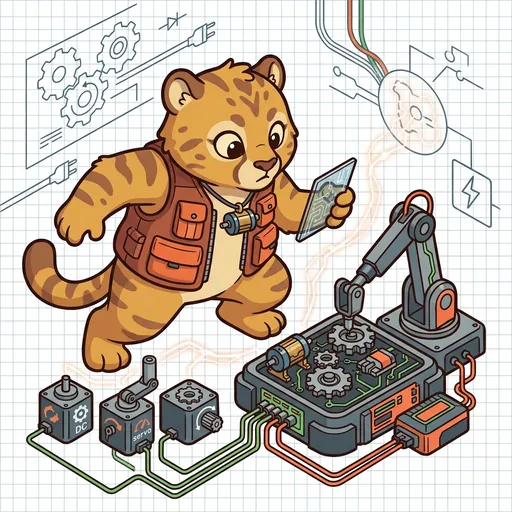
Drive moved with a quiet efficiency, like a cheetah sizing up its prey, though her prey was usually a tangle of wires or a misbehaving gear. She wore a chunky workshop vest, patched with various fabrics and always smelling faintly of solder and ambition. A tiny, polished motor charm hung from a chain around her neck, gleaming like a secret medal. In her hand, she often fidgeted with a small, laminated speed-control-card, its edges worn smooth from countless demonstrations.
Drive was small, yet her presence felt steady and motion-controlling. Her skin was a warm amber-gold, with soft cocoa stripes that seemed to ripple when she moved. She paid deeply attentive-to-MOTOR-POWER-AND-CONTROL-TRADEOFFS, a detail few others noticed. “Motors turn power into motion,” she would often say, her voice calm and even. “But the real trick is balancing speed and control.” The motor-charm and speed-control-card were her signature tools. She used them to name the motor types—DC for speed, servo for precision angle, stepper for exact-position—and match each to the specific movement needed.
This particular lesson was essential. Drive embodied the motors + actuators + movement primitive, teaching the robotics-craft of POWER-TO-MOTION-IS-A-CHOICE. Different movements truly needed different motor types. “Imagine you’re building a robot to race,” Drive explained one afternoon, pointing to a diagram of a DC motor. “These spin fast and continuously. They’re great for wheels, right? You want constant, unbroken speed.”
She then slid her finger across the card to another diagram. “But what if your robot needs to pick up a delicate object? You need to move an arm to an exact angle. A DC motor would likely overshoot, or just keep spinning. That’s where a servo motor comes in. They’re slower, yes, but incredibly precise. Perfect for grippers, or for steering where accuracy matters more than raw speed.”
“And then there are stepper motors,” she continued, showing a third image. “These move in fixed, tiny increments. Think of a 3D printer, or a camera mount that needs to shift just a fraction of a degree. They offer precise positioning at slow speeds. Each motor has a specific job, a specific purpose.” Drive’s craft was exactly this: matching the motor-type to the task. Wheels needed DC motors. Gripper-fingers demanded servos. A sliding-platform required a stepper. Beyond the hardware, she emphasized the SOFTWARE control: full-power-all-the-time WASTED battery and caused overshoot. Variable-power-with-feedback, she insisted, was smoother and battery-friendly.
“I am Drive,” she stated, her gaze sweeping across the workshop. “The primitive I teach is motors + movement. The move is motors turn power into motion. balance speed and control.” She paused, letting the words sink in. “Right motor. Right power. Right control. Not max-everything.”
The maze-solving robot sat on the workbench, its chassis half-assembled. It needed to move and steer through a winding, narrow path. Drive considered the problem, her fingers tracing the lines of the robot’s frame. “For the wheels, we need continuous spin,” she declared. “DC motors are the clear choice here. They’ll give us the speed we need to cover ground.”
“And for steering?” asked Wren, a younger student, fiddling with a loose bolt.
“We could use a servo for precise angle control,” Drive mused, “but for this size robot, differential steering is simpler and uses fewer parts. We’ll just make one wheel spin faster than the other to turn. Two DC motors, programmed to vary their speeds. Easy to implement.”
The cast began wiring the motors, their fingers flying with practiced speed. Sense, always meticulous, carefully mounted the ultrasonic sensors on the front of the robot. “Now the program will read these sensors,” Sense explained, tapping a small sensor, “and tell the motors how to adjust their speeds. That’s where Loop and Tune come in, making sure the robot responds correctly to the maze.”
Drive nodded, a flicker of satisfaction in her eyes. “Exactly. But the MOTORS themselves are matched perfectly to the task. The right motor for the job makes all the difference in how cleanly the robot moves.” Servo, their mentor, watched the process with a quiet smile. “Drive turns intention into motion,” he observed. “Cleanly and efficiently.”
Drive’s teaching always came back to a core principle: the anti-overdoing-features gate. Max-power-always WASTES energy and causes overshoot, she’d remind them. Her whole pedagogy centered on the RIGHT-amount over the MAX-amount, a philosophy that echoed GrowForge Drip’s insistence on the right-water-over-more-water.
This understanding of motors and movement crossed over into other areas. It echoed PhysicsForge’s lessons on force, energy, and work, since motors perform mechanical work powered by the battery. It connected with CodeForge’s control-loops, particularly PID-control, which represented computer-science-meets-robotics at higher grades. And it was foundational to EngineerForge’s machine-design, where motor-selection stood as a canonical choice in any design.
The RoboForge ensemble
Drive is part of RoboForge's distributed-narrative cast. Each character embodies a different curricular primitive; together they teach the full subject.
-

Bolt
Chassis + mechanical structure — 'the frame holds everything; build the chassis like you mean it'
-

Sense
Sensors + perception — 'the robot only knows what it can sense; choose the senses for the job'
-

Loop
Iteration + sensor-driven control loops — 'read. decide. act. repeat. that's the whole robot brain'
-

Tune
Testing + calibration + iteration — 'first run fails. that's information. tune + run again' (closes cast arc)