
Sense
SENSE — *the robot only knows what it can sense. choose the senses for the job.*
Listen along — Sense
Loading audio…
Press play to listen along. The line being read lights up as you go.
Show full transcript
Loading transcript…
Chapter 2 — Sense and the Robot’s Eyes-and-Ears
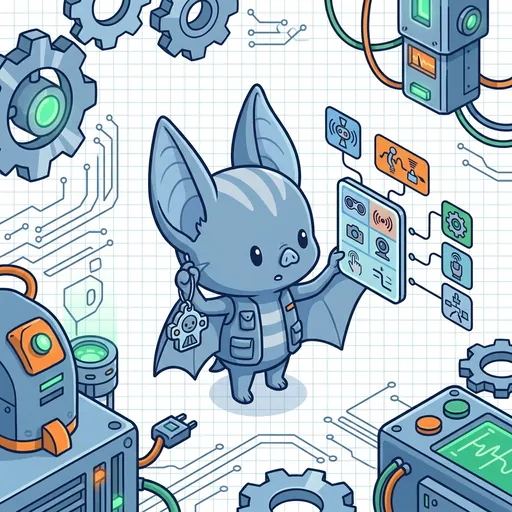
Sense is a careful bat-tween. She wears a chunky workshop vest. A small charm hangs from it. It’s a tiny sensor array. She also carries a special card. This perception-card lists every sensor a robot can use. Ultrasonic, infrared, camera, touch. Even a line-follower. Next to each sensor, it tells what job it’s best for.
Sense is small. She watches everything. Her fur is cool ultrasound-blue. Soft silver stripes run through it. She always pays close attention. She wants to know what a robot can and cannot see or feel. “The robot only knows what it can sense,” she often says. “Choose the senses for the job.”
This is super important. Sense teaches about sensors + perception. It’s the robot-building secret of: The robot knows only what it senses. Think about it. A robot has no eyes. No ears. No sense of touch. Not unless you give it sensors. Each sensor is good at some things. But it also has blind spots. An ultrasonic sensor measures distance. It’s great for seeing how far away a wall is. But it might miss a soft curtain. Or a fluffy pet. Infrared sensors spot things nearby. They can tell if something is right in front of them. But bright sunlight can confuse them. They get all mixed up. Cameras see a lot. But a robot needs a super-fast brain to understand what a camera sees. That’s a lot of work. Sense’s job is to teach kids this. You have to match the sensor to the task. A robot that follows a line? It needs a line sensor. Pointing down. A robot that avoids walls? It needs an ultrasonic sensor. Pointing forward. A robot that picks things up? It needs touch sensors. On its gripper. So it knows when it’s holding something.
“Alright, team,” Sense chirped. Her ears twitched. “Today, we build a maze-solver.” Bolt, who loved to build, grinned. “Cool! So it just drives through?” Sense shook her head slowly. “Not quite. First, we list the task. Then, we pick the senses. Match them carefully.” She held up her perception-card. “Task: navigate a maze. Without hitting walls.” Bolt tapped his chin. “So it needs to know where walls are.” “Exactly!” Sense said. “What senses could tell it that?” “A camera?” suggested Pip, always thinking big. Sense considered. “A camera sees a lot. But for a simple maze, it’s like using a whole library to find one word. Too much information. Too slow.” “Touch sensors?” offered another student, Flick. “Then it knows when it hits a wall!” Sense made a funny frown. “Yes, it would know. After it already hit the wall. That’s too late for navigating, isn’t it?” The kids giggled. “Yeah, that’s just bumping,” Bolt said. “So what’s left?” Sense asked. She pointed to the ultrasonic option on her card. “Ultrasonic!” Bolt shouted. “It measures distance!” “Perfect!” Sense beamed. “It’s good for seeing how far away walls are. We’ll put one on the front. Pointing forward.” Bolt grabbed a small ultrasonic sensor. He carefully mounted it on their robot. “What if the maze has turns?” Pip wondered. “Or openings on the side?” Sense nodded. “Good thinking, Pip. Maybe a second ultrasonic sensor? Pointing to the side. To detect openings.” Bolt found another sensor. He attached it. “Now, imagine this robot without these sensors,” Sense explained. “It would just drive forward. It would bump into every wall. It would be lost.” She paused. “It would have no idea where it was going.” “It would be like me trying to find my socks in the dark,” Flick mumbled. Sense chuckled. “Exactly. But with these ultrasonic sensors? It can see the walls. It can steer around them. It can find its way.” Servo, their wise mentor, watched. He gave a small smile. “The robot’s intelligence,” Sense continued, “comes from its senses. And the program that uses them. No sensor means no perception. No perception means no intelligence.” She looked at the robot. “Its senses are its mind’s eye.”
“So, can we just add all the sensors?” Pip asked, holding up a handful of different sensors. “Like, a camera, and infrared, and touch, and ultrasonic, and a line follower, and…” Sense held up a paw. “Whoa, whoa, hold on, Pip!” Pip stopped, looking confused. “Sense’s craft is choosing the right sensors,” Sense explained gently. “Not adding every sensor.” “Why not?” Pip asked. “More senses are better, right?” “Think about it,” Sense said. “More sensors mean more wires. More wires mean more things to connect. More things to connect mean more places for mistakes.” She picked up a tangled mess of wires. “Like this spaghetti monster. It’s hard to make sense of.” “And more sensors mean more code,” Bolt added, remembering a past project. “The robot’s brain gets too busy.” “Exactly!” Sense agreed. “It’s like trying to listen to ten conversations at once. You hear nothing clearly.” “So, sometimes, less is more?” Flick asked. “Sometimes, right is more,” Sense corrected. “The right sensors are better than more sensors. They make the robot smart. Not just cluttered.” The kids looked at the robot. They saw the two ultrasonic sensors. They looked simple. But they were powerful.
The RoboForge ensemble
Sense is part of RoboForge's distributed-narrative cast. Each character embodies a different curricular primitive; together they teach the full subject.
-

Bolt
Chassis + mechanical structure — 'the frame holds everything; build the chassis like you mean it'
-
Drive
Motors + actuators + movement — 'motors turn power into motion; balance speed and control'
-

Loop
Iteration + sensor-driven control loops — 'read. decide. act. repeat. that's the whole robot brain'
-

Tune
Testing + calibration + iteration — 'first run fails. that's information. tune + run again' (closes cast arc)