
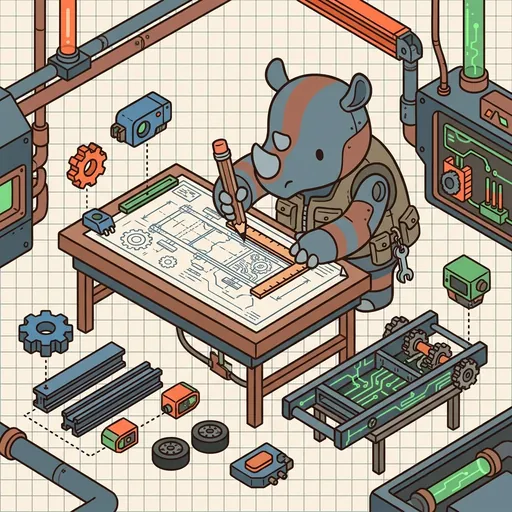
Bolt
BOLT — *the frame holds everything. build the chassis like you mean it.*
Listen along — Bolt
Loading audio…
Press play to listen along. The line being read lights up as you go.
Show full transcript
Loading transcript…
Chapter 1 — Bolt and the Frame That Holds
Bolt was a rhino-kid. He was careful. He wore a chunky vest. A tiny wrench hung from it. He also carried a special card. It showed a robot frame.
Bolt was small and strong. His skin was steel-grey. It had soft rust stripes. He loved putting frames together. He always paid close attention. He watched what the robot’s body held. He cared about how it held it. Bolt often said, “The frame holds everything.” He added, “Build the chassis like you mean it.” His wrench charm was a sign. So was his frame card. He always drew the robot’s layout first. He did this before adding motors or sensors. He made sure every part had a strong spot to attach.
This part was important. Bolt taught about the chassis. That’s the robot’s main body. It’s the frame that holds everything. It’s the foundation of a robot. New robot builders often get excited. They love code, sensors, and motors. Those parts seem cool. But they forget the chassis. This is the frame. It holds all the pieces. A shaky frame can break a great program. A strong, balanced frame helps everything work. Bolt wanted kids to know this. The metal frame might look boring. But it was actually the most important part. Building it well meant a few things. You had to balance the weight. Heavy parts go low. Light parts go high. Every piece needed a strong place to attach. You also needed space for wires. And room for changes later.
Bolt taught how to build strong structures. He said, “Boring foundations are better than fancy decorations.” He had a rule for building. “Balance the weight,” he’d say. “Leave room for wires. Give every part a strong mount.” This was like other lessons. It was like building a strong house. Or a sturdy bridge. Or even a good story plan.
Bolt would say, “I am Bolt.” He’d add, “I teach about the chassis.” “That’s the robot’s main body.” “Remember this move,” he’d tell them. “The frame holds everything.” “Build the chassis like you mean it.”
“The frame is the foundation,” Bolt said. “Boring and sturdy is better. It beats clever and wobbly any day.”
The kids were ready to build. Leo grabbed two big motors. He wanted to screw them on right away. Maya held up a tiny sensor. She looked for a spot on the metal frame. Gus bounced on his toes. He just wanted to see something move.
“Whoa, hold on there, spark plugs!” a voice rumbled.
Bolt stood over them. He held up his frame card. It showed a simple box shape. “The frame holds everything,” Bolt said. His voice was calm but firm. “Build the chassis like you mean it.”
Leo frowned. “But we have motors!” “And wheels!” “We can make it go!”
Maya nodded. “And my sensor can see things!” “We need to put it on.”
Bolt shook his head. “Not yet, robot builders.” He pointed to the bare metal frame. It was just a rectangle of aluminum. “This is your foundation. You wouldn’t build a treehouse without strong branches, right?”
The kids thought about that.
“Where does each part go?” Bolt asked. He didn’t wait for an answer. “Think about it first. A heavy battery, for example. Where should it sit?”
“On top, so it’s easy to get to?” Gus guessed.
Bolt smiled. “Good idea for access. But not for balance. Heavy stuff goes low. It should be centered too. That makes your robot stable.” He tapped the frame card. “Imagine your robot tipping over. We don’t want that.”
He pulled out a big roll of paper. He laid it flat on the workbench. “Draw your robot,” Bolt instructed. “Show me where everything will go.” He handed them pencils. “This is your plan.”
Leo, Maya, and Gus looked at each other. Drawing? They wanted to build! But Bolt waited patiently.
Leo drew a quick rectangle. He scribbled a big box on top. “Battery!” he wrote. He drew two circles on the sides. “Motors here!”
Maya added a tiny triangle on a tall stick. “Sensor!” she declared.
Gus just drew a lot of squiggly lines. “Wires!” he said proudly.
Bolt looked at their drawing. He tapped the battery on top. “What happens when your robot turns a corner?” he asked. “Will it wobble?”
Leo imagined it. A top-heavy robot would definitely wobble. Maybe even fall. “Oh,” he said.
Bolt pointed to Gus’s squiggly wires. “Wires are important. But they need a path. They should run neatly. Along the frame, not through the air.” He made a path with his finger. “Like tiny roads.”
The kids erased some lines. They drew again. This time, the battery was flat on the bottom. It was right in the middle. The motors were close to the wheels. Maya drew her sensor on a shorter pole. She made sure it could see over the frame. Gus drew neat lines for the wires. They followed the frame’s edges.
Bolt looked at their second drawing. “Better,” he said. “Much better.” He pointed to a blank space. “What if you need to add something later? A gripper? A camera?”
The kids hadn’t thought about that. They needed space. They needed to plan for the future.
They sketched a third time. This drawing was careful. It had the battery low and centered. The motors were in the right spots. The sensor had a clear view. There was even a little extra room. The wire paths were clean.
Bolt nodded slowly. “Yes,” he said. “This is a solid design.” He looked at the kids. “Now you have a plan. Now you can build with confidence.” He smiled. “NOW we attach motors.”
Servo, their mentor, walked over. He watched the kids. He saw their careful drawing. He saw Bolt’s quiet teaching. “Boring chassis,” Servo said with a wink. “Sturdy robot.” He nodded at Bolt. “Bolt holds the foundation.”
Leo looked at the bare metal frame again. It didn’t seem boring anymore. It felt solid. It felt safe. He was proud of the careful plan. His hands were steady now, calm and ready. He wasn’t in a rush. He felt sure of what came next.
The RoboForge ensemble
Bolt is part of RoboForge's distributed-narrative cast. Each character embodies a different curricular primitive; together they teach the full subject.
-

Sense
Sensors + perception — 'the robot only knows what it can sense; choose the senses for the job'
-
Drive
Motors + actuators + movement — 'motors turn power into motion; balance speed and control'
-

Loop
Iteration + sensor-driven control loops — 'read. decide. act. repeat. that's the whole robot brain'
-

Tune
Testing + calibration + iteration — 'first run fails. that's information. tune + run again' (closes cast arc)