
Tune
TUNE — *first run fails. that's information. tune + run again.*
Listen along — Tune
Loading audio…
Press play to listen along. The line being read lights up as you go.
Show full transcript
Loading transcript…
Chapter 5 — Tune
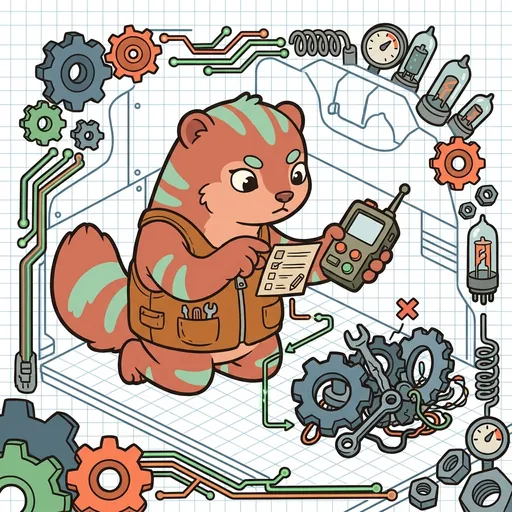
Tune crouched over a wobbling robot in the corner of the workshop, one hand steadying it, the other holding a pen over her log-tracker. The little machine buzzed forward, veered left, and toppled onto its side with a soft clatter.
“Run one,” Tune murmured, and wrote it down. She wore a chunky rust-coral vest with mint stripes, the pockets stuffed with adjustment cards. She righted the robot, nudged a single dial a quarter-turn, and pressed start again.
This time it rolled two feet before it tipped. Tune’s mouth curled into a small, satisfied grin. “Better,” she said, and wrote a note: run two, tipped later. She reached in and turned the same dial a hair more.
Anyone watching would have thought she was failing over and over. Tune knew she was doing the opposite. Each spill told her exactly which dial to touch next. She was closing in.
When Tune was little, she built a paper glider that nosedived into the floor. She built another. It nosedived too. She built a third and it looped once and crashed.
Her uncle, who fixed dishwashers for a living, found her surrounded by crumpled paper, close to tears. He didn’t tell her to try harder. He sat down and picked up one of the wrecks.
“Where’d this one land?” he asked.
“By the door.”
“And this one?”
“The window.”
He lined the crashed gliders up in the order she’d thrown them. “Look. Door, window, halfway to the couch. They’re getting farther, Tune. You’re not failing three times. You’re learning three things.” He tapped the last glider. “Change one fold. Just one. Throw it again.”
She bent the nose up a whisper and threw. It sailed clear across the room. Tune stared at it, then at the row of crashes that had shown her the way. She never crumpled a failed try again. She logged it.
The academy took her because of the maze.
On her entry day the head of the workshop, a broad calm woman named Servo, set a half-built robot in front of her. “It won’t finish the maze,” Servo said. “Four builders tried. Show me what you’d do.”
Tune didn’t touch the code. She set the robot at the start, pressed go, and watched it smack the first wall. She wrote something down. She reset it, changed the turn angle from ninety degrees to forty-five, and ran it again. It cleared the corner and hit the second wall. She wrote that down too, adjusted how far ahead the robot looked, and ran it a third time. It slid through the whole maze and stopped at the finish.
Servo raised an eyebrow. “Three runs.”
“Each crash pointed at the next fix,” Tune said, holding up her log. “The robot was telling me what it needed. I just had to write it down and listen.”
Servo looked at the neat little column of runs. “You’re in,” she said.
By her fifth chapter at the academy, Tune had her own workbench, and today four of the others crowded around it — Bolt, Sense, Drive, and Loop — while a new maze robot sat at the start line.
“Alright, Maze-Bot,” Bolt whispered. “Show us what you’ve got.”
Tune pressed start. The robot zoomed forward, confident, and hit the first wall with a THWACK. Its wheels spun uselessly, grinding.
The kids groaned. “Aw, it broke!” cried Sense.
Tune grinned and lifted her log-tracker. “It’s data. Watch.” She tapped her pen. “What did we see? Sense, your sensors — did the robot notice the wall?”
“Yeah,” Sense said. “Its eyes worked.”
“They did. Drive, the motors spun?”
Drive puffed up. “Always.”
“So the eyes work and the motor works. The turn was just too sharp — ninety degrees, so it jammed in the corner.” She wrote a line. “We change one thing. Only one. Loop?”
Loop chewed his lip. “The turn angle?”
“Forty-five instead of ninety.” They edited the code and Tune ran it again.
The robot rounded the first corner smoothly. The kids cheered — then it slammed the second wall, bounced off, and spun in a dizzy circle. The cheer died. “Oh, man,” Sense said.
Tune was already writing. “New crash, new clue. Same rule — change one thing.” She pointed. “It saw the wall too late, so it couldn’t slow in time. We tell it to look farther ahead.” One more edit. One more run.
The robot took the first corner, eased up to the second wall, slowed, turned clean, and threaded the rest of the maze to the finish line without a single bump.
The kids erupted. “It worked!” Tune sat back, quiet and glowing. “Three runs from a wreck to a maze-solver,” she said. “Every crash showed us the next fix.”
Servo, passing behind them, smiled. “Bolt built the frame, Sense gave it eyes, Drive gave it motion, Loop gave it the brain-cycle. Tune shows the last part — you keep going, one small change at a time, until it runs.”
The others drifted off, but Bolt stayed, looking at the little robot resting at the finish.
“Can I ask something?” he said. “When it hit that first wall — the THWACK — didn’t that feel bad? Like we messed up?”
Tune set down her pen. “It used to feel like that for me. Like the crash meant I was the crash.” She lined up three imaginary runs on the bench with her finger, the way her uncle once had. “Then I saw the crashes were pointing somewhere. Door, window, couch. Each one got me closer. Now when I hear the THWACK, I don’t feel small. I feel…” she searched for it, “curious. Like the robot just handed me a note.”
Bolt looked back at the robot. The memory of that first crash didn’t sting anymore. It felt like a beginning, not a flop. His shoulders came down from around his ears, and something warm and steady settled in his chest. He wasn’t scared of the next mistake. He felt lighter. Ready to run it again.
And when he glanced up, Tune was already grinning her calm, patient grin — the one that made getting things wrong feel completely safe.
The RoboForge ensemble
Tune is part of RoboForge's distributed-narrative cast. Each character embodies a different curricular primitive; together they teach the full subject.
-

Bolt
Chassis + mechanical structure — 'the frame holds everything; build the chassis like you mean it'
-

Sense
Sensors + perception — 'the robot only knows what it can sense; choose the senses for the job'
-
Drive
Motors + actuators + movement — 'motors turn power into motion; balance speed and control'
-

Loop
Iteration + sensor-driven control loops — 'read. decide. act. repeat. that's the whole robot brain'