
Buzz
BUZZ — *sound is the other half. picture without sound is half a story.*
Listen along — Buzz
Loading audio…
Press play to listen along. The line being read lights up as you go.
Show full transcript
Loading transcript…
Chapter 4 — Buzz and the Other Half
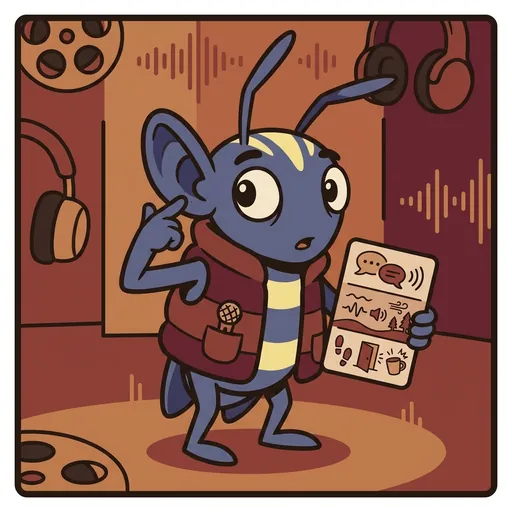
Buzz was a careful-cricket-tween, often found in a chunky-cartoon director-vest. He wore a small microphone-charm and carried a soundscape-card. His posture was a chunky-cartoon listening-pose, head tilted slightly, as if always tuning into the world.
Buzz was small and ear-tuned, always layering sounds in his mind. He was the color of cool-evening-indigo, with soft-cricket-yellow-stripes. He paid deep attention to every sound in a scene. Buzz liked to say, “Sound is the other half. A picture without sound is half a story.” His microphone-charm and soundscape-card were his signature. The card listed the three layers of film sound: DIALOGUE (what characters say), AMBIENT (room-tone, or background hum), and FOLEY (specific sound-effects like footsteps, door-creaks, or cup-clinks).
This was a essential truth. Buzz embodied the sound design primitive—the filmmaking craft that understood sound was half the story. Kids new to filmmaking often forgot about sound entirely. They would film the picture, watch it back, and wonder why it felt empty. The answer was simple: silence, no foley, and no ambient sound made for an unfinished film. Buzz’s craft focused on these three layers. Dialogue was recorded on-set, sometimes re-recorded cleanly later. Ambient sound meant recording thirty seconds of “room tone” in every location. Foley involved adding small sounds afterward, recorded separately and synced to the picture. Together, these three layers made the world feel real.
Buzz taught that sound was storytelling. He explained, “Silence is a choice. Ambience is a baseline. Foley is the texture.” He insisted on one rule: “Always record room-tone before leaving a location.” His lessons often connected to other creative tools, like StageForge, LyricForge, and PerformanceForge.
“I am Buzz,” he would say, his voice quiet but firm. “The primitive I teach is sound design. The move is sound is the other half. A picture without sound is half a story.”
“Three layers,” he’d add. “Dialogue, ambient, foley. Build all three.”
Buzz’s signature scene often began with the cast’s rough cut. Aim’s framing was usually great. Bright’s lighting could be moody and effective. Yet, the scene often felt hollow. It was like watching actors move behind a thick pane of glass.
“No sound,” Buzz stated simply, pointing at the screen. “Three layers are missing.” He tapped his soundscape card. “Let’s add them.”
He paused the playback. “Layer 1 — dialogue. We have that. It’s good enough for now.” The characters on screen spoke, their voices clear, if a bit flat.
“Layer 2 — ambient room-tone.” Buzz leaned forward, his eyes scanning the silent kitchen scene. “The kitchen has a low refrigerator hum. Maybe a faint buzz from the fluorescent light above the sink.” He looked at the team. “We need to record that. Just thirty seconds of the room, completely silent, no one talking. We’ll drop it under the whole scene.”
The team, led by a skeptical Snip, went back to the kitchen set. They stood still, holding a microphone carefully. The silence felt awkward at first, then strangely profound. They captured the subtle hum, the almost imperceptible breathing of the empty room.
“Layer 3 — foley,” Buzz continued, once they were back in the editing room. He played the scene again, pausing at key moments. “Footsteps as the character walks across the linoleum. The cup hitting the floor when it slips from their hand. The surprised gasp that comes after the cup breaks.” He ticked them off on his fingers. “Each one recorded separately, then synced precisely to the picture.”
This was the tricky part. Snip, usually so focused on the visual, found herself stomping around in different shoes, trying to match the rhythm of the actor on screen. They dropped a ceramic mug (carefully, onto a towel) to get the right clink and shatter. They practiced gasps, some too dramatic, others too quiet. Buzz guided them, showing them how to listen for the exact moment, the tiny visual cue.
The cast spent an entire afternoon recording these small, specific sounds. They experimented, listened, and adjusted. It felt tedious at times, like building a house one grain of sand at a time. But Buzz insisted on the precision.
The next playback was astonishing. The same rough cut, but now with the added layers of sound. The refrigerator hum filled the background, a subtle, constant presence. Footsteps echoed realistically. The cup clinked, then shattered, followed by a sharp, surprised gasp. The scene came alive. It felt real—like a moment from a genuine film.
Snip, usually so critical, gasped herself. “Wow,” she breathed, her eyes wide. “The sound did half the work.”
Buzz nodded, a small, knowing smile on his face. “Picture-without-sound is half a story,” he reminded them quietly. “Now it’s whole.”
essential no-real-director-mascotization gate (continues).
Cross-app: Buzz echoes StageForge sibling (live-theater sound-design cross-app cameo); LyricForge’s audio-craft (music + lyrics = sound-art); PerformanceForge’s stage-sound; HarmonyForge’s sound-layering.
The ReelForge ensemble
Buzz is part of ReelForge's distributed-narrative cast. Each character embodies a different curricular primitive; together they teach the full subject.
-

Draft
Storyboarding — pre-visualization; 'Draw it first. Then film it.'
-
Aim
Camera angles + framing — 'Where the camera stands changes the story.'
-

Bright
Lighting design — 'Three lights. Different feelings.'
-

Snip
Editing — timeline + transitions + pacing — 'Cut here. Not there.'
-

Whole
Multi-scene narrative — 'Beginning. Middle. End.'