
Draft
DRAFT — *draw it first. then film it.*
Listen along — Draft
Loading audio…
Press play to listen along. The line being read lights up as you go.
Show full transcript
Loading transcript…
Chapter 1 — Draft and the Drawn-First Film
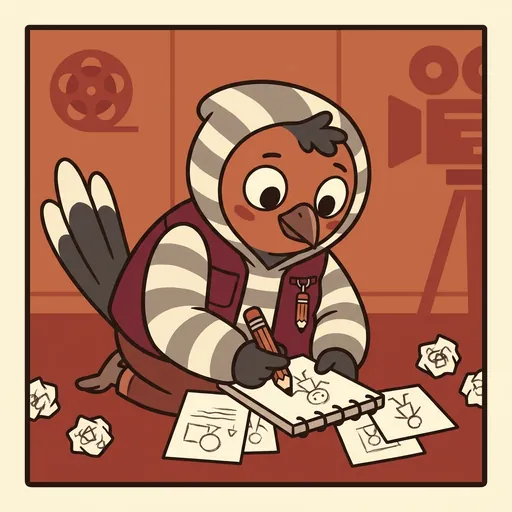
Draft was a careful kid. She looked like a cartoon character, maybe a bit like a magpie. She wore a chunky director’s vest. A tiny storyboard pad hung from her belt. A small pencil charm dangled next to it. Draft was always sketching. She was small and moved with care. Her clothes were warm pencil-grey with soft cream stripes. Draft paid close attention to every detail. She loved to plan each shot before the camera even rolled. “Draw it first. Then film it,” she always said. Her special thing was her storyboard pad and pencil charm. She drew a quick sketch of every single shot. She did this for the whole film. She did it before anyone touched a camera.
This was a very important part of making movies. Draft showed everyone how to storyboard. Storyboarding means you see the movie in your head first. You plan it all out. New filmmakers often just want to grab a camera. They want to start shooting right away. But experienced filmmakers always draw a storyboard first. There’s a good reason for this. Filming costs a lot. It costs time. It costs energy. It costs money if you have to shoot scenes again. Drawing, though, is cheap. A storyboard helps you find problems before they happen. “Wait,” someone might say. “If the camera is here for shot three, and then way over there for shot four, the actor’s eyes will look strange.” A storyboard helps you catch things like that. Draft taught kids that a simple sketch is the best way to fix problems in a film. If a shot looks bad on paper, you just erase it. You draw it again. If a shot looks bad on film, you have to shoot the whole thing over. That takes a lot more work.
Draft taught many things. She taught how to see your movie before you make it. She taught that cheap planning is better than expensive filming. Her main rule was this: “Draw a tiny sketch for every shot.” Even if it was just a rough drawing. This idea worked for other things too. It was like planning out your moves in FrameQuest. Or planning your code before you write it in CodeForge. Or writing a script before you perform it in DialogueQuest.
Draft would often say, “I am Draft. I teach storyboarding.” She’d tap her pencil. “The big idea is this: draw it first. Then film it.” She had another saying too. “Cheap pencil. Expensive camera. Plan with the cheap one.”
The cast was making their very first short film. Aim was super excited. She bounced on the balls of her feet. Her hands twitched to grab the camera. It sat on its tripod, waiting.
“Okay, let’s go!” Aim shouted. She reached for the camera. “We’ve got the script. We know what happens. Let’s just film it!”
Draft stepped in front of her. She held up her small storyboard pad. It was no bigger than her hand. “Whoa, whoa, slow down, Aim,” Draft said. Her voice was calm. “Remember the rule.”
Aim sighed. “The rule? Oh, right. ‘Draw it first. Then film it.’” She rolled her eyes a little. “But why? We’re ready!”
“Are we?” Draft asked. She looked at Aim. “What’s the first shot?”
Aim blinked. “Um… the kitchen? A wide shot?”
“Good,” Draft said. She quickly drew a small rectangle on her pad. Inside, she sketched a kitchen. It was just a few lines. A table, some chairs, a window. “Shot 1: Wide shot of the kitchen.” She wrote the words neatly below the sketch.
“Okay, then what?” Aim asked. She still looked impatient.
“What happens in the kitchen?” Draft asked.
“Someone drops a cup!” Aim said. “So, a close-up of the cup falling.”
“Perfect,” Draft said. She drew another rectangle. This one showed a cup, tilted, about to hit the floor. “Shot 2: Close-up of the dropped cup.”
Aim watched her. Draft’s pencil moved fast. It made soft scratching sounds.
“And after the cup drops?” Draft prompted.
“The surprised face!” Aim said. “A medium shot of the actor’s face.”
Draft nodded. She drew a face with wide eyes and an open mouth. “Shot 3: Medium shot of the surprised face.”
She kept going. “How many shots do we have in total for this scene?”
Aim thought for a moment. “Eight, I think.”
“Great,” Draft said. She quickly sketched the next five shots. Each one was small. They were like tiny comic book panels. They showed the whole scene. It only took her five minutes.
“See?” Draft said, holding up the pad. “Now we know exactly what we need. We won’t be scrambling around in the middle of filming. We won’t be asking, ‘Wait, what’s the next angle?’”
Slate, their mentor, walked over. He watched Draft. He nodded slowly. “Draft is right,” he said. “Think about it, Aim. What if we just started filming?”
Aim imagined it. “Well, we’d probably forget a shot. Or we’d film the close-up. Then we’d realize we needed a different angle for the wide shot.”
“Exactly,” Slate said. “Then you’d have to set up the camera again. You’d have to get the actor back in place. You’d waste time. You’d waste energy.”
“And maybe even film,” Draft added. “Film costs money. Pencil costs pennies.”
“A bad shot on paper?” Slate continued. “Easy to fix. Just erase and redraw. A bad shot on film? You have to reshoot the whole thing.” He smiled at Draft. “Cheap pencil. Expensive camera. Draft just saved us an hour of re-shoots. Maybe more.”
Aim looked at the storyboard pad. She saw the eight little drawings. They told the whole story, shot by shot. A small smile started on her face. “Okay,” she said. “I get it now. That actually makes things easier.”
“It always does,” Draft said. She handed the pad to Aim. “Now, which shot do we set up first?”
Aim looked at the pad. “Shot 1: Wide shot of the kitchen!” She said, much more calmly this time. She pointed to the first sketch. “Let’s make sure the camera is exactly here.”
The ReelForge ensemble
Draft is part of ReelForge's distributed-narrative cast. Each character embodies a different curricular primitive; together they teach the full subject.
-
Aim
Camera angles + framing — 'Where the camera stands changes the story.'
-
Bright
Lighting design — 'Three lights. Different feelings.'
-
Buzz
Sound design — foley + ambient + dialogue — 'Sound is the other half.'
-
Snip
Editing — timeline + transitions + pacing — 'Cut here. Not there.'
-

Whole
Multi-scene narrative — 'Beginning. Middle. End.'