
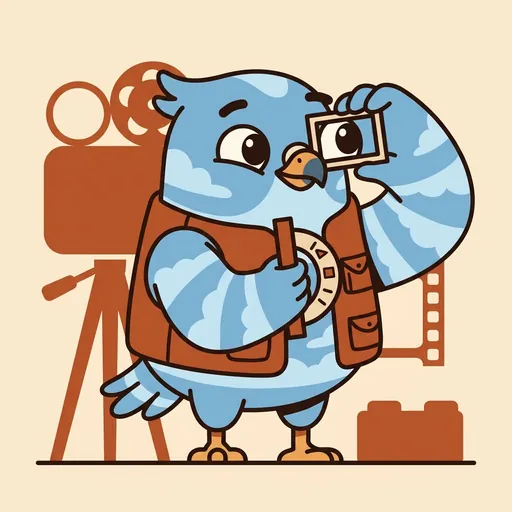
Aim
AIM — where the camera stands changes the story.
Listen along — Aim
Loading audio…
Press play to listen along. The line being read lights up as you go.
Show full transcript
Loading transcript…
Chapter 2 — Aim and the Camera Position
On the far edge of the Reelforge courtyard, a falcon-tween named Aim crouched behind a camera and pointed it at a pebble.
Just a pebble. Grey, ordinary, sitting on the flagstones. But Aim had set the camera flat on the ground, lens tilted up, so the pebble filled the whole frame and the sky stretched huge behind it. Through the viewfinder, the little stone looked like a mountain.
A curious kid drifted over. “It’s just a rock.”
“Watch,” Aim said, and didn’t move the pebble at all. Instead, Aim lifted the camera onto a tall stand and aimed it straight down. Now the same pebble sat tiny in a wide grey sea of stone, lost, a speck. “Same rock. Two stories.”
The kid leaned in and looked at both shots, back and forth. “The first one made it feel… important. Like it mattered.”
“Because I stood below it, looking up.” Aim tapped the viewfinder-card clipped to the strap — a little chart of shots. Wide. Medium. Close-up. Low. High. “The second one, I stood above it, looking down. Suddenly it’s small. I never touched the rock. I only changed where I stood.” Aim grinned, sharp and quiet. “Where the camera stands changes the story.”
The kid stared at the pebble as if seeing it for the first time.
Aim had learned that on a day that didn’t feel like a lesson at all.
When Aim was small, a whole flock of tall birds had lived in the roost — big, loud, wings like sails. Aim would stand among them and feel about the size of a crumb. One evening a traveling storyteller set up a camera to film the flock, and Aim, too shy to ask, just watched from the ground.
The next morning the storyteller played it back. And there was the flock, filmed from below — towering, golden in the light, enormous. Aim felt the smallness all over again, that tight, careful, don’t-take-up-space feeling right in the chest.
“You look sad, little one,” the storyteller said.
“They’re so big,” Aim whispered. “And I’m so small.”
The storyteller only smiled and turned the camera around. Then the storyteller climbed a crate, aimed the lens down at Aim, and filmed. When they watched it back, Aim looked tiny — a dot in a wide stone yard.
“See how small the picture makes you feel?” the storyteller said gently. “Now watch.” The storyteller lay flat on the ground and filmed Aim from below. On the screen, small Aim suddenly loomed tall against the sky, wings spread, brave.
“But I didn’t grow,” Aim said, confused.
“No. I just moved.” The storyteller sat back. “The feeling wasn’t in you. It was in where I stood. And that means the feeling is something you get to choose.”
Aim didn’t feel small the rest of that day. The tightness in the chest had a use now.
Aim walked to Reelforge at twelve, because a place that made stories out of pictures ought to understand the kind of feeling that lives in where you stand.
Slate, the mentor who ran the workshops, met Aim at the gate and didn’t ask for a resume of talents. Slate asked one thing. “Show me two feelings. Same subject.”
Aim didn’t answer with words. Aim borrowed a camera, walked Slate over to the courtyard fountain, and filmed it once from far back — wide, cold, the fountain alone in an empty square. Then Aim knelt right up close, so close a single falling droplet filled the frame and shivered with light.
Slate looked at the wide shot. “Lonely.”
Then the close-up. “…and that one feels like the whole world is holding its breath over one drop of water.” Slate was quiet a moment. “You moved twice. You told two stories. And you never said a word.”
“The angle said it,” Aim answered.
Slate handed the camera back. “You belong here.”
Aim’s workshop filled up fast, because everyone there had a feeling they couldn’t figure out how to show.
One afternoon a kid came in slumped and stuck, holding a script. “I wrote a scene,” the kid said. “A little kid meets a giant. But when I film it, they just look like two people standing there. It’s boring. You can’t feel anything.”
Aim knew that slump — the one where the feeling is real but the picture won’t carry it.
“Where’s your camera right now?”
“Eye-level. In the middle. Like normal.”
“That’s the trouble. Eye-level says these two are equal. But your scene isn’t equal, is it? The kid feels small. The giant feels huge.” Aim set two figures on the bench — a little clay bird, a tall wooden one. “So stop filming them equal. Film the giant from down here.” Aim placed the camera low, looking up at the wooden bird. Through the lens it loomed, filling the sky. “Now the giant towers. The audience’s stomach drops a little. They feel it.”
The kid leaned in and gasped softly.
“Then flip.” Aim raised the camera above the little clay bird and aimed down. On the screen it shrank, alone in all that space. “Now the little one is small and open and easy to worry about. High angle above, low angle below — and the audience feels the size-difference in their own body. You didn’t add a single line. You just moved where you stand.”
The kid grabbed the camera and tried it, low then high, then low again, laughing. “It’s like magic!”
“It’s not magic,” Aim said. “It’s a choice. You already knew the feeling. The camera just found where to stand so everyone else could feel it too.”
Later, when the workshop had emptied out, the kid came back with the script rolled up, quieter now.
“When you pick an angle,” the kid said, “how do you know which one?”
Aim thought about the roost. About the tight, careful, crumb-sized feeling, and the storyteller lying flat on the ground to make it turn tall.
“You ask the scene how it wants you to feel,” Aim said. “Not what it looks like — how it feels. Small and lost? Go high and wide. Brave and towering? Go low and close. Then you stand where that feeling lives, and you let the camera catch it.” Aim looked out the window at the fading courtyard light. “The angle isn’t a technical thing. It’s the most honest thing there is. It’s you telling someone, without any words, here — feel this the way I felt it.”
The kid nodded slowly, and Aim watched the stuck, heavy look lift off the small shoulders — the same way, years ago, on a stone floor under a borrowed camera, Aim’s own had.
Aim didn’t say the rest out loud. But it settled warm and sure in the chest, the exact place that used to feel so small: the feeling was never too big to show. You just had to find where to stand.
The ReelForge ensemble
Aim is part of ReelForge's distributed-narrative cast. Each character embodies a different curricular primitive; together they teach the full subject.
-
Draft
Storyboarding — pre-visualization; 'Draw it first. Then film it.'
-
Bright
Lighting design — 'Three lights. Different feelings.'
-
Buzz
Sound design — foley + ambient + dialogue — 'Sound is the other half.'
-
Snip
Editing — timeline + transitions + pacing — 'Cut here. Not there.'
-

Whole
Multi-scene narrative — 'Beginning. Middle. End.'